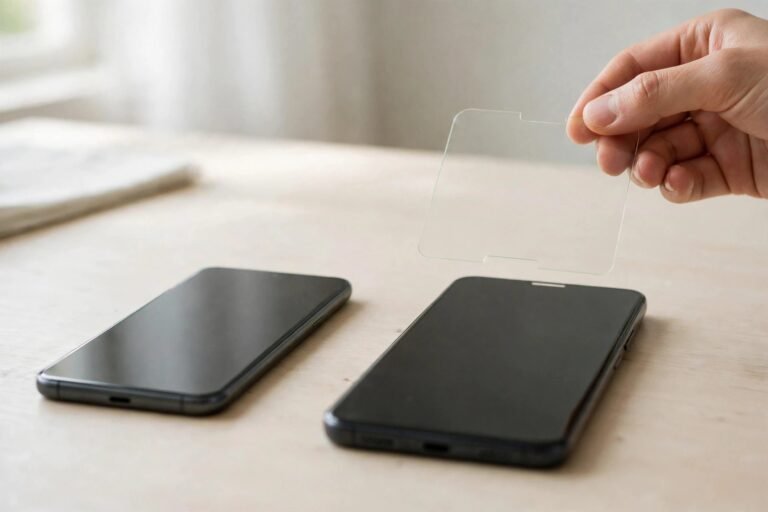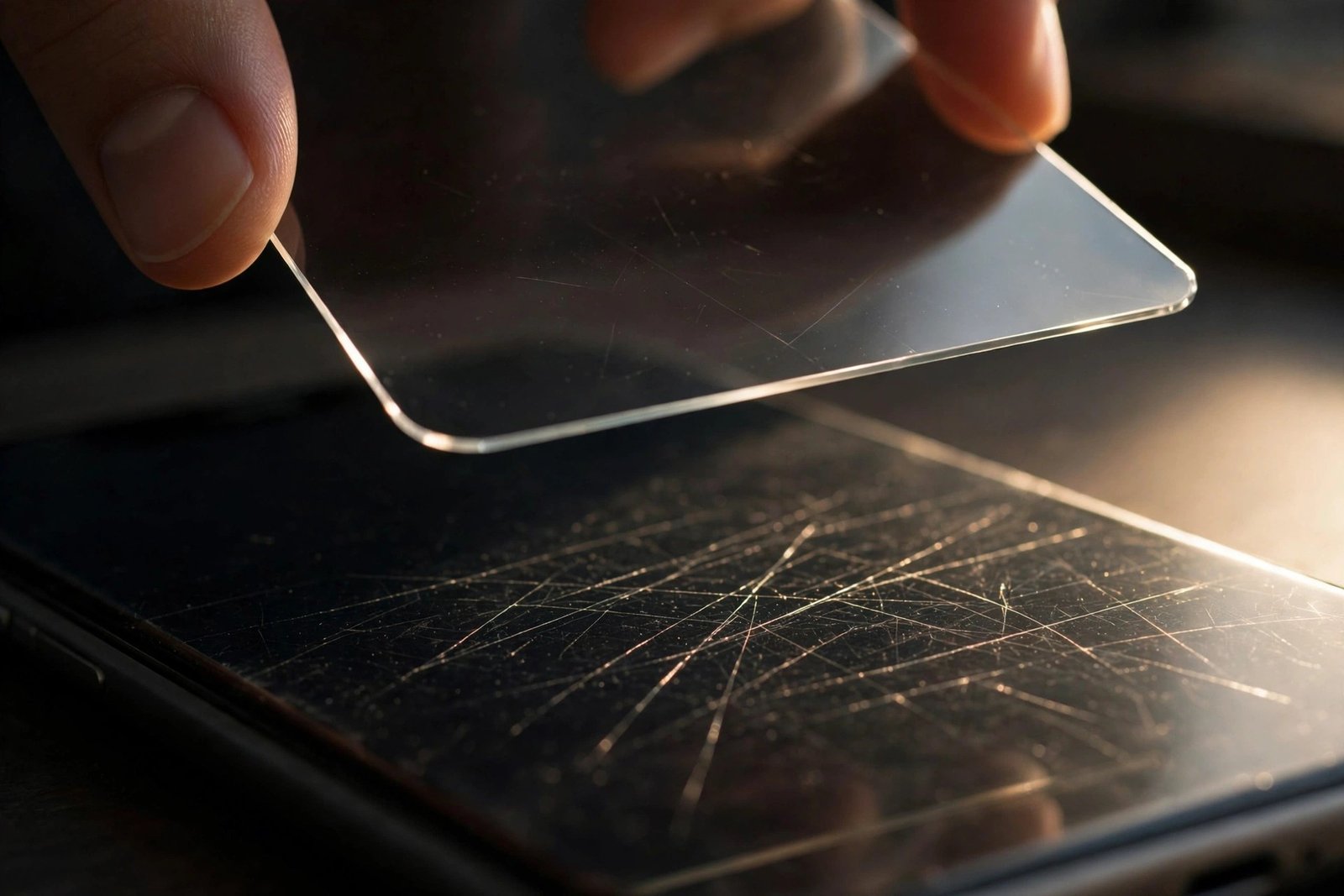
Your screen has picked up a fine scratch — from keys in a pocket, grit on a desk, an unlucky encounter with a zip. It’s not cracked, just marked, and every time the light catches it you see it. So the question follows naturally: if you fit a screen protector over the top, will the scratch disappear underneath it? It’s one of the most commonly asked questions in phone care, and unusually for this kind of thing, the answer is “quite often, yes” — with conditions.
This guide is about scratches only — on the phone’s screen itself, or on an existing protector. (Cracks are a different kind of damage entirely, and no protector hides those.) Here is why a protector can make scratches vanish, when it can’t, and how to get the best result.
Key Takeaways
- Fine, shallow scratches on the screen often become nearly invisible under a protector — the adhesive fills the groove and stops it catching the light.
- A full-adhesive tempered glass protector hides scratches best; the glue layer is what does the optical work.
- Deep scratches you can feel with a fingernail will be softened but usually still faintly visible, especially on a bright or white screen.
- Scratches on an old protector are simpler: peel it off, and they leave with it — the screen beneath is usually unmarked.
- A protector hides scratches cosmetically, not structurally — it covers existing marks and prevents new ones, but doesn’t repair the glass.
Why a Protector Makes Scratches Disappear
A scratch is visible because it’s a tiny groove that interrupts the smooth surface of the glass. Light hits the groove’s edges and scatters instead of reflecting cleanly, which is why scratches show up most as bright lines when the screen is off or displaying dark content. The groove itself is usually far too shallow to feel — what you’re seeing is optics, not depth.
A screen protector with a full layer of adhesive changes that optics completely. When the protector is fitted, its soft adhesive flows into the groove and fills it, replacing the air in the scratch (air and glass bend light very differently) with a material whose optical properties are much closer to glass. With the groove filled, light passes through almost as if the surface were unbroken — and the scratch effectively vanishes. The shallower the scratch, the more complete the effect; most everyday hairline scratches fall well within what adhesive filling can hide.
Which Protector Hides Scratches Best?
Tempered glass with full-coverage adhesive is the best choice for this job. Its glue layer covers the entire back of the glass, so it fills scratches anywhere on the screen, and the rigid glass on top presents a perfectly flat new surface. Two cheaper designs do noticeably worse: protectors with adhesive only around the edges (common on some curved-screen models) leave air over the middle of the screen, so scratches there stay visible — and may even look worse under the slight haze. Basic film protectors sit between the two: their adhesive also covers the full surface and fills scratches well, though film shows its own wear sooner.
One type to avoid for this purpose is a matte protector. Matte finishes work by diffusing light with a microscopic texture, which softens the whole image slightly — scratches blur, but so does everything else, and many people find the trade-off looks like a permanent haze rather than a clean fix. A clear glass protector preserves sharpness and hides the scratch outright.
- Before fitting, judge your scratch honestly under a bright light with the screen off. If you can feel it catch a fingernail, expect it to remain faintly visible afterwards — most noticeable on white backgrounds. Hairline marks you can only see, not feel, are the ones that disappear completely.
Scratches on the Protector Itself
There’s a second, happier version of this question. If the scratches you can see are on your current protector rather than the screen, the fix isn’t covering them — it’s removing them, because they’re on a part designed to be thrown away. Peel the old protector off and the scratches go with it. In most cases the screen beneath is pristine, because the protector took the damage it was there to take.
This is also why fitting a second protector over a scratched one is never the answer: you’d have two adhesive layers, degraded touch feel, and the old scratches still trapped visibly between them. Always remove the old protector first, clean the screen thoroughly, and fit the new one directly to the glass.
Getting the Best Result When Fitting Over a Scratch
Preparation matters more than usual here, because anything trapped near the scratch will be sealed in with it. Clean the screen meticulously — wet wipe, dry microfibre, then a dust-removal sticker — and inspect it at an angle under a bright light. A single speck of dust sitting in the scratch groove can hold the protector off the surface just enough to leave a visible line or a small bubble that never settles.
Fit the protector slowly and let the adhesive spread from the centre outward on its own rather than pressing hard immediately; the glue needs a few moments to flow into the groove. Small bubbles around a filled scratch usually clear within 24–48 hours as the adhesive finishes settling — judge the result after two days, not two minutes.
- Don’t try to polish the scratch out first with toothpaste, baking soda, or “scratch remover” pastes. These are abrasives: on a modern phone screen they strip the oleophobic coating and can turn one fine line into a cloudy patch — damage a protector cannot hide. Fitting the protector directly is both safer and more effective.
Frequently Asked Questions
Will a protector hide a deep scratch?
Partially. The adhesive fills the groove and removes most of the light-scattering that makes it obvious, so a deep scratch typically goes from glaring to faint. It will usually still be detectable on bright, plain backgrounds if you look for it. Only a screen repair or replacement removes a deep scratch entirely.
Does hiding the scratch weaken the screen or the protector?
No. The protector adheres normally over a fine scratch and protects exactly as it would on an unmarked screen. The scratch itself is cosmetic surface damage; it doesn’t compromise the protector’s fit or its ability to absorb future impacts.
Can a protector hide scratches on the back of my phone?
The same principle applies — a full-adhesive glass back protector or a skin will fill and mask fine scratches on a glass back panel in exactly the same way. It won’t restore a deep gouge, but hairline marks from cases and grit typically disappear under the adhesive layer.
A screen protector can’t un-scratch glass — but by filling the groove and restoring a flat optical surface, it can make most fine scratches vanish as if they’d never happened. It’s the rare repair that’s also the prevention.