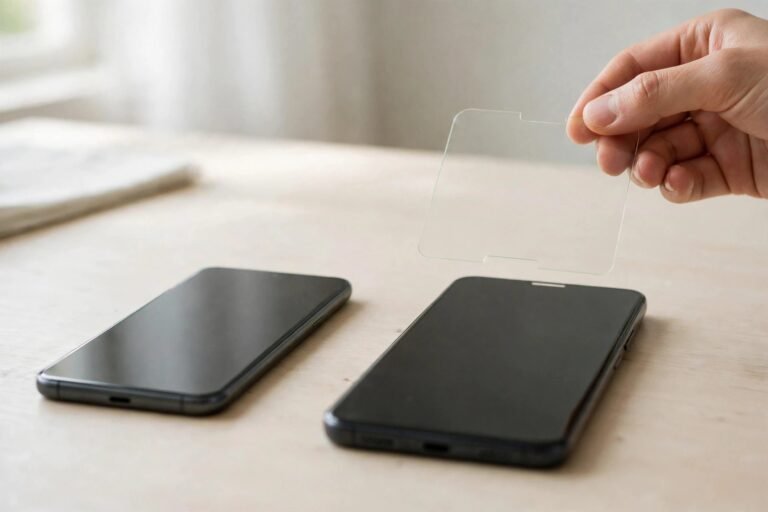
You have already applied a liquid screen protector, and now you are wondering whether you can fit a sheet of tempered glass over the top of it for extra protection. It is a reasonable idea — the liquid layer guards against micro-scratches, and the glass adds real impact protection — but the two do not always get along as well as you might hope.
The short answer is yes, you can put tempered glass over a liquid screen protector, but how well it sticks depends heavily on the state of the coating underneath. This guide explains why the combination can misbehave, when it works perfectly well, and how to give the glass its best chance of staying put.
Key Takeaways
- Tempered glass can be fitted over a cured liquid coating, but adhesion is often weaker than on bare glass.
- Liquid coatings are designed to be slick and low-friction — exactly the surface a glass adhesive struggles to grip.
- The most common problem is edges lifting in the days after fitting, not an instant failure.
- Results are far better once the coating has worn down or been polished off before fitting.
- A freshly applied liquid layer — less than a few days old — is the worst base for tempered glass.
- If the glass will not stay down, removing the coating first is usually the answer, not a different protector.
How Liquid Screen Protectors Work
A liquid screen protector is not a sheet of anything. It is a nano coating — typically based on silicon dioxide — that you wipe onto the screen, where it cures into an extremely thin, invisible layer bonded to the glass. Its whole purpose is to change the surface properties of the screen: it makes the glass smoother, more hydrophobic, and more resistant to the fine scratches that keys, coins, and grit would otherwise leave behind.
That smoothness is the point, and it is also the problem. The coating is engineered so that water beads up and slides off, fingerprints wipe away easily, and dirt does not cling. Unfortunately, a tempered glass protector’s adhesive is, from the coating’s perspective, just another thing trying to cling — and the coating was designed to stop exactly that.
What Happens When You Fit Glass Over the Coating
Tempered glass protectors bond using a full-surface silicone adhesive layer. On clean, bare glass, that adhesive wets out evenly and grips firmly. Over a fresh liquid coating, the bond is noticeably weaker. The protector will usually still go on and may look fine on day one, but the reduced grip shows itself over the following days: a corner starts to lift, an edge develops a faint halo that will not press out, or the whole sheet shifts slightly when you refit a tight case.
Touch sensitivity can suffer too. A protector that is only loosely bonded can sit on microscopic pockets of air, and that deadens the feel of taps and swipes. None of this damages your phone or the coating — it is simply a compatibility issue between two products designed for the same job in different ways.
- Timing matters more than technique. If you have just applied a liquid protector, wait at least a week of normal use before fitting glass over it — the coating’s slickness settles as it fully cures and wears, and the glass will grip noticeably better.
The Best Approach: Remove or Wear Down the Coating First
If you want the reliability of a normal tempered glass install, the coating has to go — or at least fade. Liquid coatings are not permanent. They wear away gradually through everyday use, cleaning, and pocket friction, typically over a period of months. If your liquid protector has been on the phone for a good while, the surface may already behave much like bare glass, and a tempered glass protector will often bond without any drama at all.
To speed things up, you can polish the coating off deliberately. Repeated firm cleaning with a microfibre cloth and a small amount of isopropyl alcohol gradually breaks the layer down, and fine glass-polishing compounds are sometimes used for the same purpose. Work gently, avoid anything abrasive enough to mark the screen itself, and clean the surface thoroughly afterwards so no residue remains to interfere with the new adhesive.
How This Differs From Layering Other Protectors
Layering protectors is not always a bad idea — the outcome depends on what is underneath. A paper-like film over tempered glass, for example, works well because the glass provides a hard, high-friction surface for the film to grip. Glass over liquid coating is the opposite situation: a rigid, adhesive-backed sheet trying to bond to the slipperiest surface your phone can have. The pairing is not impossible, just less forgiving, and it is worth knowing that before you spend money on the glass.
- Before committing the glass, do a corner test: fit the protector, leave it for 24 hours, then check each corner and edge for lifting. If it is still flat after a full day of pocket and case use, the bond is likely to hold.
If the Glass Keeps Lifting
Pressing a lifted edge back down rarely fixes it for long, because the problem is the surface, not the pressure. If your tempered glass lifts repeatedly over a liquid coating, you have two sensible options. Either strip the coating back fully and refit with a fresh protector — remember that lifting and reapplying weakens the adhesive each time — or accept the liquid coating as your scratch protection and skip the glass. What you should not do is keep buying different brands of glass hoping one will grip; the surface underneath is the variable that matters.
Frequently Asked Questions
Will fitting glass over a liquid protector damage my screen?
No. The worst realistic outcome is poor adhesion — lifting edges, a halo effect, or slightly reduced touch response. Neither the coating nor the glass will harm the screen itself, and the glass can be removed in the usual way if it does not work out.
Do I need to remove the liquid protector before fitting tempered glass?
Not always. If the coating is old and well worn, glass often bonds fine. If the coating is fresh — applied within the last few days — removing it or waiting for it to wear down will give you a far more reliable fit.
Can I apply a liquid protector over tempered glass instead?
Yes, and this order actually works better. A liquid coating applied over a tempered glass protector simply refreshes that protector’s surface — restoring some slickness and scratch resistance — with no adhesion problems, because nothing needs to stick on top of it.
Tempered glass over a liquid coating is a workable combination, but only once the coating has stopped being at its slickest. Give it time, or take the coating off — the glass will thank you by staying exactly where you put it.