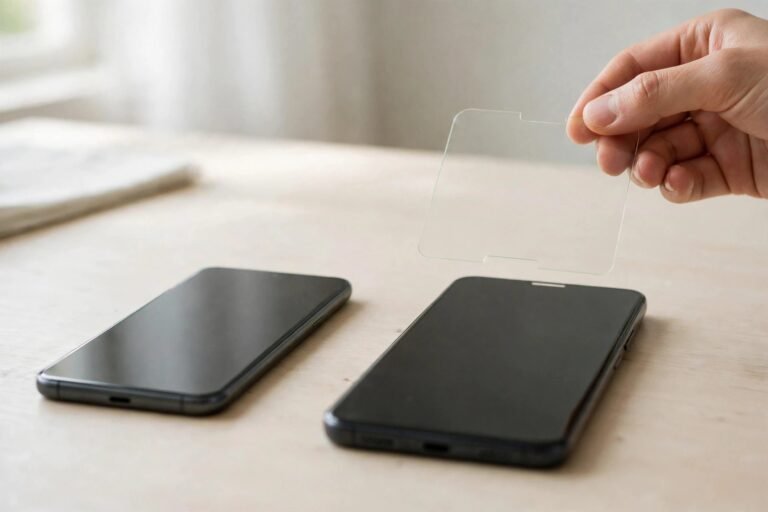
The Galaxy S23 Ultra has one of the toughest fronts Samsung has ever fitted — Gorilla Glass Victus 2 — and one of the most expensive screens to replace if it does break. So is a screen protector genuinely necessary, or is modern glass finally good enough to go bare?
The sensible answer for most owners is yes, fit one. Not because the S23 Ultra is fragile — it isn’t — but because its strengths and weaknesses are lopsided: excellent drop resistance, ordinary scratch resistance, a curved screen that is costly to repair, and a fingerprint sensor that needs the right kind of protector. This guide works through each factor.
Key Takeaways
- Gorilla Glass Victus 2 is built for drop survival, but it still scratches at roughly level 6 on the Mohs scale — sand and grit remain a threat.
- The S23 Ultra’s curved screen edges are exposed to knocks and make the display one of the pricier ones to replace.
- The ultrasonic fingerprint sensor works through a protector, but only a compatible one — some glass needs full adhesive or a fingerprint-friendly design.
- The S Pen works fine through glass and film protectors; matte finishes change the writing feel rather than stopping it.
- A case helps with drops but leaves the curved screen face open to scratches every minute the phone is out of a pocket.
- A protector costs a small fraction of a screen repair — it is cheap insurance on a flagship you will likely keep for years.
Tough Against Drops, Ordinary Against Scratches
Gorilla Glass Victus 2 was engineered to survive falls onto hard, rough surfaces like concrete — historically the drop scenario most likely to kill a screen. It is genuinely good at that job. But toughness against impact is not the same as hardness against scratching, and on the Mohs scale the S23 Ultra’s glass behaves much like other flagship glass: it picks up scratches from materials around level 6, with deeper grooves from level 7.
The everyday culprit is quartz — the mineral in sand and much household grit — which is harder than the glass. A single beach trip, a dusty workbench or grit in a handbag can leave fine permanent lines that no amount of polishing removes. A protector takes that damage instead, and because it is sacrificial, you can peel off a scratched one and fit a fresh one in minutes. The screen underneath stays as it left the factory.
The Curved Screen Problem
The S23 Ultra’s display curves over both long edges. It feels premium and makes the phone seem slimmer, but it leaves the curved part of the glass exposed where a flat screen would be protected by the frame. A knock against a table edge or a face-down slide tends to land precisely on that curve — and curved glass is also more vulnerable to cracking from a point impact than a flat panel.
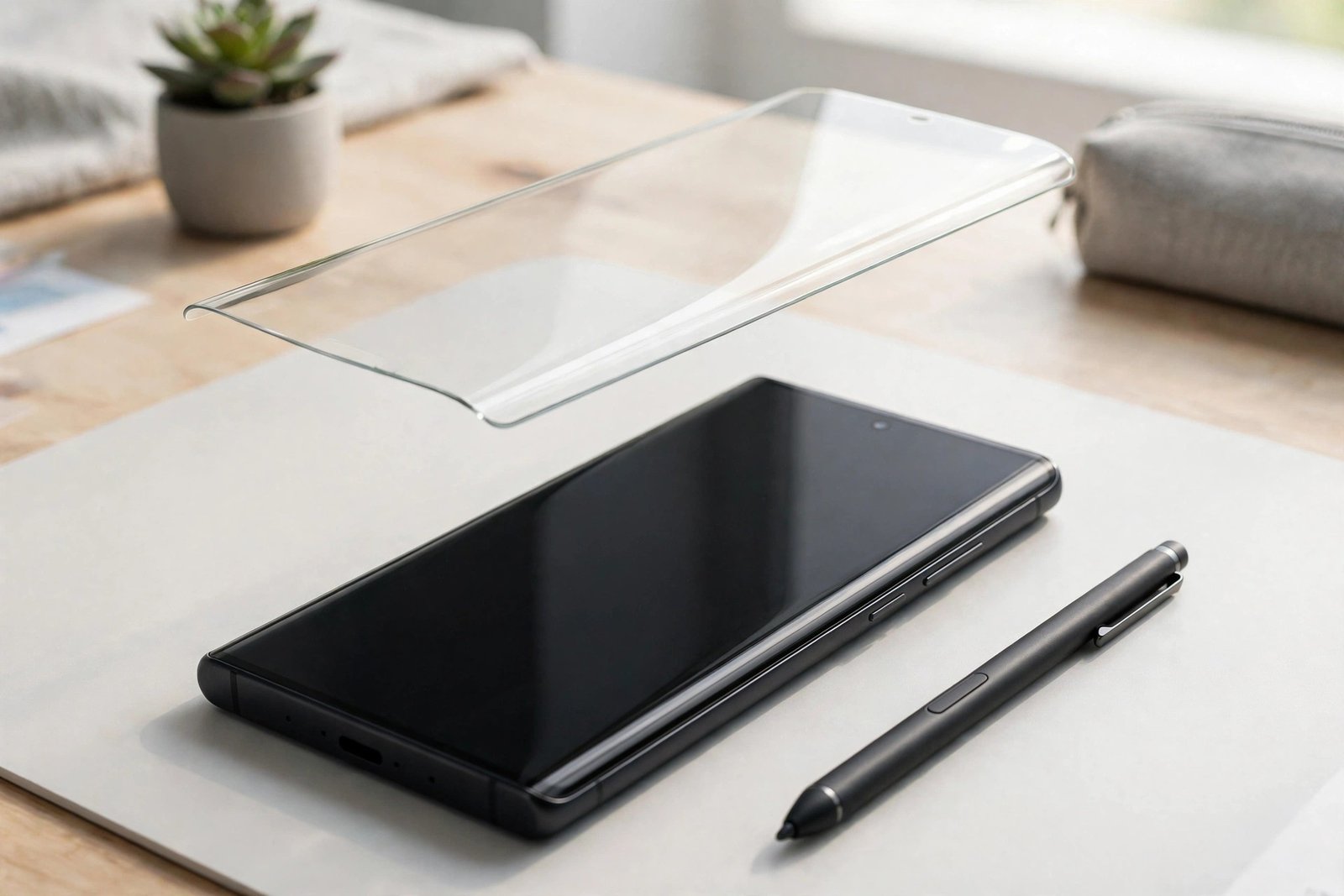
Repair economics sharpen the argument. A curved flagship display, bonded to its digitiser and frame, sits at the expensive end of screen replacements, typically a few hundred in local currency out of warranty. A protector cannot make a heavy drop harmless, but it absorbs the glancing blows and scrapes that cause a large share of real-world screen damage — and it covers the curves if you choose a design that wraps them, such as a full-adhesive glass or a flexible film.
- For curved screens, fit matters more than brand. Full-adhesive (often UV-cured) glass and flexible film protectors follow the S23 Ultra’s curves and stay sealed at the edges; cheap glass that only sticks around its border is the kind that lifts, collects dust and breaks fingerprint unlocking.
Fingerprint Sensor and S Pen Compatibility
The S23 Ultra unlocks with an ultrasonic fingerprint sensor under the display, which reads your fingerprint through the glass. It works through most protectors, but the margin for error is smaller than with optical sensors: an air gap under a cheap, border-adhesive-only protector can make unlocking slow or unreliable. Protectors described as fingerprint-compatible — full-adhesive glass, UV-gel glass, or film and hybrid designs — are the safe choice, and re-registering your fingerprints after fitting improves results further. Samsung also provides a touch sensitivity setting that helps.
The S Pen is a non-issue by comparison. It uses a digitiser layer that works happily through glass and film, so note-taking and drawing are unaffected. Where you do have a choice is feel: glossy protectors keep the slick, glassy glide, while matte or paper-feel finishes add a little friction that some people prefer for writing and drawing. Neither harms the pen — it comes down to taste.
When You Might Reasonably Skip One
There is a fair case for going without. If you use a sturdy case with raised corners, keep the phone in a dedicated soft pocket, have accidental-damage cover, and simply prefer the feel and look of the bare curved glass, the risk you are running is modest — drops are the danger the phone is best built to survive. Some owners also dislike the visible edge line any protector adds to a curved display.
Just make that choice with the right expectation: the screen will accumulate fine scratches over a year or two of normal life, and on a phone as expensive to repair as the S23 Ultra, those marks also chip away at resale value. For most people — and especially anyone who keeps a flagship for three years or more — a well-fitted protector is the cheaper, calmer option. If you fit one thing only, make it a fingerprint-compatible protector matched to a case-friendly cut.
- After fitting a protector, delete your saved fingerprints and register them again, pressing a little more firmly than usual. Fresh enrolment through the protector makes ultrasonic unlocking noticeably faster and more reliable.
Frequently Asked Questions
Will a screen protector stop my fingerprint sensor working?
A compatible one won’t. Choose a protector described as fingerprint-friendly — full-adhesive or UV-cured glass, or film and hybrid types — and avoid cheap glass that only glues around the edges, which leaves an air gap the ultrasonic sensor struggles with. Re-registering your fingerprints after fitting, and turning on touch sensitivity in Display settings, gives the best results.
Does the S Pen still work with a protector fitted?
Yes. The S Pen’s digitiser works through tempered glass and film protectors without any loss of accuracy. The only difference is feel: a matte or paper-feel protector adds slight friction for a more pen-on-paper sensation, while glossy glass keeps the original slick glide.
Is a case on its own enough protection?
A case is excellent against drops and corner impacts, and the S23 Ultra’s cases typically raise the top and bottom edges to guard the screen face-down. But a case does nothing about scratches from grit in a pocket, or a knock that lands directly on the exposed curved edge of the glass. Case and protector cover different risks, which is why most owners use both.
The S23 Ultra doesn’t need a protector because its glass is weak — it needs one because the glass is expensive, curved and still scratchable. Fit a compatible protector and the only screen you’ll ever replace is the one that costs very little.