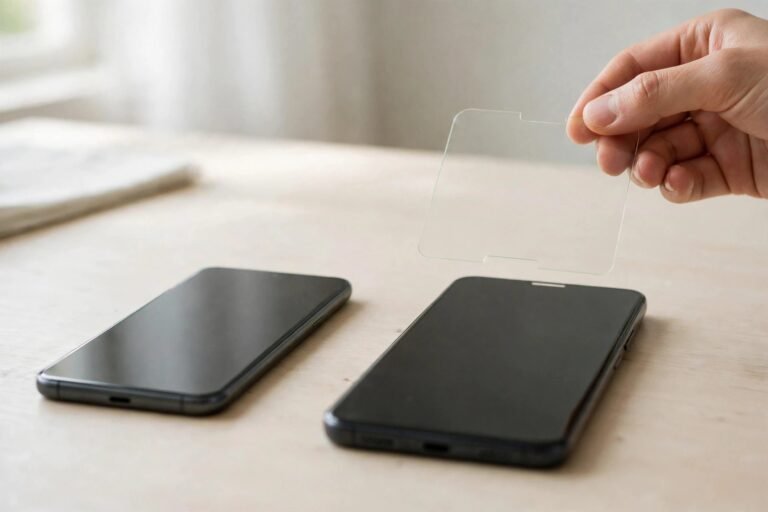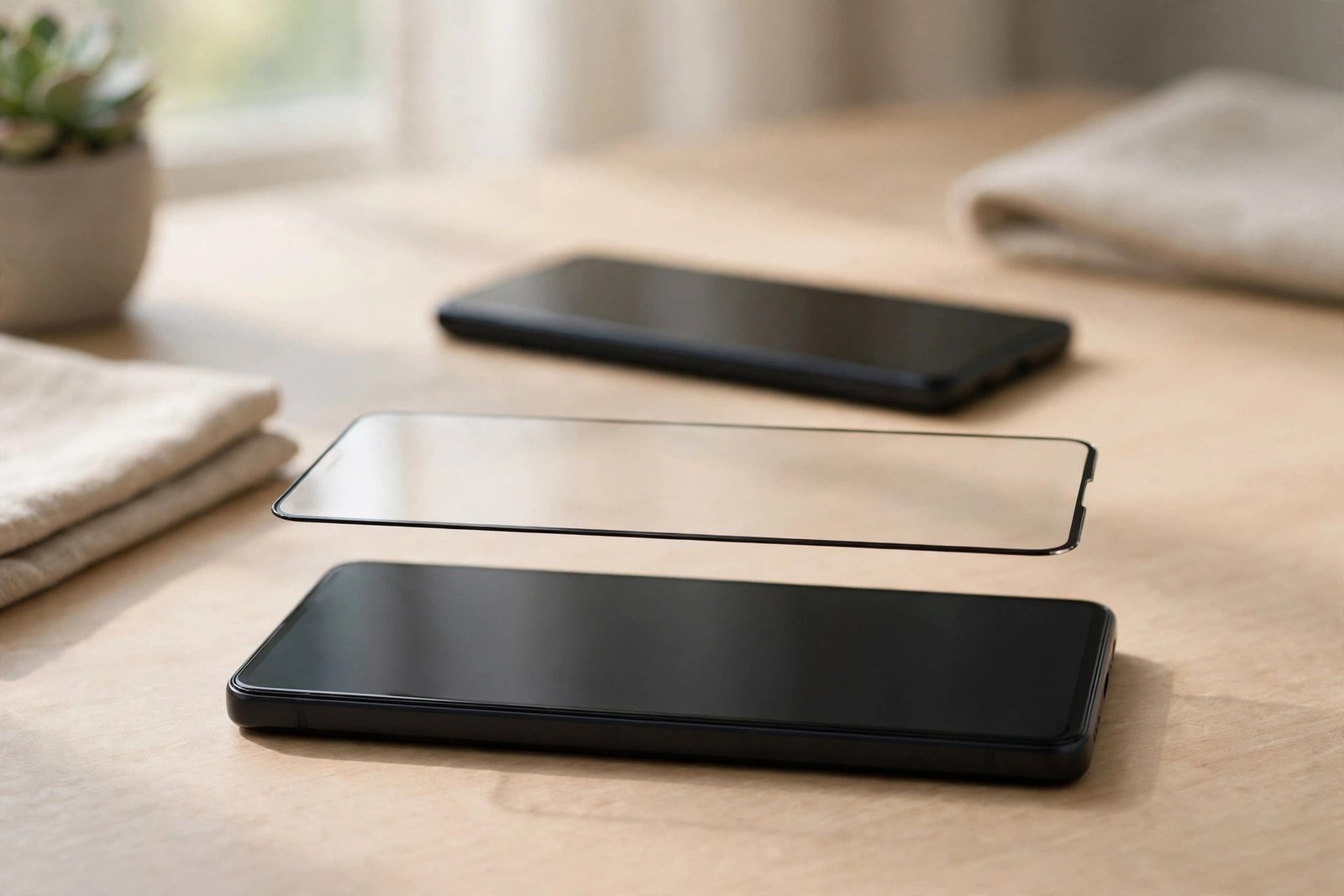
Not every generation change means your spare screen protectors become useless. The Galaxy S22 and Galaxy S23 are one of the friendlier pairings in recent years: both are compact flagships with a flat 6.1-inch display, and — unusually — a protector made for the S22 will, in most cases, fit the S23 properly.
That is not a guess based on the shared screen size. The two phones’ bodies are within a few tenths of a millimetre of each other, their displays are flat rather than curved, and the camera hole and fingerprint sensor sit in the same places. There are still a couple of small caveats worth knowing — particularly with full-coverage glass and alignment trays — and this guide walks through them so you can use your spares with confidence.
Key Takeaways
- Yes, usually — most S22 tempered glass and film protectors fit the S23, because both phones have a flat 6.1-inch display in a near-identical body.
- The S23 is a fraction larger (about 146.3 × 70.9 mm vs 146.0 × 70.6 mm), so full-coverage S22 glass may sit a hair small on it.
- Case-friendly cuts are deliberately undersized, which hides the tiny size difference completely.
- The centred front camera hole and the in-display fingerprint sensor are in the same positions on both phones.
- An alignment tray made for the S22 clips onto that phone’s exact body, so it may not seat correctly on the S23 — fit the glass by hand instead.
- The same logic works in reverse: most S23 protectors also fit the S22.
Nearly the Same Phone Up Front
Samsung kept the S23’s design deliberately close to the S22’s. The S22 measures roughly 146.0 × 70.6 × 7.6 mm and the S23 about 146.3 × 70.9 × 7.6 mm — differences of around three-tenths of a millimetre in height and width, with identical thickness. Hold the two phones face up and the fronts are, for practical purposes, the same rectangle of glass surrounded by the same slim bezels.
Just as importantly, what sits within that rectangle did not move. Both phones have a small centred punch-hole camera at the top of the display, and both place the ultrasonic fingerprint sensor in the same zone in the lower half of the screen. A protector is essentially a shaped sheet with holes and coverage in the right places, and on these two phones the right places are the same — which is why so many listings simply sell one protector for “S22 / S23” and are telling the truth.
Why Flat Glass Forgives Small Differences
The flat display does most of the work here. A flat sheet of tempered glass only has to match the screen in outline; it does not have to bend over an edge or follow a curve. On curved-screen phones, a fraction of a millimetre of shape difference ruins the bond at the edges. On the S22 and S23, there is no curve to mismatch, so the tiny dimensional differences between the two phones simply disappear into the small margin every protector already leaves around its perimeter.
Adhesion is the other half of the story. Flat glass protectors bond across their whole face, so as long as the sheet sits within the flat area of the display, it seals fully and stays put. Neither phone asks the protector to do anything exotic — no edge glue, no UV-cured adhesive, none of the compromises curved flagships demand. It is one of the easiest fittings in the Galaxy range, whichever of the two phones you own.
- Do a dry fit first: lay the S22 protector on your S23 without removing the backing and check the camera hole centres and all four corners sit evenly. Thirty seconds of checking beats peeling the backing and hoping.
The Small Caveats Worth Knowing
The one place the 0.3 mm difference can show is with full-coverage protectors — the edge-to-edge style, often with a black painted border, designed to cover the screen right up to the bezel. An S22 full-coverage protector on the fractionally larger S23 may sit a hair small all round, leaving the painted border a touch inside the display’s visible area. It is cosmetic rather than harmful, but if you are buying new rather than using a spare, an S23-specific full-coverage version is the tidier choice. Case-friendly protectors, which are cut smaller by design, are unaffected.
The other caveat is fitting aids. Many modern protectors come with an alignment tray or frame that clips over the phone to position the glass automatically. That tray is moulded to one phone’s exact body — buttons, corners and all — so an S22 tray may not clip securely onto an S23, and a loose tray defeats its own purpose. If your spare protector includes a frame, check it seats firmly before trusting it; if it rocks or gaps, discard the tray and align the glass by hand, lining up the camera hole first.
When to Buy S23-Specific Anyway
Using an S22 spare on an S23 makes most sense when the protector is already in your drawer — it cost you nothing extra and will do its job well. If you are buying fresh, though, there is no reason to choose anything other than the version listed for your exact phone: the price is the same, the fit is guaranteed, and the alignment tray will match your handset. That logic applies doubly to speciality protectors such as privacy or matte versions, where exact cut and coating alignment matter more.
One warning on listings: make sure any cross-compatible claim really means the standard S22 and S23. The S23 FE is a different, larger phone (6.4-inch display) despite the similar name, and its protectors fit neither the S22 nor the S23. The S22+ and S23+ are also larger models with their own sizes. Check the model name on the box rather than the headline claim, and you will not go wrong.
- After fitting a protector on an S23, delete and re-register your fingerprints with the glass in place. The ultrasonic sensor works through most glass protectors, but registering through the fitted protector noticeably improves first-press unlocks.
Frequently Asked Questions
Does an S23 screen protector fit the S22 the other way round?
Yes, generally. The compatibility runs in both directions because the fronts of the two phones are effectively the same size and layout. An S23 full-coverage protector on the marginally smaller S22 may overhang by a fraction of a millimetre, so case-friendly versions are again the safest bet, but ordinary glass and film protectors swap between the two phones without drama.
Will the fingerprint sensor still work with an S22 protector on my S23?
Yes, provided the protector is fitted cleanly with no air gap over the sensor area, which sits in the same place on both phones. Press the glass down firmly over the lower half of the screen during fitting so the adhesive bonds evenly, then re-register your fingerprints afterwards. Thick or poorly bonded glass is the usual cause of sensor complaints, not the protector’s model year.
My S22 protector came with an alignment tray. Can I use it on the S23?
Only if it clips onto the S23 firmly and squarely. The tray is moulded to the S22’s body, which is a fraction smaller, so it may sit loosely or refuse to clip at all. If it feels anything less than snug, fit the protector freehand instead — a wobbling tray will position the glass worse than your own eyes will.
The S22 and S23 are the rare pair of generations that genuinely share a fitting — use your spare with confidence, just mind the tray and the full-coverage edge.