You push the corner bubble out on Monday. By Wednesday, it’s back — same corner, same crescent of air creeping under the edge of your screen protector. A bubble that keeps returning is not an installation mistake you can simply redo. It’s a symptom, and until you find the cause, every fix you make will quietly undo itself.
This guide is about recurring corner bubbles specifically: the ones that reappear hours or days after a perfect press-out. We’ll work through the usual suspects — case interference, a warped or lifting edge, dust wedged under the border — and how to tell them apart before you waste another protector.
Key Takeaways
- A bubble that returns to the same corner is being pushed up by something — most often your phone case.
- Test without the case for 24 hours. If the bubble stays gone, the case is the culprit, not the protector.
- Edge lift (the “halo” outline) means the protector can’t lie flat — dust, a curved screen edge, or a warped pane.
- Pressing harder won’t fix a returning bubble. Remove the interference or the bubble wins.
- A case-friendly protector (slightly smaller than full coverage) is the permanent cure for case-push bubbles.
Why Corner Bubbles Come Back
Air doesn’t sneak under a well-seated protector by magic. For a bubble to re-form, the edge of the protector has to lift away from the glass, even slightly, and let air creep underneath. Once the edge is lifted, ordinary handling — sliding the phone into a pocket, gripping it by that corner — pumps a little more air in each time.
That’s why pressing the bubble out never lasts. You’re treating the air, not the lift. The real question is always the same: what is levering that edge up? There are three common answers, and each has a different fix.
Suspect 1: Your Case Is Pushing the Edge
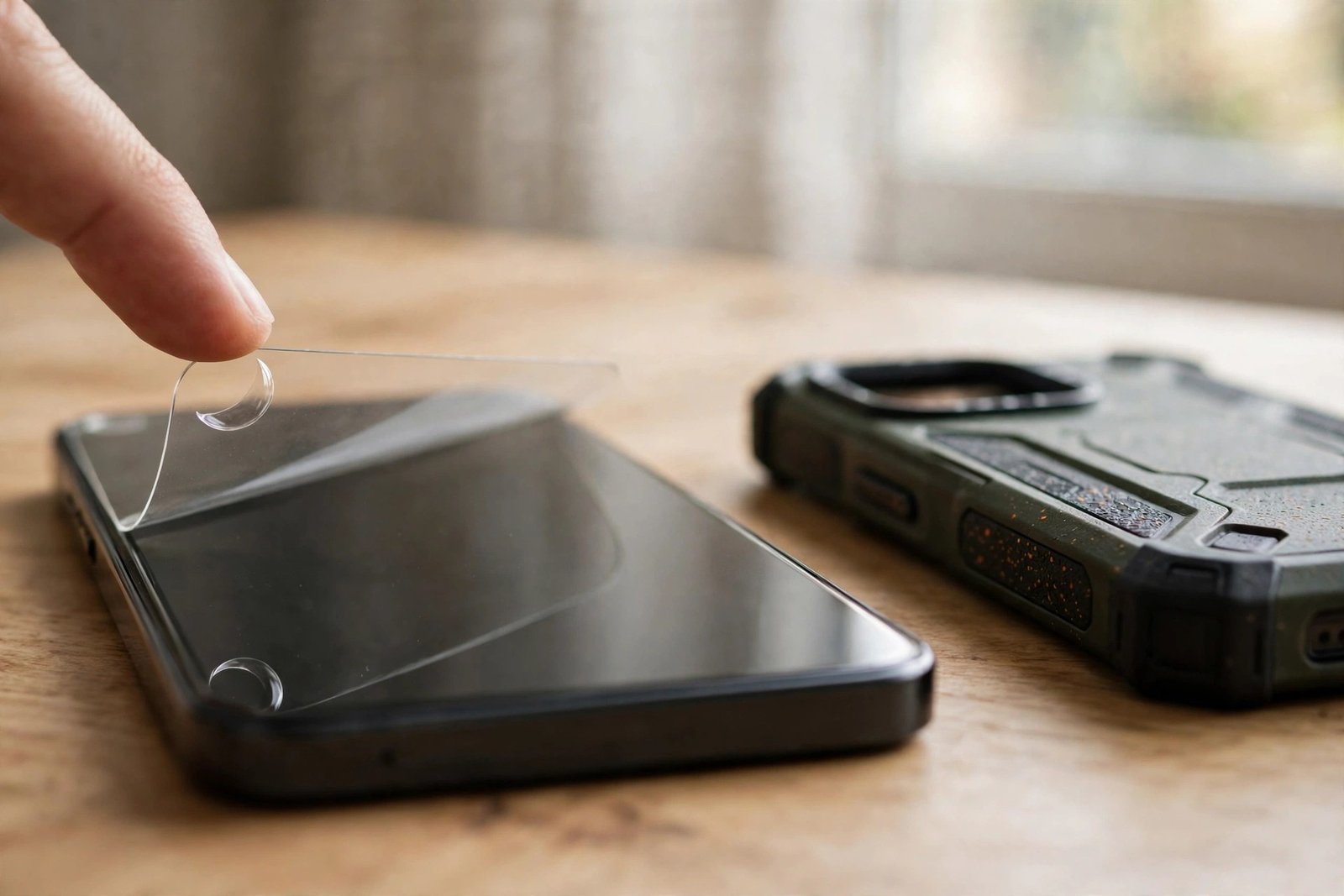
This is the cause in the large majority of cases. Many cases have a raised lip that wraps slightly onto the front of the phone. If the protector is a full-coverage model, its edge sits directly under that lip — and every time the case flexes, the lip nudges the protector’s corner upward by a fraction of a millimetre. It’s slow, it’s silent, and it’s relentless.
The giveaway signs: the bubble always returns to a corner (or two corners on the same side), it gets worse after the phone has been in a pocket, and it appeared only after you put the case on, not during installation. The fix test is simple — remove the case, press the bubble out, and use the phone caseless for a day. If the corner stays flat, you’ve found your offender.
- Run a fingernail around the case lip where it meets the screen. If you can feel it catching on the protector’s edge, that’s direct contact — case interference confirmed.
- Before buying anything, try the case and protector together on a flat table and look along each corner at eye level. A tiny gap or overlap at one corner tells you exactly where the fight is happening.
Suspect 2: Dust or Grit Wedged Under the Edge
A single grain of grit under the border acts like a tent peg: it holds the edge up permanently, and air pools around it. Unlike case-push, this bubble usually returns to the same spot on an edge, not necessarily a corner, and it will have a faint visible speck at its centre if you tilt the phone under a lamp.
The fix: lift just that edge with a piece of sticky tape, dab the speck away with a dust-removal sticker, and press the edge back down firmly for 30 seconds. Work in the steamiest, stillest air you can manage — a bathroom after a hot shower — so you don’t trade one speck for another.
Suspect 3: The Protector Edge Itself Is Lifting
Sometimes neither the case nor dust is to blame. Screens with strongly curved edges can defeat a flat protector: the pane simply cannot bend enough to follow the glass, so the perimeter never bonds — the classic “halo effect”, a pale outline tracing part of the border. A warped or cheap pane can do the same on a flat screen.
You can identify this one easily: the lift follows a whole edge or a long stretch of the border rather than one corner, and pressing it down gives a springy feel — it pops back the moment you let go. No amount of pressing cures geometry. The answer is a protector designed for your screen’s curves, or a case-friendly cut that ends before the curve begins.
- When you press a lifting edge down, hold firm pressure for a full 30 seconds, then leave the phone face-up and untouched for an hour. Adhesive needs dwell time, not repeated poking.
- A warm room helps borderline edges bond. Keep the phone somewhere comfortably warm (never hot) for the first few hours after pressing.
The Permanent Fixes, in Order
- Case confirmed as the cause: switch to a case-friendly protector, or a case with a lower, softer lip.
- Dust under the edge: tape-lift, sticker the speck, reseat with 30 seconds of pressure.
- Halo on a curved screen: replace with a curved-edge or case-friendly protector made for your model.
- Nothing works: the pane is warped — replace it; multi-packs exist precisely for this.
Frequently Asked Questions
Why does the bubble always come back in the same corner?
Because the thing lifting that corner hasn’t moved. Case lips, a grit speck, and screen curvature are all fixed in place, so the bubble they create is fixed too. A returning bubble in the identical spot is the clearest diagnostic signal you can get — random bubbles would wander; caused bubbles don’t.
Can I glue a lifting corner down?
Please don’t. Household glues can creep under the display, damage the oleophobic coating, and make the protector impossible to remove cleanly later. If an edge won’t bond after cleaning and firm pressure, the protector and screen simply aren’t compatible — replacing it is cheaper than repairing glue damage.
Is a small corner bubble actually a problem?
Cosmetically, it’s minor. Practically, a lifted edge is an open door: it collects pocket lint and grit, weakens the bond over time, and gives the pane a leverage point if the phone is dropped. It’s worth fixing properly rather than pressing it down every few days forever.
A bubble that keeps coming back isn’t stubborn — it’s telling you something. Find what’s lifting the edge, remove it, and the corner will stay flat for good.