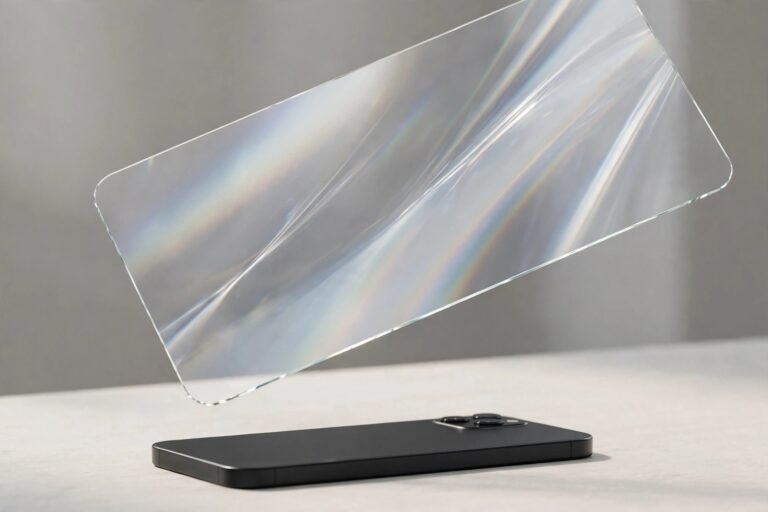
Liquid glass is the odd one out in the screen protection world, because there is no sheet to peel. What you applied — or paid a shop to apply — was a wipe-on liquid filled with microscopic silicon dioxide particles. As it cured, it filled the tiny valleys in your screen’s surface and formed a hardened nano coating a few hundred nanometres thick, bonded directly to the glass. So “removing” it is a completely different conversation from lifting off tempered glass.
The honest summary first: you cannot take liquid glass off the way you take off a protector, and in most cases you don’t need to. It wears away gradually on its own, and fresh coatings — or a sheet of tempered glass — can go straight over the top of what’s left. This guide explains how the coating wears, how to tell how much of it remains, and the polishing methods that genuinely strip it when you have a real reason to.
Key Takeaways
- Liquid glass is a cured nano coating bonded to the screen, not a film — there is nothing to peel or lift.
- It wears off gradually through everyday friction, fastest where your thumb swipes and along the edges.
- Water beading is your wear gauge — where water still beads tightly, coating remains; where it sheets flat, it’s gone.
- You can usually apply fresh liquid glass or tempered glass over the top without removing the old coating.
- True removal means polishing the coating off with a fine glass polish — possible, but slow and not risk-free.
- Most “removal” worries are actually about patchy wear, which a fresh application evens out in minutes.
How Liquid Glass Wears Away
The coating is at its thickest the day it cures, and from then on your life sandpapers it down. Every thumb swipe across the middle of the screen, every slide in and out of a pocket, every wipe with a cloth removes an almost immeasurably thin layer. High-friction zones — the thumb arc, the area under a keyboard, the edges a case doesn’t cover — wear first, while sheltered corners can keep their coating for far longer.
Most manufacturers rate liquid glass at six months to two years of useful life, and that spread is mostly about wear rather than time. A phone that lives on a desk keeps its coating; a phone thumbed for six hours a day in a jeans pocket sheds it much faster. Nothing goes wrong when it wears — the screen underneath is simply ordinary glass again.
How to Tell How Much Coating Is Left
There are two simple tests. The first is the water test: clean the screen, let a few drops of water fall on it, and watch their behaviour. On coated glass, droplets stand up in tight beads and roll off at a tilt. On bare glass, water spreads out and sheets. Test several areas — centre, edges, thumb zone — and you’ll often find a map of the wear: beading at the corners, sheeting in the middle.
The second test is your fingertip. Coated glass feels distinctly slick, almost slippery, and fingerprints wipe away easily. Worn patches feel draggier and hold smudges. Neither test is laboratory-grade, but together they’re more than accurate enough to answer the only question that matters: is there enough coating left to be worth anything?
- Do the water test after a thorough clean — skin oils alone can make bare glass bead water and give you a false “still coated” reading.
- Patchy results are normal and harmless; uneven wear is not damage, and a fresh application over the top levels it out.
Do You Actually Need to Remove It?
Almost always, no. Switching to tempered glass? Clean the screen thoroughly and fit the glass as normal — its adhesive bonds happily to a worn or partial nano coating. Reapplying liquid glass? The new layer goes over the old; manufacturers design top-up applications exactly this way. Selling the phone? The coating is invisible and has no effect on value or function either way.
The genuine reasons to strip a coating are rare: a botched application that cured with visible streaks or a rough patch, or a screen repair process that requires completely bare glass. If neither applies, the sensible “removal” is simply to let friction finish the job while you get on with using the phone.
Polishing It Off: The Only True Removal
If you do need bare glass, the coating has to be abraded away with a fine glass polish — the cerium-oxide-based compounds sold for removing watch and windscreen scratches are the usual choice. Worked by hand with a microfibre pad in small circles, the polish gradually cuts through the nano layer. Expect this to be slow: you are removing a hardened coating measured in nanometres, evenly, across the whole screen, without polishing a dip into any one spot.
Two cautions. First, polish doesn’t distinguish between the coating and the screen’s own factory oleophobic layer beneath it — strip one and you’ve stripped both, so the glass will attract fingerprints more readily afterwards. Second, keep compound and slurry away from speaker grilles, buttons and seams, and mask them with tape before you start. If the screen matters enough to be polishing at all, it’s worth asking a repair shop for a quote — they do this with proper compounds and far more practice.
- Test the polish on a tiny corner area first and check it under bright light — you want the coating gone, not a hazy patch in the glass.
- Check your progress with the water test as you go; when water sheets evenly everywhere, the coating is uniformly off and you can stop.
Frequently Asked Questions
Can I just peel liquid glass off like a normal protector?
No — there’s nothing to peel. Liquid glass cures into a coating bonded at microscopic level to the glass itself, with no edge, no adhesive layer and no sheet. Anything that looks like a peeling film on a liquid-glass phone is something else — usually the factory shipping film that was never removed, or a conventional protector fitted over the top.
Will solvents or alcohol dissolve the coating?
Not in any useful, controlled way. Cured silicon dioxide is chemically stubborn — that’s rather the point of it. Household solvents and alcohol wipes may slowly degrade it with repeated use, but they’ll attack the oleophobic layer and the phone’s seals long before they cleanly remove the coating. Polishing is the only deliberate removal method that works.
Does a worn liquid glass coating affect a new protector?
No. Tempered glass adheres to a partially coated screen without any issues, and fresh liquid glass bonds over old residue as part of its normal top-up process. The one thing that does affect a new protector is a dirty screen — so whatever state the coating is in, clean the glass thoroughly before fitting anything over it.
Liquid glass doesn’t come off — it wears off, quietly, swipe by swipe. Test what’s left with a drop of water, top it up or cover it as you please, and save the polishing compound for the rare day you truly need bare glass.