A spray gun only lays paint as well as the pressure at its inlet — not the number on your compressor tank. I spent two weeks screwing regulators and valves onto HVLP and LVLP guns, primer in the booth and lacquer on cabinet doors, setting every one with the trigger pulled: pressure read standing still is not pressure you spray at.
One warning before the picks: half the products sold as spray gun regulators are not regulators at all. A true regulator holds a set PSI while tank pressure swings; a flow valve just chokes airflow and drifts with the line. Both have their place — I have labelled each pick honestly so you know which you are buying.
Key Takeaways
- Best overall: SNS AR2000-N02 — a 0-40 PSI band in the HVLP window, and it holds its pressure
- Set pressure with the trigger pulled: dynamic inlet pressure runs several PSI below the static reading
- A flow valve is not a regulator — it trims airflow but cannot hold a PSI number as line pressure swings
- Check the thread: gun inlets and regulators are 1/4″ — PTFE tape keeps the joint honest
- Keep oil away from paint: never spray through an FRL lubricator, or you will be stripping fisheyes
The 10 Best Spray Gun Pressure Regulators Compared




More Details on My Top Picks
SNS AR2000-N02 Low-Pressure Regulator
The AR2000-N02 is a general-purpose low-pressure regulator, labelled honestly as such — but its 0-40 PSI band is precisely where HVLP and LVLP guns live. Screwed into the line feeding my gun, it let me dial 26 PSI at the inlet and hold it there.
That holding is the difference between a regulator and a valve. When my compressor kicked in and tank pressure swung, the SNS vented and re-seated like a proper relieving regulator — the needle barely moved mid-panel. Its gauge reads in the band you actually use, so 2 PSI changes are visible.
The limits are honest: max operating pressure is only 42 PSI, so this is a dedicated low-pressure station, not a shop-wide regulator, and there is no filter — pair it with a water trap upstream. As a set-and-forget paint-gun pressure station, nothing here matched it for the money.
- ✅ Fine, repeatable adjustment in the 15-35 PSI band
- ✅ Relieving design holds pressure as the tank cycles
- ✅ Costs less than most gun-branded regulators
- ❌ General-purpose unit, not spray-gun branded
- ❌ 42 PSI ceiling — no room for high-pressure tools
- Type: Low-pressure regulator with gauge
- Adjustment Range: 0-40 PSI
- Thread: 1/4″ NPT female
- Max Operating Pressure: 42 PSI
- Flow Capacity: 550 L/min class
- Weight: 10.5 oz
- Includes: Gauge, bracket
- Model: AR2000-N02
NANPU Zinc Filter Regulator
This NANPU is a line-side filter regulator, not a gun-inlet unit — I mounted it at the drop, where it does two jobs: the 5 micron brass element strips out the water and grit that cause fisheyes, and the regulator sets line pressure before the hose run.
In practice I set it a few PSI above target to cover hose drop, then fine-tuned at the gun. The zinc body feels a class above plastic-bowl budget units, the bowl twists off for element checks, and the manual drain actually gets used because it is easy to reach.
The weakness is the gauge: a 0-150 PSI dial is vague at 25 PSI, so treat this as your air-prep and coarse-regulation stage, paired with a gun-inlet gauge for the final number. As a paint setup’s first line of defence, it is the strongest filter regulator here.
- ✅ Cleaner air means fewer fisheyes and dust nibs
- ✅ Quick-release bowl for fast element checks
- ✅ Regulates across the full 0-145 PSI span
- ❌ Line-side unit — it mounts at the drop, not on the gun
- ❌ 0-150 PSI gauge is coarse down at 25 PSI
- Type: Filter regulator (line-side)
- Thread: 1/4″ NPT
- Filter Element: 5 micron brass
- Regulator Range: 0-145 PSI
- Gauge: 0-150 PSI
- Body: Zinc alloy
- Drain: Manual, quick-release bowl
- Bracket: Metal, included
Anest Iwata IWA8130B Air Regulator
The IWA8130B is the regulator Iwata builds for its own LPH and W-400 guns, and it shows in the dial: a 0-140 PSI face with colour zones putting the HVLP inlet band in green, printed with ‘check manual for optimal inlet pressure’. One glance tells you if you are in the window.
It screws straight onto the gun inlet, and the knurled side knob turns easily with gloves on, mid-job, without putting the gun down. Across a week of primer and clear, the needle returned to the same reading every trigger pull — no creep, no droop worth mentioning.
You pay Iwata money for it, and the 140 PSI dial ceiling confirms it is a gun accessory, not a shop regulator. But for finish coats, where 2 PSI either way shows in the orange peel, this is the one I would bolt to the gun and leave there.
- ✅ The most legible gun-inlet gauge in this test
- ✅ Metal body built for daily booth use
- ✅ Holds its setting panel after panel
- ❌ Premium price for a single-gun accessory
- ❌ Dial tops out at 140 PSI — gun use only
- Type: Gun-inlet analogue regulator
- Gauge: 0-140 PSI, colour-zoned dial
- Thread: 1/4″ NPT
- Body: Metal
- Adjustment: Knurled side knob
- Model: IWA-8130B
- UPC: 799621107358
PneumaticPlus PPR2-N02BG-2 Mini Regulator
The PPR2-N02BG-2 is an instrument regulator whose party trick is resolution: the whole span is 3-30 PSI, so a quarter-turn moves the needle by a whisper. For LVLP guns, touch-up work and spraying at 15-25 PSI, nothing here trims pressure this finely.
It is also over-built in the right ways — a 250 PSI maximum inlet means any shop line is safe, and rated flow of roughly 49 SCFM is several times what a gun can drink, so it never starves at full trigger.
The catch is the ceiling: a full-size HVLP gun wanting 29-35 PSI at the inlet runs this regulator at its top, leaving no headroom. Treat it as the precision station for low-pressure work — detail guns, LVLP, cabinet finishing — and it is superb. For big HVLP guns, look at the SNS.
- ✅ Finest low-pressure resolution of any unit here
- ✅ Korean-made, with gauge and bracket included
- ✅ Tiny footprint suits a bench or booth wall
- ❌ 30 PSI ceiling is tight for full-size HVLP guns
- ❌ General-purpose instrument regulator, not paint-specific
- Type: Miniature precision regulator
- Adjustment Range: 3-30 PSI
- Gauge: 0-30 PSI
- Max Inlet Pressure: 250 PSI
- Flow Capacity: 1,394.88 L/min (49 SCFM)
- Thread: 1/4″ NPT
- Includes: Gauge, bracket
- Origin: Made in Korea
- UPC: 841693112966
NANPU DFR-02 Air Drying System
The DFR-02 is a two-stage drying system with a regulator on the end — honestly a booth-wall unit, not a gun accessory. Air passes a 5 micron particulate filter, then a 0.01 micron coalescing stage that pulls out oil and water aerosol a single filter misses, then the regulator sets pressure.
On humid days this was the difference between clear coat and a fisheyed respray. The semi-auto drain dumps condensate when the line depressurises, so the bowls never quietly filled between sessions, and the metal bowl guards shrug off the knocks that crack bare polycarbonate.
You pay in size, price and upkeep — two elements on a replacement schedule. If your compressor is small, oiled and in a damp shop, though, this unit makes air paint-ready before any gun-inlet regulator fine-tunes it. Dry air first, pressure second.
- ✅ Driest, cleanest air in this test
- ✅ Semi-auto drain empties condensate without babysitting
- ✅ Metal-guarded bowls survive workshop life
- ❌ Bulky — a booth-wall unit, never a gun-inlet one
- ❌ Two elements to replace on a schedule
- Type: Two-stage filter + regulator (line-side)
- Thread: 1/4″ NPT
- Stage 1: 5 micron particulate filter
- Stage 2: 0.01 micron coalescing filter
- Regulator Range: 0-145 PSI class
- Bowls: Polycarbonate with metal guard
- Drain: Semi-automatic
- Model: DFR-02
GEMSENBOFU Brass Flow Valve 2-Pack
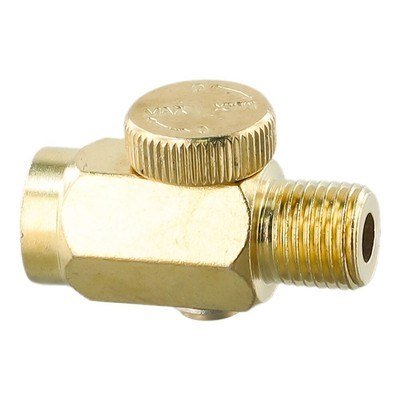
Honesty first: these are flow valves, not regulators. A needle chokes airflow at the gun inlet; there is no diaphragm holding a set pressure and no gauge to read. If line pressure swings, gun pressure swings with it. Within that limit, they are the best-value fine-tuners here.
The brass bodies are properly machined, the male-female 1/4″ NPT ends screw straight between hose and gun, and the knob sweeps from full flow to a whisper — ideal for dropping pressure for a detail pass without walking back to the wall regulator.
My setup pairs one with a gauged regulator upstream: set the true pressure at the wall, then trim feel at the gun. At this money, keeping one on each gun is an easy habit. Just never mistake knob position for a PSI number — that is what the gauged picks are for.
- ✅ Instant at-the-gun airflow tweaks
- ✅ Brass body will outlive the gun
- ✅ Second valve covers a second gun or a spare
- ❌ No gauge — it chokes flow, it does not regulate to a set PSI
- ❌ Setting wanders if line pressure swings
- Type: In-line flow control valve (no gauge)
- Pack Size: 2 valves
- Thread: 1/4″ NPT male and female
- Body: Brass
- Max Operating Pressure: 150 PSI
- Weight: 3.2 oz
- Model: qiliufamen
Quickun Brass Flow Valve
The Quickun is the same idea as the GEMSENBOFU valve — a brass in-line flow control at the gun inlet — at the lowest price here. It is not a regulator and has no gauge; it meters how much air reaches the gun, which for many sprayers is the adjustment they make all day.
The knob’s sweep is smooth, the threads are clean 1/4″ NPT at both ends, and it disappears on the gun — no gauge to snag, no weight worth mentioning. On a regulated line it trims fan pressure the way old-school cheater valves always have.
One quirk: fully closed, it still passes a breath of air — it does not seal 100%, so never treat it as a shut-off. And like every flow valve, it cannot hold a PSI number. As a budget trim control paired with a real regulator, it earns its keep.
- ✅ Costs less than a roll of masking tape
- ✅ Smooth sweep from open to nearly shut
- ✅ Small enough to live on the gun permanently
- ❌ Does not seal airflow 100% when fully closed
- ❌ No gauge and no pressure regulation — flow only
- Type: In-line flow control valve (no gauge)
- Thread: 1/4″ NPT male and female
- Body: Brass
- Adjustment: Knurled knob
- UPC: 744215191541
- Part Number: 1-2600-regualtor-1pcs
MASUNN AFR-2000 Filter Regulator Kit
The AFR-2000 kit is the classic first paint-air purchase: filter regulator, water separator trap, gauge, bracket and couplers in one box. I mounted it at the bench drop and had a working paint station in twenty minutes.
For a first setup the value is real — the trap catches the moisture that ruins beginner paint jobs, and included fittings save three trips for adapters. Regulation is coarse but honest, fine as the upstream stage feeding a gun-inlet gauge.
Keep expectations matched to the price: plastics and gauge feel a class below NANPU’s zinc units, and this is a line-side kit, not a gun accessory. As the starter stage of a paint air system, it is a sensible first rung.
- ✅ Everything a first paint setup needs in one box
- ✅ Bracket mounting keeps it tidy at the bench
- ✅ Gauge included for setting line pressure
- ❌ Budget plastics feel a class below NANPU zinc
- ❌ Line-side kit — too bulky for the gun itself
- Type: Filter regulator kit (line-side)
- Thread: 1/4″ inlet and outlet
- Filter: Water separator trap
- Gauge: Included
- Kit Includes: Regulator, gauge, couplers, mounting
- Model: AFR-2000
NANPU FRL Combo 1/4″
An FRL — filter, regulator, lubricator — is the mixed-shop answer: one zinc unit at the drop cleans the air, sets pressure and meters oil to the tools that want it. NANPU’s shares the zinc body, 5 micron brass element and quick-release bowls of its filter-only sibling, regulating across 0-145 PSI.
The paint warning matters: never spray through the lubricator. Oil mist in a paint line means fisheyes and a stripped panel. Run it as filter-plus-regulator for the paint drop — oiler dry, or paint hose plumbed before it — and oil only the tool line.
Set up that way, it was the hardest-working unit on my bench: grinders and impacts got their oil, the paint line stayed clean, one gauge ran the drop. Three bowls mean three drains to remember, but for a shop that sprays and wrenches off one compressor, it is the pragmatic pick.
- ✅ Serves the whole bench — tools oiled, air clean
- ✅ Zinc body and metal bracket
- ✅ Regulates the full 0-145 PSI span
- ❌ Paint work must bypass the lubricator
- ❌ Three bowls to drain and maintain
- Type: Filter regulator lubricator (line-side)
- Thread: 1/4″ NPT
- Filter Element: 5 micron brass
- Regulator Range: 0-145 PSI
- Gauge: 0-150 PSI
- Body: Zinc alloy
- Drain: Manual, quick-release bowls
- Bracket: Metal, included
Rolair REG0250M Regulator
Full disclosure: the REG0250M is a tank-side replacement regulator for Rolair compressors, not a gun-inlet unit. It earns its place because half the ‘my gun pressure won’t stay set’ complaints trace back to a dying compressor regulator — when that creeps or leaks, no gun regulator downstream can fix it.
As the genuine OEM part, it drops into Rolair compressors with the correct 4-port body and 1/4″ threads, instead of a universal regulator needing adapters and guesswork. Swapping mine took one wrench and thread tape.
If your compressor is not a Rolair, this is not your part, and it will never fine-tune pressure at a gun — that is what the other nine picks are for. But if your Rolair’s pressure wanders, replacing this is the cheapest fix in the article, and everything downstream works better for it.
- ✅ OEM fit means no thread or port surprises
- ✅ Cheaper than replacing the compressor
- ✅ A worn regulator is the usual cause of pressure creep
- ❌ Tank-side replacement part — not a gun-inlet regulator
- ❌ Brand-specific; little use off a Rolair compressor
- Type: Compressor replacement regulator (tank-side)
- Ports: 4-port body
- Thread: 1/4″
- Model: REG0250M
- Fitment: Rolair compressors (OEM part)
- UPC: 795525334852
How I Tested These Regulators
Gun-inlet units were screwed between hose and gun; line-side units mounted at the drop feeding the same hose. Every setting was made dynamically — trigger pulled, air flowing — because a regulator reading 29 PSI static can deliver 24 PSI mid-panel, and that gap is where orange peel is born.
I sprayed the same primer and lacquer panels with each setup, cycled a second tool to swing line pressure, and watched what the gun received. Units were judged on holding a set pressure, adjustment fineness in the 15-40 PSI band, gauge legibility and clean 1/4″ thread fit.
What Actually Matters: Range, Gauge and Airflow
Start with the adjustment range, not maximum pressure. A 0-160 PSI regulator gives you a sliver of knob travel for the 20-35 PSI a gun uses; a 0-40 or 3-30 PSI unit puts the whole sweep to work, with a gauge readable to a PSI or two. Match the band to the gun, and check max inlet pressure covers your line.
Then check airflow. A full-size HVLP gun drinks serious CFM, and an undersized regulator starves it wherever the needle sits — the picks here are rated well beyond a gun’s appetite. Finally, threads: gun inlets are 1/4″ (NPS on many swivel nuts, NPT on most regulators); they mate in practice, sealed with PTFE tape, snugged, never forced.
Analogue, Digital, or a Simple Flow Valve?
Analogue gun regulators are the sweet spot: instant to read, nothing to charge, tough enough for the booth — and a colour-zoned dial like the Iwata’s reads faster mid-panel than digits. Digital units read finer, but cost several times more, with batteries and electronics living in overspray; here, the analogue units held pressure just as honestly.
Flow valves are the third way, and the cheapest: no gauge, no regulation, just a trim knob. Paired with a gauged regulator upstream they are genuinely useful — set the number at the wall, trim the feel at the gun. Bought alone and mistaken for a regulator, they are how pressure problems start.
My money goes on the SNS AR2000-N02 as the pressure station and the Iwata IWA8130B on the gun for finish work — one holds the number, the other lets me see it mid-panel. Match the band to your gun, set it with the trigger pulled, and these ten will spray truer than the tank gauge ever did.
As an Amazon Associate, I earn from qualifying purchases made through links in this article, at no extra cost to you.