

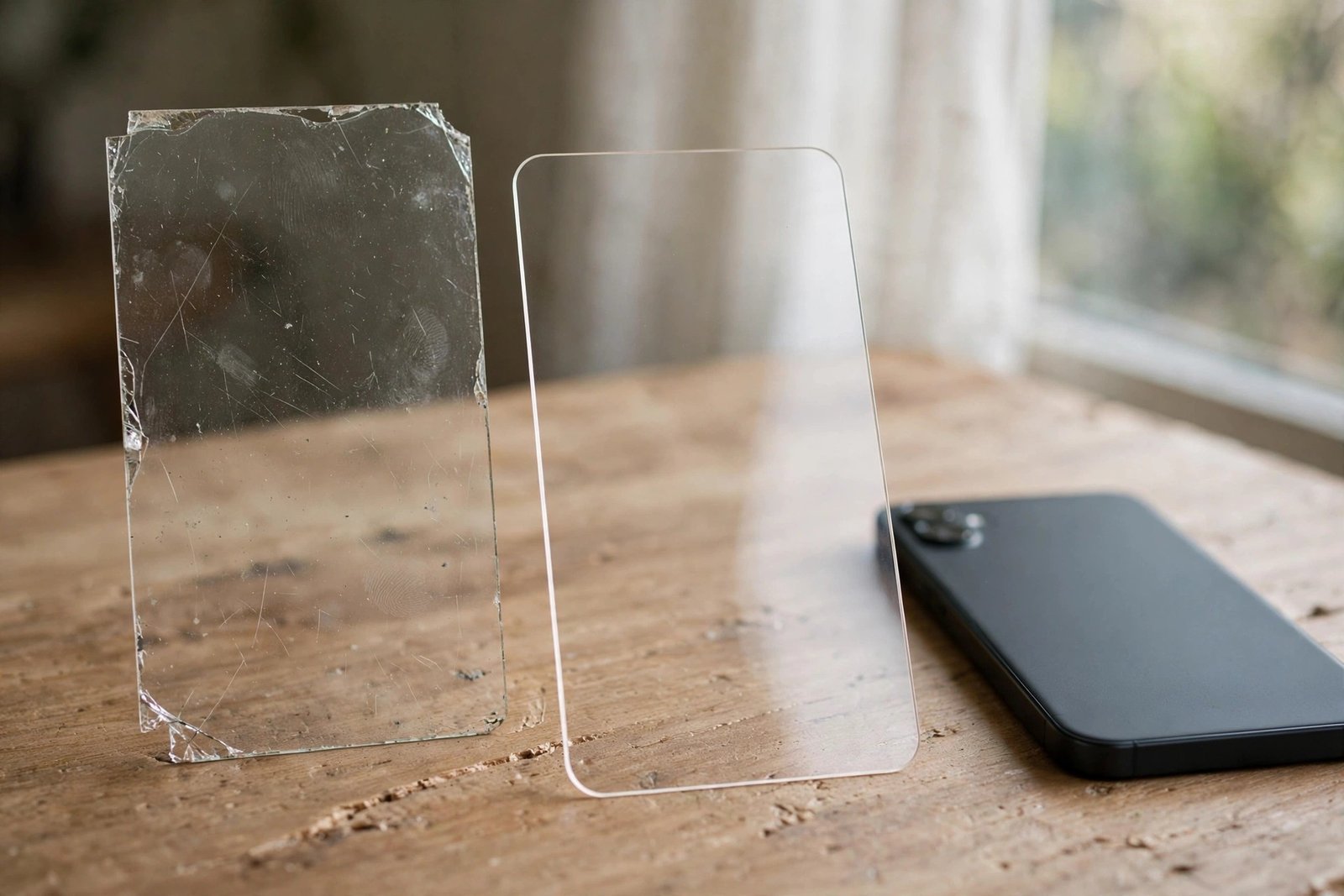
A screen protector never really dies of old age — it wears out, piece by piece, until one day you realise it is doing more harm to your view than good to your screen. But how long should one last? A month? A year? The real answer depends on which type you fitted and what your phone goes through every day.
Tempered glass and film protectors age very differently, and within each type, the coating, edges, and adhesive all wear at different speeds. This guide breaks down realistic lifespans for both, explains what gives up first, and ends with a simple checklist so you can judge your own protector’s remaining life at a glance.
Key Takeaways
- Tempered glass typically lasts 6–24 months; film usually needs replacing after 3–6 months.
- The oleophobic coating wears first — fingerprints and smudges are your earliest warning.
- Chipped edges and lifting corners mean the glass is no longer sealing or protecting properly.
- Cloudiness, scratches, and rainbow streaks mean the protector is now degrading your screen, not guarding it.
- Any crack at all ends a glass protector’s life immediately, even a hairline one.
Tempered Glass: Built to Sacrifice Itself
A tempered glass protector in gentle service — a phone kept in a case, carried in a clean pocket, rarely dropped — can last well beyond a year, sometimes two. There is no countdown ticking inside it. Its life ends through accumulated damage: each drop it absorbs, each knock on a door frame, each slide across a gritty surface spends a little of its strength.
That is the deal you make with tempered glass: it is a sacrificial layer. A protector that cracks after six months has not failed early — it has very likely saved your actual screen at least once. Judged by damage avoided rather than months survived, even a short-lived glass protector has usually earned its keep several times over.
Film Protectors: Thinner, Softer, Shorter-Lived
Plastic film protectors — PET or TPU — live faster, shorter lives. The material is soft, so keys, fingernails, and even coarse cloth leave marks that glass would shrug off. Within three to six months, most films show a frosted patchwork of fine scratches in the main touch areas, and self-healing TPU films, while better, eventually accumulate dents and orange-peel texture that no amount of patience will smooth out.
Film also yellows. Sunlight and heat slowly discolour the plastic, so an ageing film protector can tint your whole display a faint amber. If your screen suddenly looks warmer than it used to, peel back a corner mentally before blaming the phone — very often it is the film that has aged, not the display.
- Film protectors often come in multi-packs for a reason — treat them as a consumable you refresh every few months, not a fit-and-forget accessory.
- A quick lifespan test: run a fingernail lightly over the surface. A gritty, draggy feel means the top layer has worn through.
What Wears Out First
On almost every protector, the first casualty is the oleophobic coating — the invisible layer that makes glass feel slick and resists fingerprints. It is only nanometres thick and faces constant friction, so within a few months prints start lingering, smudges need harder wiping, and the surface feels less slippery than the bare edges near the bezel. The protector still protects at this stage; it has just become less pleasant.
Next come the edges. Corners catch on pockets and case lips, picking up microscopic chips that grow into visible nicks, and once an edge starts lifting, dust creeps underneath and the lift spreads. The adhesive itself ages last — after a year or more it can yellow slightly, weaken, or leave the protector prone to shifting — but by then the coating and edges have usually made the decision for you.
End-of-Life Signs: A Quick Checklist
Run through this list every few months. Any single item from the second half means replacement time: fingerprints that will not shift; a dull or cloudy patch in the centre; edges you can lift with a fingernail; chips along any border; cracks of any size; scratches you can feel; colours looking tinted through film; or touch that feels draggy and rough.
If your protector shows none of these, its age alone is no reason to bin it — a spotless eighteen-month-old glass protector protects exactly as well as the day it went on. Replace on condition, not birthday, and you will get the full life out of every protector you fit, without ever carrying one long past its best.
- Inspect your protector monthly under a bright lamp with the screen off — wear that is invisible in normal use shows up instantly at an angle.
- Buy protectors in multi-packs: the moment one reaches end of life, its replacement is already in the drawer.
Frequently Asked Questions
Does a screen protector expire if I never drop my phone?
It does not expire, but it does wear. Even a never-dropped protector loses its oleophobic coating to daily friction, gathers micro-scratches, and may start lifting at the edges after a year or so. It will keep protecting against scratches, but most people replace it once it turns cloudy or grubby.
Why did my cheap protector wear out so much faster?
Usually the coating and the adhesive. Budget protectors often have thinner oleophobic layers that fade in weeks rather than months, softer glass that chips more easily, and weaker adhesive that lifts sooner. The glass hardness may be identical on paper — it is everything around the glass that decides lifespan.
Can I extend a protector’s life with better care?
Yes. Clean it with microfibre only, keep the phone away from loose keys and coins, use a case with a modest lip so edges are not catching on everything, and avoid leaving the phone baking on a sunny dashboard. None of this makes a protector immortal, but it reliably stretches its useful life.
A protector’s job is to age so your screen doesn’t have to: judge it by its condition, not its age, and replace it the moment it stops earning its place.


