Your installation looked flawless on day one. Then, three days later, a bubble appeared along one edge — and when you pressed it out, it came back the next morning. Bubbles that show up or return days after fitting are a different problem from the air pockets you chase out during installation. They are a symptom, and squeezing them away treats only the symptom.
This guide explains why late-appearing bubbles form, the three causes behind nearly every case, and how to fix the cause so the bubble stays gone. The removal technique itself takes about a minute; the diagnosis is what makes it permanent.
Key Takeaways
- Late bubbles usually mean something is lifting the glass — a case, heat, or tiring adhesive.
- Pressing a bubble out without fixing the cause buys you a day or two at most.
- A tight case lip pressing on the protector’s edge is the most common culprit.
- Heat from charging, sunny dashboards and pockets softens adhesive and lets air creep in.
- Ageing adhesive lets go gradually, starting at corners and curved edges.
- Remove the bubble last — change the condition that created it first.
Why Bubbles Appear Days After a Clean Install
A screen protector’s adhesive keeps flowing for a day or two after fitting, so the bond you have at hour one is not the bond you have at hour forty-eight. During that settling window small pockets can still move around. But a bubble that arrives after the adhesive has set is telling you something different: somewhere along the edge, the seal is being opened, repeatedly, and air is getting in.
Think of it as a seal failing slowly rather than air being trapped from the start. The glass is lifted by a fraction of a millimetre at one spot — far too little to see — and each flex of the phone pumps a little more air underneath. The visible bubble is often not even at the entry point; air migrates to wherever the adhesive is weakest, which is why the bubble and its cause can sit on opposite sides of the screen.
Cause One: Case Pressure on the Edge
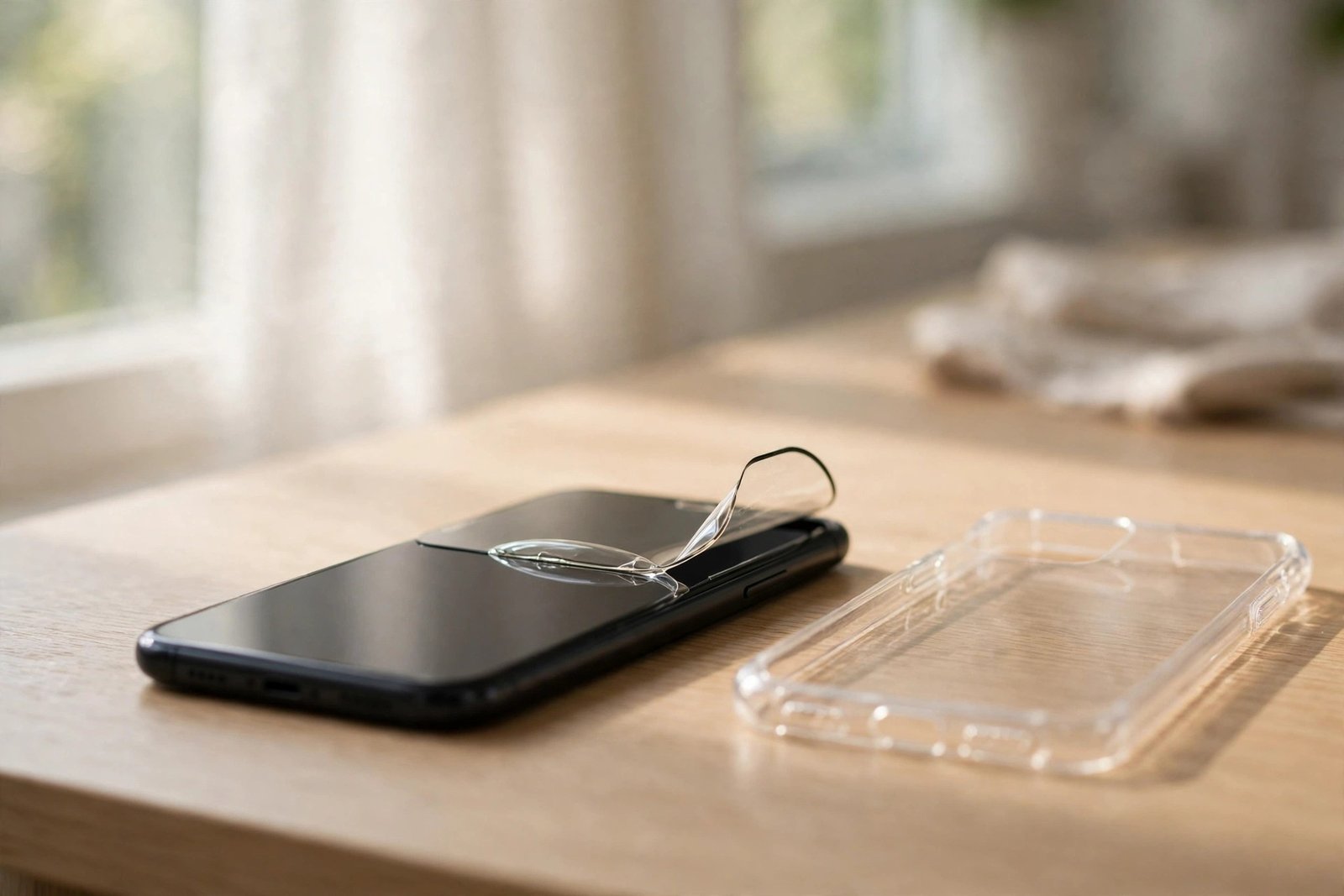
The single most common cause of returning bubbles is the case. Many cases wrap a raised lip around the front of the phone, and if that lip overlaps the edge of the protector, every squeeze of the handset — and every trip in and out of a pocket — levers the glass up a tiny amount. Fitters call it case lift, and it usually appears within days of fitting a new case, or straight after fitting a protector that is slightly too large for the case.
The telltale sign is location: the bubble hugs one edge or corner, often the corner where the case grips hardest. Test it properly before blaming the protector. Press the bubble out, take the case off, and use the phone case-free for twenty-four hours. If the bubble stays gone, you have your answer. The fixes are to choose a case-friendly protector that sits slightly inside the case lip, or a case with a lower front lip — pressing the edge down harder will never outlast a lip that lifts it daily.
Cause Two: Heat and Ageing Adhesive
Heat softens protector adhesive. A phone left on a sunny dashboard, warmed nightly by fast charging, or run hot by long gaming sessions goes through repeated cycles of the adhesive relaxing and the trapped air expanding. A pocket that was invisible when cool can swell into a visible bubble by afternoon, shrink overnight, and swell again the next day — a bubble that seems to come and go with the weather is almost always a heat bubble.
Age does something similar, more slowly. After a year or so of service the adhesive gradually loses tack, beginning wherever the glass flexes most: the corners and the rims of curved screens. The sign of age is pace — bubbles multiplying over weeks rather than appearing overnight, with edges that look faintly pale where the bond has thinned. No technique resticks tired adhesive for long; it is the protector telling you it has done its time.
- After pressing a bubble out, lay the phone face-down on a flat surface overnight — its own weight holds the seal closed while the adhesive re-sets.
- Slide a thin business card between the case lip and the screen. If it catches on the protector’s edge, the case is levering the glass.
Fix the Cause, Then Remove the Bubble
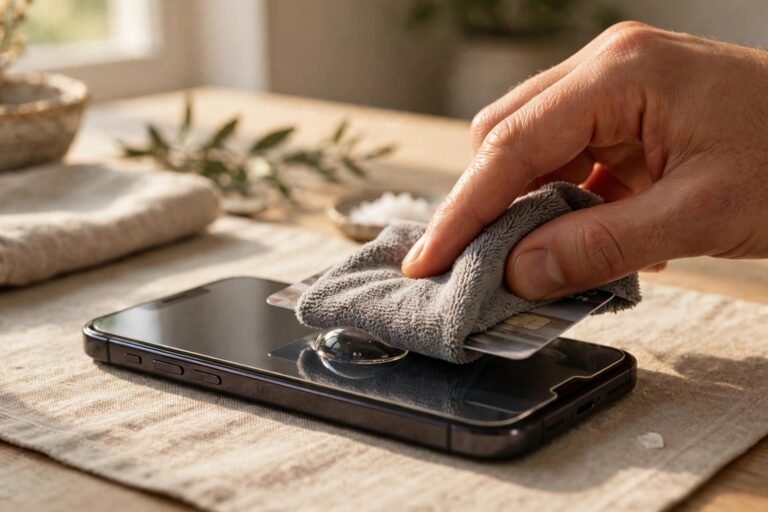
Order matters. Deal with the cause first — case off or changed, the phone out of the habit of baking on dashboards — and only then do the final removal. Wrap a bank card in a microfibre cloth, set it behind the bubble, and push in slow, short strokes towards the nearest edge. When the air escapes, hold firm pressure on that edge for ten seconds to close the seal behind it.
If the glass still will not seal with the cause removed — the edge springs back the moment you let go, or the pale halo refuses to close — the adhesive at that spot is spent. That is not a failure of technique, and more pressing will not change it. A fresh protector, fitted to suit the case this time, is the honest and inexpensive fix.
- Always work a bubble out towards the nearest edge, never across the screen — a long push just relocates the air.
- A bubble that returns within hours in the exact same spot means the glass is being lifted there mechanically — look for what touches that edge.
Frequently Asked Questions
Why does the same bubble keep coming back in the same place?
Because whatever is lifting the glass is doing it in the same place, every day. A case lip, a slightly raised patch of the screen frame, or a pocket of weakened adhesive reopens the moment you finish pressing. Your removal technique is fine — the condition causing the lift is what needs to change.
Can a bubble that appears after a week still disappear on its own?
Rarely. The self-settling that clears installation bubbles happens inside the first forty-eight hours, while the adhesive is still flowing. A bubble that arrives after a week means new air is getting in somewhere, and it will keep arriving until the entry point — usually a lifted edge — is found and sealed.
Is it worth replacing the protector if bubbles keep returning?
It depends on the cause. If a case is lifting the edge, a slightly smaller case-friendly protector solves it permanently and is money well spent. If the bubbles are age — several edges lifting, the halo spreading week by week — replacement is the right call too, because tired adhesive never recovers its grip.
A bubble that arrives late is a message, not bad luck. Read it, fix what is lifting the glass, and the next bubble you press out will be the last one.