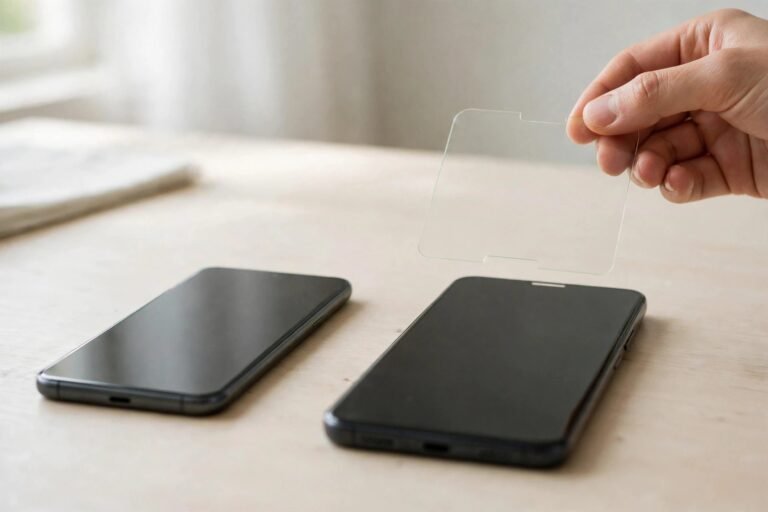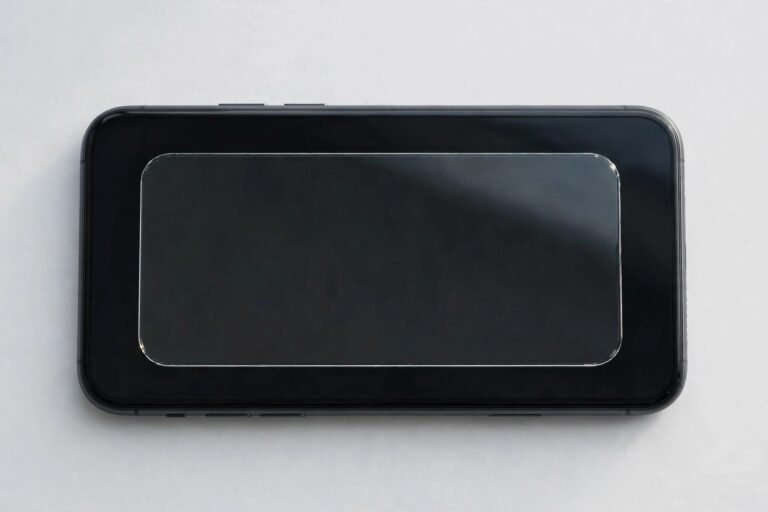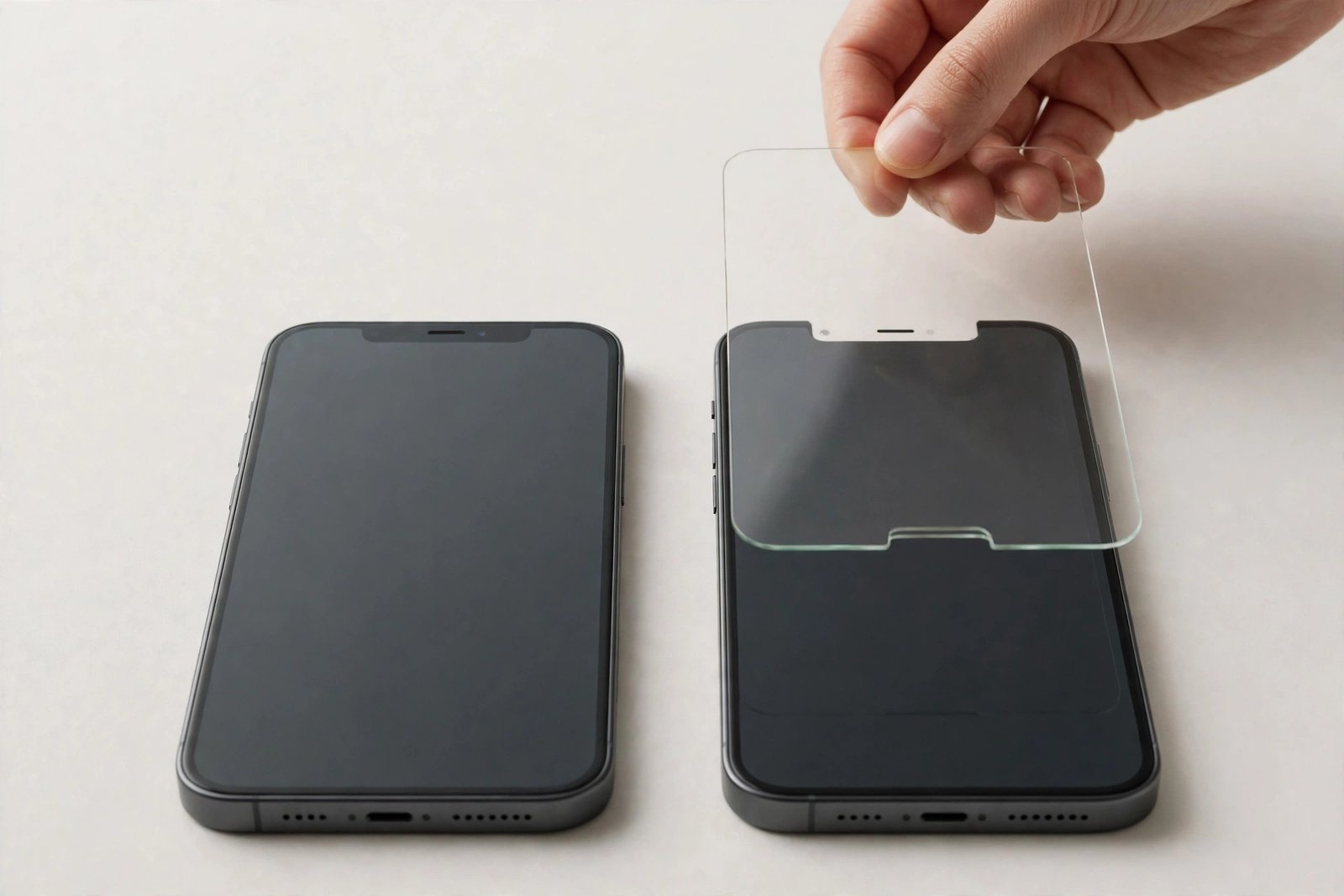
You have upgraded from an iPhone 13 to an iPhone 14 — or you are holding a spare iPhone 13 protector and wondering if it can go on the 14. The two phones look nearly identical, both have 6.1-inch displays, and the protectors in the shop are frustratingly similar in size. Surely they are interchangeable? Almost — but that “almost” lives exactly where it matters most: the notch.
This guide explains what actually differs between the iPhone 13 and 14 front glass, what happens if you fit a 13 protector to a 14, and why the sensible answer is a protector cut for the 14 — even though the 13’s will physically go on.
Key Takeaways
- Both phones have 6.1-inch displays, so an iPhone 13 protector is the right overall size for an iPhone 14 — it will physically fit.
- The catch is the notch and speaker slot: the 14’s earpiece and sensor layout sits slightly differently, so a 13 cutout can sit off-centre.
- A misaligned cutout can crowd the speaker slot and look visibly wrong, even if Face ID usually still works.
- Cases are not protectors: case compatibility between generations says nothing about glass fit, because cases grip the body, not the display surface.
- For a clean, centred fit, buy the iPhone 14 version — they cost the same and are cut to sub-millimetre accuracy for the 14’s layout.
Same Size, Different Details
On paper, the two phones are twins: 6.1-inch displays, flat-edged bodies, near-identical dimensions. Screen protectors, though, are not cut to “near-identical” — they are cut to fractions of a millimetre, and the details that differ between the 13 and 14 are precisely the ones a protector has to navigate: the notch outline, the earpiece speaker slot, and the placement of the front camera and sensors within it.
Apple subtly rearranged the top of the display between generations. The iPhone 14’s notch keeps the same general shape, but the speaker slot and sensor positions shifted slightly compared with the 13. A protector cut for the 13 has its cutout — or its printed border — positioned for the 13’s arrangement. Lay it on a 14 and everything is a fraction off: not dramatically, but visibly, if you look at the top edge with any care.
What Actually Goes Wrong
Fit a 13 protector to a 14 and three things can happen. First, the cutout may partially overlap the speaker slot, slightly muffling earpiece audio on calls — rarely a complete blockage, but the slot is small and the tolerance is fine. Second, if your protector has a printed black border frame (as many full-coverage designs do), that border can clip the very edge of the display area or sit unevenly around the notch, which looks sloppy every time you glance at the phone.
Third, and most likely, nothing catastrophic happens at all — which is exactly why this question is so common. Face ID generally still works, touch is unaffected, and the protector protects. You end up with a protector that is 90% right: protecting perfectly well, aligned imperfectly. Whether that bothers you depends on how often your eyes travel to the top of your screen. For many owners, it bothers them every single day.
- Before peeling the backing off a spare 13 protector, hold it over the 14’s screen unpeeled and sight down the notch. You can see immediately whether the cutout centres on the speaker and camera — a thirty-second dry check beats discovering the offset after the adhesive is down.
Why Case Compatibility Proves Nothing
A common argument goes: “my iPhone 13 case fits my 14 fine, so the protector must too.” The logic fails because cases and protectors interact with different surfaces. A case wraps the phone’s body — frame, buttons, back — and the 13 and 14 bodies are close enough that many cases do swap between them. A protector, by contrast, must align with features on the glass itself, where the generations genuinely differ.
There is a second trap here: a swapped-over case can also push against the protector’s edges. Case-friendly protectors leave a margin sized for their own generation’s cases. Stack a 13 protector under a snug case on a 14 and the tolerances that were comfortable separately can combine into edge lifting that neither would cause alone.
The Sensible Verdict
If a 13 protector is genuinely all you have — travelling, a cracked protector needing instant replacement, a spare in a drawer — fit it without guilt. It protects the glass, which is the primary job, and the imperfections are cosmetic. Treat it as a stopgap, and order the correct one at leisure.
But if you are buying anyway, there is no argument for the 13 version: iPhone 14 protectors cost exactly the same, are stocked everywhere, and are cut so the cutout centres perfectly on the 14’s speaker and sensors. Precision is the entire product. Buying the previous generation’s cut to save nothing is the one false economy in a market full of genuine bargains.
- Check listings carefully — some sellers advertise one protector as fitting “iPhone 13/14” jointly. Reputable brands’ joint listings are fine where the cut genuinely suits both, but a 14-specific listing from a known brand remains the safest purchase for a centred fit.
Frequently Asked Questions
Will Face ID still work with a 13 protector on a 14?
Usually, yes. The TrueDepth sensors are relatively tolerant, and a fractionally offset cutout rarely blocks them. The more common issues are cosmetic — a cutout that looks off-centre — and slight speaker muffling, rather than a Face ID failure.
Does this apply to the 13 Pro and 14 Pro too?
No — and there the answer is an outright no. The 14 Pro replaced the notch with the Dynamic Island, a completely different cutout. Nothing from the 13 Pro fits a 14 Pro. The near-fit described in this guide applies only to the standard 6.1-inch 13 and 14.
What about the other direction — a 14 protector on a 13?
The same near-fit logic applies in reverse: it will go on and protect, with the same slight cutout offset at the notch. Again, fine as a stopgap, but the generation-specific protector is always the better fit.
Nearly fitting is not fitting — the iPhone 13’s protector will guard an iPhone 14 in a pinch, but the 14’s own costs the same and lands perfectly. Buy the one cut for your phone.