Both phones have big 6.7-inch-class displays, both are called “Pro Max”, and their screen protectors look nearly identical in the packet. So it is tempting to assume an iPhone 11 Pro Max protector and a 12 Pro Max protector are interchangeable. They are not. The two phones belong to different design generations, and the small differences between them are exactly the ones a precision-cut sheet of glass cannot forgive.
This guide walks through the measurements and design changes that separate the two models — body dimensions, frame shape, and the layout around the earpiece and sensors — and explains why a near-fit is not good enough for tempered glass.
Key Takeaways
- The 11 Pro Max and 12 Pro Max are not the same size — the newer phone is taller and wider by small but crucial margins.
- The 11 Pro Max has a rounded frame; the 12 Pro Max switched to flat edges, changing how protectors sit and seal.
- The earpiece and sensor layout in the notch area differs between the two generations, so cutouts do not line up.
- A wrong-generation protector typically lifts at the edges, covers a sensor, or overhangs — it will not sit flat and sealed.
- Always buy the protector listed for your exact model; “Pro Max” alone is not a specification.
The Dimensions Are Close — but Not Equal
On paper the two phones look like twins. The iPhone 11 Pro Max measures roughly 158 × 77.8 mm with a 6.5-inch display, while the 12 Pro Max is around 160.8 × 78.1 mm with a 6.7-inch display. In other words, the 12 Pro Max is nearly three millimetres taller, a fraction wider, and carries a larger screen inside a redesigned front panel. To a tape measure that sounds trivial. To a screen protector — a rigid pane cut to within a fraction of a millimetre of the glass it must cover — it is an entirely different product.
Consider what those millimetres do in practice. A protector cut for the smaller 11 Pro Max leaves an exposed band of glass around a 12 Pro Max display, with edges that collect dust and catch on pockets. A protector cut for the larger 12 Pro Max overhangs the 11 Pro Max, and an overhanging glass edge cannot bond — it lifts, flexes, and eventually cracks or peels. Neither direction of swap produces a protector that sits flat and sealed, which is the entire point of fitting one.
Rounded Frame vs Flat Frame
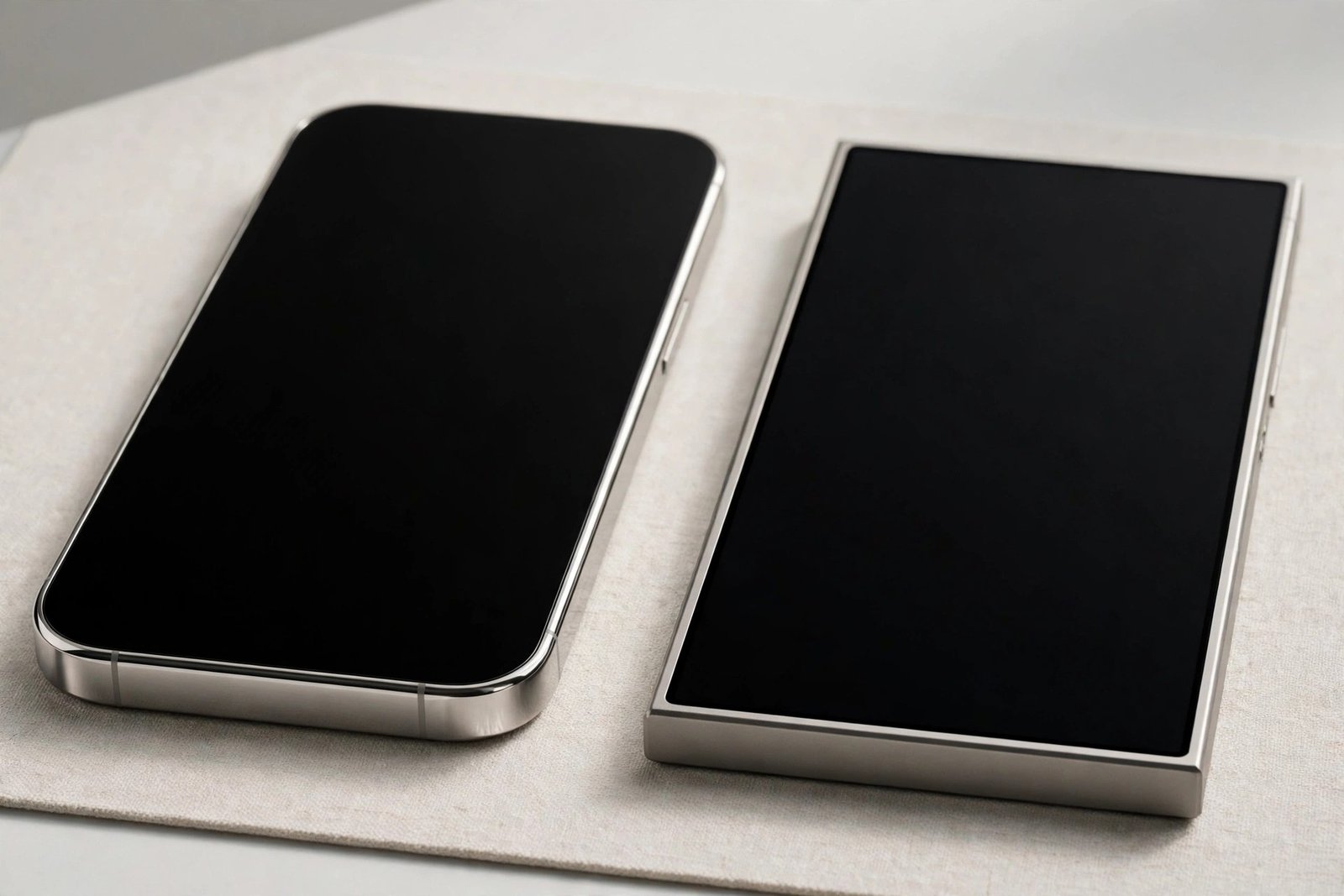
The generational change goes deeper than size. The 11 Pro Max belongs to the rounded-edge era: its stainless steel frame curves smoothly into the front glass, and the display surface itself rolls gently at the borders. Protectors for it are designed around that curve, typically stopping short of the edges so the glass stays bonded on the flat portion of the screen.
The 12 Pro Max introduced the flat-sided design that defined its generation — a squared-off frame and a front panel that stays flat much closer to its edges, protected by a tougher ceramic-infused glass. Its protectors are cut to suit that flatter, larger surface. Put a rounded-era protector on the flat phone, or vice versa, and the edge behaviour is wrong even where the outline nearly matches: gaps appear, the halo effect shows at the borders, and the adhesive perimeter never fully seals against dust.
- Check the packet for the exact model name, not just “Pro Max”. Listings that claim one protector fits both the 11 and 12 Pro Max are describing a compromise cut that fits neither properly.
- If you are unsure which phone you have, check Settings → General → About for the model name before ordering.
The Notch, Earpiece and Sensors Moved Too
Even if the outline were identical, the top of the screen would give the swap away. Between the two generations, the arrangement of the earpiece speaker, front camera and Face ID sensors within the notch was revised — most noticeably, the earpiece was repositioned higher in the 12-series design. Protectors are cut (or deliberately left uncut) around these features with the same sub-millimetre precision as the outline.
A protector from the wrong generation can therefore cover part of the earpiece slot, sit awkwardly across a sensor window, or leave an opening where none is needed. Covering the speaker muffles calls; misaligned cutouts look untidy and can interfere with the sensors and proximity detection that dim the screen against your cheek. These are not cosmetic quibbles — they are functional problems created by a sheet of glass that was simply made for a different phone.
What About Cases and Other Accessories?
The same logic applies beyond protectors. Because the body dimensions and frame shape changed, cases are not interchangeable either — a 12 Pro Max case will not grip an 11 Pro Max correctly, and the camera module on the back differs in size and layout as well. Camera lens protectors, likewise, are model-specific. The 11 Pro Max and 12 Pro Max are best treated as what they are: two different phones that happen to share a name and a similar screen class. When shopping for any fitted accessory, the model name on the box must match the model name in your settings, digit for digit.
- Selling or gifting your old phone? Do not pass its spare protectors on to someone with the other generation — hand over the phone, keep the glass out of the deal, and save them a frustrating install.
- Multi-packs are cheap insurance: buy a pack for your exact model so a cracked protector can be swapped in minutes rather than days.
Frequently Asked Questions
Can I trim a 12 Pro Max protector down to fit an 11 Pro Max?
No. Tempered glass cannot be trimmed at home — attempting to cut or grind it will shatter the pane or leave dangerously sharp, weakened edges. Film protectors can technically be cut, but the result is a rough, poorly sealed edge that lifts within days. A correct protector costs little; improvising one is a false economy.
The listing says “fits 6.7-inch iPhones” — is that enough?
No. Screen size in inches describes the display diagonal only, and several different iPhone generations share similar diagonals while having different body dimensions, frame shapes and sensor layouts. A trustworthy listing names the specific model. If it only quotes a screen size, look elsewhere.
Are the 12 Pro Max and 13 Pro Max protectors the same?
Also no — the same trap in a different pairing. The 13 Pro Max has a smaller notch with a repositioned earpiece, so its protectors differ around the top edge even though the body size barely changed. The rule is universal: every generation gets its own protector, however similar the phones appear.
Similar name, similar size, different phone. The 11 Pro Max and 12 Pro Max protectors are close enough to confuse and different enough to fail — buy for the exact model and the glass will sit perfectly first time.