It looks like a simple sheet of glass or plastic, but a modern screen protector is a small feat of materials engineering. So what is a screen protector made of? The answer depends on the type — tempered glass, PET film, TPU film, and ceramic hybrids each use completely different materials, layered with adhesives and coatings you never see.
Understanding the materials helps you choose wisely: hardness isn’t everything, flexibility matters on curved screens, and some marketing claims deserve scepticism. Here’s a plain-English breakdown of what each protector type is actually made of.
Key Takeaways
- Tempered glass is real glass, heat-strengthened to four or five times normal strength.
- PET is a thin polyester plastic — light and cheap, good for scratch protection only.
- TPU is a flexible, self-healing polyurethane ideal for curved screens.
- “Ceramic” protectors aren’t fired clay — they’re flexible plastic-ceramic hybrids that won’t shatter.
- Every protector also has an adhesive layer (usually silicone) and often an oil-repelling coating.
- Harder isn’t always better — flexibility beats hardness on curved displays.
Tempered Glass: Real Glass, Superheated
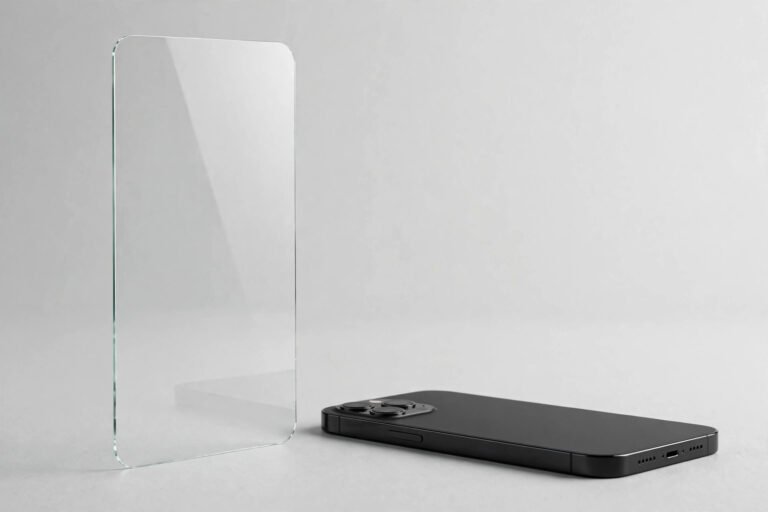
Tempered glass protectors start life as aluminosilicate glass — the same family as the glass in your phone’s actual display, typically around 0.3mm thick. It’s heated to over 600°C and then rapidly cooled. This thermal shock treatment puts the outer surfaces into compression while the interior stays in tension, which is what makes tempered glass roughly four to five times stronger than ordinary glass of the same thickness.
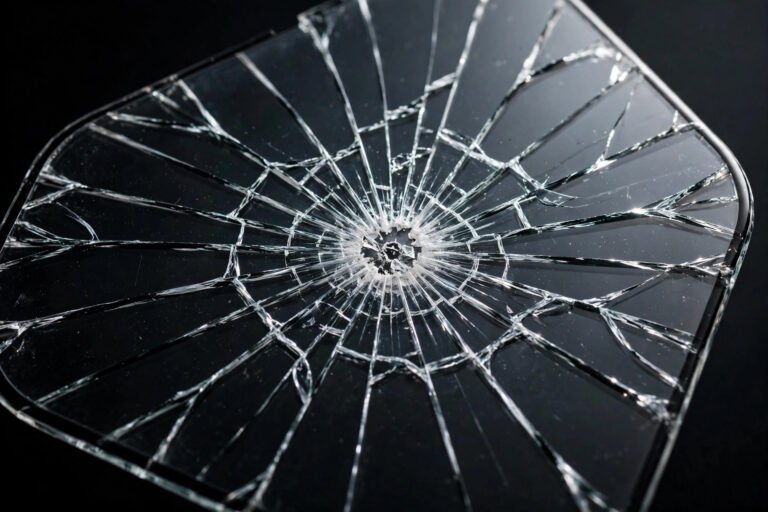
That compression layer is also why tempered glass behaves the way it does on impact: instead of cracking into dangerous shards, the stored energy makes it crumble into small, relatively blunt granules. A shattered tempered protector has done its job — it absorbed the impact that would otherwise have reached your display.
You’ll see “9H hardness” on nearly every listing. That’s a pencil-hardness rating — the protector resists scratching by a 9H pencil — not a position on the Mohs mineral scale. It’s a meaningful scratch-resistance claim, but it doesn’t mean the glass is anywhere near as hard as sapphire, whatever the marketing implies.
PET Film: The Original Plastic
PET (polyethylene terephthalate) is a polyester plastic from the same family as drinks bottles and food packaging. For screen protectors, it’s biaxially oriented — stretched in two directions during manufacture — which aligns the polymer chains and gives the film its clarity, dimensional stability, and tear resistance despite being a fraction of a millimetre thick.
PET was the original screen protector material, and it still has a place: it’s thin, light, cheap, and optically clear. Its job is scratch protection — keys, coins, and grit won’t get through it. What it can’t do is absorb impact; a hard drop transmits straight through PET to the screen beneath. Think of it as a scratch guard, not armour.
TPU Film: Flexible and Self-Healing
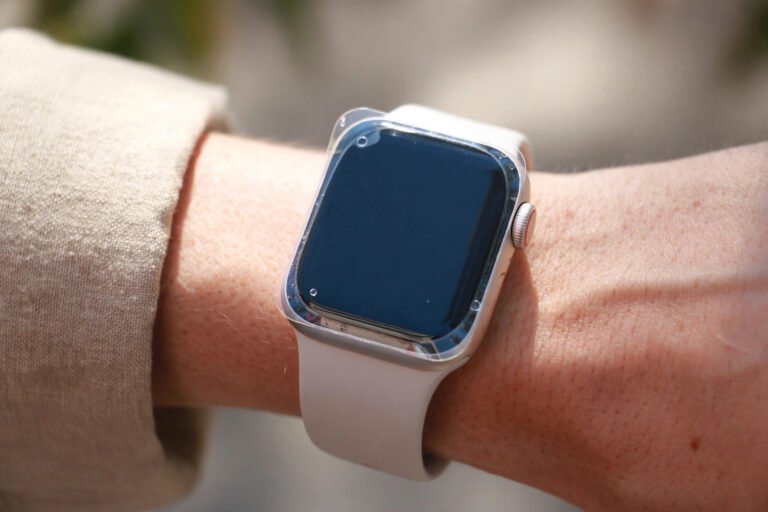
TPU (thermoplastic polyurethane) is an elastomer — a rubber-like polymer that stretches and returns to shape. That flexibility is why TPU dominates protectors for curved-edge screens, where rigid glass can’t follow the contours. It wraps around curves that would leave glass bridging with ugly air gaps.
TPU’s party trick is self-healing. The polymer chains are mobile enough that minor scratches and scuffs gradually re-bond — warmth accelerates it, which is why small marks fade after a day in your pocket. It’s genuine materials science, not marketing: the same principle is used in self-healing car paint protection films.
The trade-off is softness. TPU scratches more easily than glass in the first place (it just heals), and it offers minimal impact absorption. It’s also slightly less crystal-clear than glass, with a faint orange-peel texture visible if you look for it.
- If a listing claims both “9H hardness” and “flexible film” in the same breath, treat the 9H claim with scepticism — genuinely flexible films don’t test at 9H pencil hardness.
- “Military-grade” and “nanoscale” in protector listings are marketing terms, not material standards — focus on the actual material named (glass, PET, TPU, ceramic hybrid).
Ceramic and Hybrid Protectors: Not What They Sound Like
“Ceramic” screen protectors contain no fired clay. They’re flexible hybrids — typically PET or TPU bases infused with ceramic nanoparticles — engineered to combine plastic’s shatterproof flexibility with a harder, more scratch-resistant surface than plain film. The ceramic particles reinforce the polymer matrix much like gravel reinforces concrete.
The appeal is straightforward: they can’t shatter the way tempered glass can, they install without the alignment anxiety of rigid glass, and they survive drops that would crack a glass protector. The compromise is surface hardness — they scratch more easily than true tempered glass — and some users notice a slightly softer, less premium feel under the fingertip.
The Hidden Layers: Adhesive and Coatings
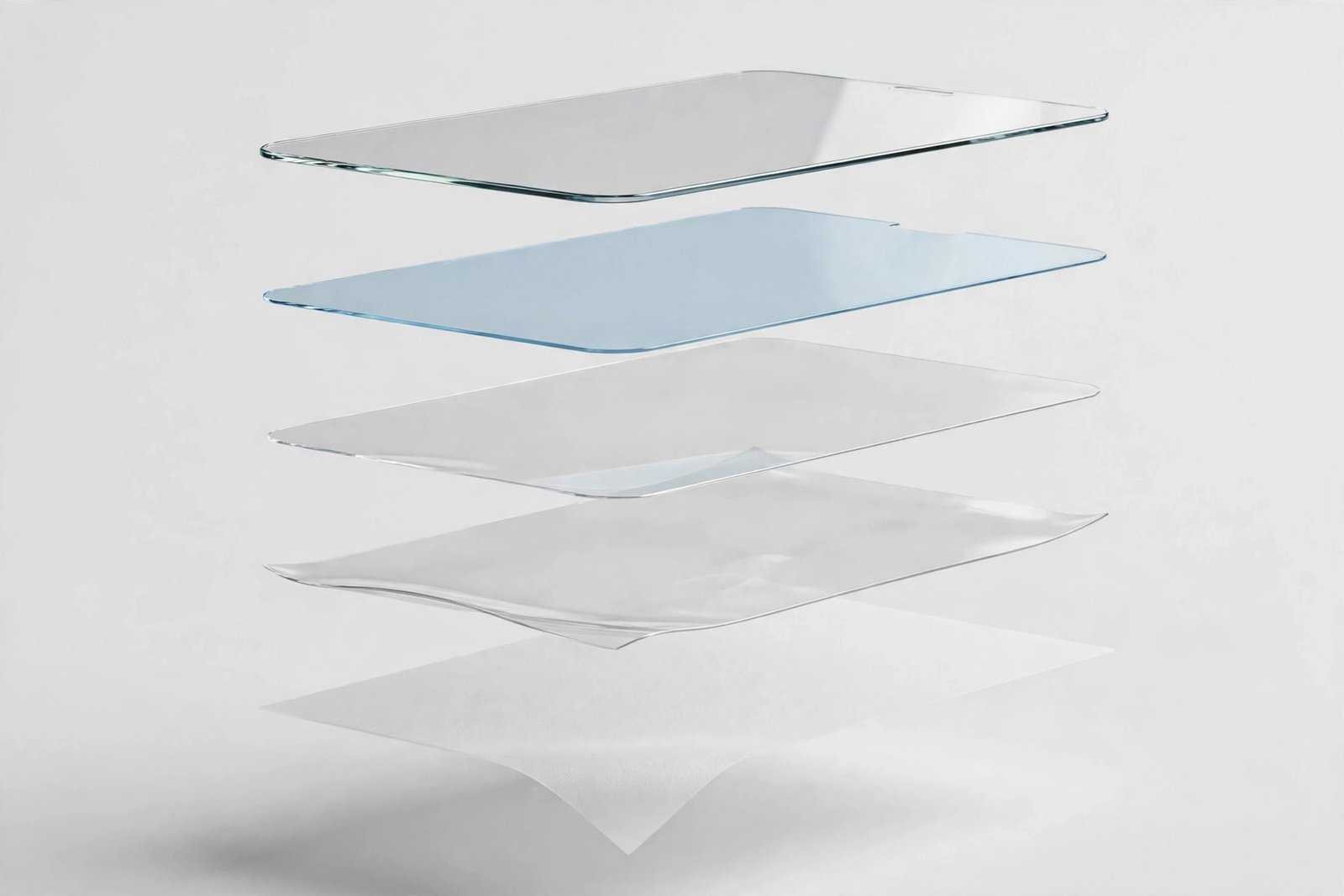
Beneath the headline material sit layers you never see but always feel. The adhesive on most protectors is a silicone pressure-sensitive layer — it bonds on contact without heat or curing, which is why installation is just “peel and stick.” Higher-end installations (like UV-cured protectors) use liquid optically clear adhesive instead, which flows into microscopic gaps before hardening under UV light.
On top, most quality protectors carry an oleophobic (oil-repelling) coating — a fluoropolymer layer nanometres thick that makes fingerprints wipe off easily and gives that silky new-glass glide. It wears off gradually with use, typically over several months, which is why an old protector feels grippier than a new one. Matte “anti-glare” protectors add one more treatment: a microscopically etched or textured surface that scatters reflections.
Which Material Suits You?
Match the material to your priority. Maximum drop protection: tempered glass, no contest. Curved-edge screen: TPU film, which is the only type that follows the curve. Budget or kids’ devices: PET film — cheap scratch defence you can replace often. Hate shattered protectors: a ceramic hybrid gives you flexibility that can’t crack. And if your screen has an under-display fingerprint sensor, check sensor compatibility first — thick glass can interfere, while thin films and UV-cured options are usually safest.
Frequently Asked Questions
Is tempered glass actually glass?
Yes — genuine aluminosilicate glass, thermally strengthened. It’s not plastic made to look like glass. That’s why it feels identical to your phone’s naked screen and why it shatters into blunt granules rather than bending.
What does 9H really mean?
It’s the top of the pencil-hardness scale used in coatings testing — the surface resists scratching by the hardest standard pencil. It’s a real scratch-resistance benchmark, but it says nothing about impact strength or where the material sits on the Mohs mineral scale.
Are “ceramic” protectors really ceramic?
Not in the pottery sense. They’re polymer films reinforced with ceramic nanoparticles — flexible, shatterproof hybrids. Genuine ceramic would be rigid and brittle, the opposite of what these products promise.
Why does the smooth coating wear off?
The oleophobic layer is only nanometres thick and every swipe abrades it microscopically. After a few months of normal use it thins out, fingerprints stick more stubbornly, and the glide feels rougher. It’s normal wear — and a fair signal that the protector is due for replacement.
Strip away the marketing and it’s refreshingly simple: hardened glass, clever plastics, a thin adhesive, and a coating measured in atoms.