

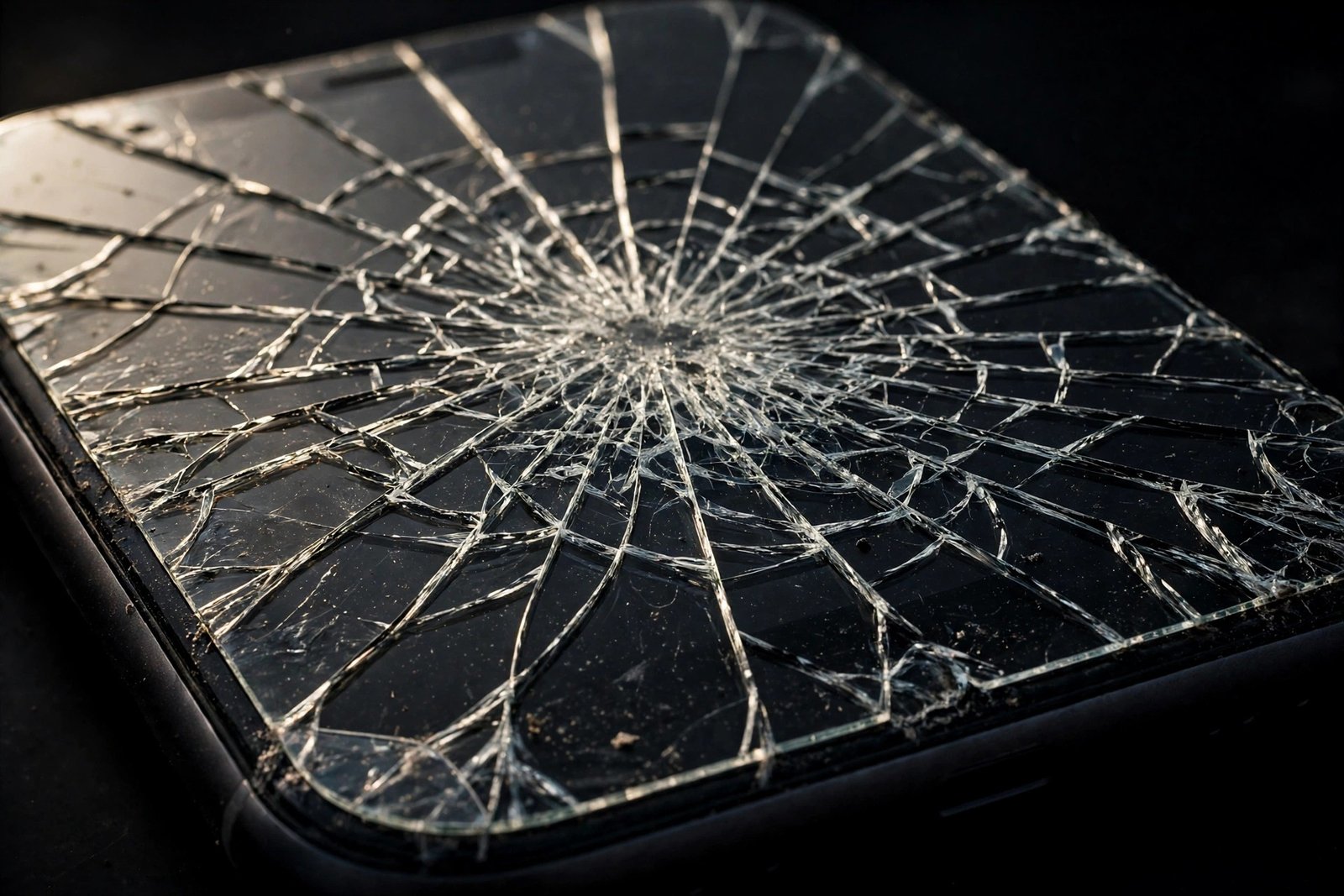
Few things make your stomach drop like picking up your phone after a fall and seeing a crack zigzagging across the screen. But before you assume the worst, look more closely: very often it is only the screen protector that has cracked, and the display underneath is completely untouched. That is not luck — it is exactly what the protector is designed to do.
Tempered glass protectors are sacrificial. They are engineered to fracture so that your phone’s screen does not have to. This guide explains how that cracking actually works, why it spreads across the glass in the patterns it does, and how to tell a cracked protector from a cracked screen.
Key Takeaways
- Yes, screen protectors crack — by design. A tempered glass protector breaks so the phone’s screen underneath does not.
- The glass is heat-treated (tempered) so that on impact it absorbs and spreads the energy, fracturing safely across its surface.
- A spiderweb pattern usually means the protector took a hard, localised hit — and did its job well.
- Plastic film protectors do not crack; they dent, crease or tear instead, and absorb far less impact.
- A cracked protector should be replaced promptly: its strength is spent, and loose fragments can scratch the screen or nick a fingertip.
Yes — Cracking Is the Protector Doing Its Job
A screen protector sits in the firing line on purpose. When your phone lands face-down or takes a knock on a corner, the energy of that impact has to go somewhere. A tempered glass protector is deliberately the weaker, cheaper, replaceable layer in the stack — so it gives way first, consuming the energy in the act of breaking, and the force left over for the real screen is a fraction of what it would otherwise have been.
Think of it like a crumple zone in a car. The crumpled bonnet looks like damage, but it is damage that happened instead of worse damage further in. A cracked protector, in the same way, is usually evidence of a rescue, not a failure. The protector you peel off and bin has quite possibly just saved you a screen repair costing many times its price.
How Tempered Glass Absorbs an Impact
Tempering is a heat treatment: the glass is heated and then cooled rapidly, which locks the outer surfaces into compression while the inner layer stays in tension. That internal stress is what makes tempered glass several times stronger than ordinary glass — and it also dictates how it breaks. When a sharp impact overcomes the compressed surface, the stored energy releases all at once and the sheet fractures through its whole thickness rather than splitting into a few long, dangerous shards.
Two supporting features complete the system. The adhesive layer beneath the glass bonds it to the screen, holding the fragments in place after a break and spreading the load of an impact across a wider area. And because the protector is slightly softer than the phone’s own display glass, it tends to lose the argument first — cracking itself while the harder screen below survives.
- Not sure whether the crack is in the protector or the screen? Run a fingernail lightly across it — a cracked protector’s lines can be felt on the surface, and if the crack stops dead at the protector’s edge, the screen is fine.
- Check the corners: protector cracks usually start from an edge or a chip. A crack that continues past the protector’s border onto the exposed screen is the worrying kind.
Spiderweb Cracks vs a Single Clean Line
The pattern tells you the story of the impact. A spiderweb — a dense burst of cracks radiating from one point — means something struck that spot directly: a stone on the pavement, the corner of a table. The protector fractured in every direction at once, spreading the energy sideways through itself instead of downwards into your screen. Dramatic as it looks, a spiderweb is often the sign of a protector that performed brilliantly.
A single clean line, by contrast, usually comes from flexing rather than a direct hit — the phone bending slightly in a pocket or bag, or a tiny edge chip quietly propagating across the sheet under everyday pressure. These hairline cracks sometimes appear hours after the event that caused them, which is why a protector can seem to “crack on its own” overnight.
When to Replace a Cracked Protector
Replace it soon. A cracked protector has already spent the strength that made it protective — the fractured sheet can no longer absorb a second impact properly — and its sharp fragment edges sit millimetres from the screen it was guarding. Every day it stays on, grit can work into the cracks and the loose glass can micro-scratch the display beneath, quite apart from the risk of a nicked fingertip.
Removal is simple and safe if you do it properly: cover the cracked surface with tape so the fragments lift away as one sheet, peel slowly from a corner, and check the bare screen under a bright light before fitting the replacement. If the screen underneath is unmarked — as it usually is — your protector has done everything it was bought to do.
- Photograph the cracked protector before you remove it. If the phone is insured or under a protection plan, that photo is useful evidence of what happened.
- Buy protectors in multi-packs: the second one in the drawer means a cracked protector gets replaced the same day, not “eventually”.
Frequently Asked Questions
If my protector cracked, is my screen definitely fine?
Usually, yes — but “usually” is not “always”, so check. Peel the protector off (with tape over the cracks) and inspect the bare screen under a bright light, running a fingertip over the area. If the glass is smooth and the display underneath shows no lines or dark patches, the protector took the full hit.
Can a screen protector crack without being dropped?
Yes. A small chip on the protector’s edge — from a case that’s slightly too tight, or a knock against keys — can grow into a full crack days later under ordinary flexing and temperature changes. Nothing has gone wrong with the protector; that is simply how fractures in tempered glass propagate.
Do plastic film protectors crack too?
No. Film is flexible plastic, so it cannot fracture — it dents, creases, stretches or tears instead. That flexibility is comfortable, but it also means a film protector absorbs far less impact energy than glass, which is why glass is the better choice if drops are your main worry.
A cracked screen protector is not a broken phone — it is a small, cheap layer that volunteered. Peel it off, check the screen it saved, and fit the next one.


