You applied a liquid glass screen protector a while ago — the kind you wipe on from a little vial and let cure — and now you want it gone. So you sit down with a fingernail at the corner of your screen, looking for an edge to lift. There is not one. There never was. And that is the first thing to understand about liquid glass: there is nothing to peel.
Liquid screen protectors are not sheets of anything. They are nano-scale coatings that bond invisibly to your display glass, and removing one is a completely different problem from removing tempered glass or film. This guide explains what is actually on your screen, how it leaves, and how to tell when it has gone.
Key Takeaways
- Liquid glass cannot be peeled off — it is a bonded nano coating, not a physical sheet with an edge.
- The coating wears away naturally over months of use, through friction, cleaning, and everyday contact.
- There is no reliable instant removal method: buffing and polishing claims are mostly marketing, and aggressive methods risk your display’s own coating.
- Signs it has worn off include water no longer beading and fingerprints sticking like they did before application.
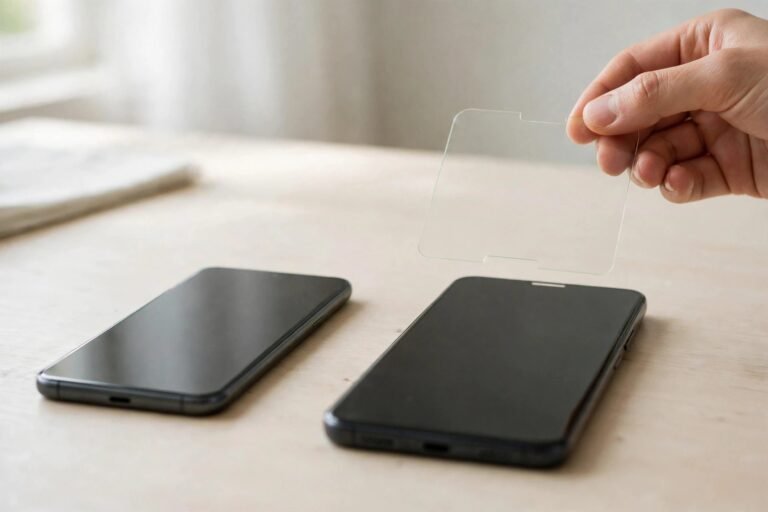
- You can fit a normal glass or film protector over the top at any time — you do not need the liquid layer gone first.
What Is Actually on Your Screen
A liquid glass product is typically a silicon-dioxide solution in a carrier liquid. You wipe it across the display, the carrier evaporates, and the silica bonds to the glass at a microscopic level, filling in the pores and tiny imperfections of the surface. The resulting layer is measured in nanometres — hundreds of times thinner than a human hair, and utterly invisible. It does not sit on your screen the way a sheet of glass does; it is better thought of as a treatment of the surface.
This is why every instinct from removing normal protectors fails here. There is no edge, no adhesive layer, no thickness your nail can find. Any guide promising to show you how to “peel off” liquid glass is describing a product that does not exist. The coating and your screen’s outer surface are, for practical purposes, one thing.
How It Actually Comes Off: Time and Wear
The honest removal method is waiting. The nano coating is not permanent; it erodes gradually through the same forces your screen faces daily — friction from fingers and pockets, microfibre cleaning, contact with surfaces. Most liquid glass products are rated by their own makers for a lifespan of several months up to around a year or two, and they fade progressively rather than failing all at once. The centre of the screen, where your thumbs live, wears fastest; the corners hold on longest.
Normal life accelerates the process: frequent cleaning with alcohol-based wipes, abrasive cases or mounts, and heavy daily use all strip the coating faster. Deliberately, the only “technique” that genuinely hastens wear is the ordinary one — use the phone, clean the phone, and let physics do the work. Within months, the treatment is functionally gone whether you hurry it or not.
- If you want the coating gone because you are about to fit a normal protector, do not wait at all — just fit the protector. A tempered glass or film protector adheres perfectly well over a liquid-treated screen.
The Buffing and Polishing Myth
Search online and you will find suggestions to buff the coating off with various compounds, pastes, or aggressive polishing. Treat these with real scepticism. Anything abrasive enough to strip a bonded silica layer quickly is also abrasive enough to damage the oleophobic coating your display came with — and potentially micro-scratch the glass itself. You would be trading an invisible, harmless, self-removing layer for permanent damage to the surface underneath it.
Gentle methods are safe but ineffective in any dramatic sense: washing with warm soapy water, wiping with isopropyl alcohol, or cleaning with a microfibre cloth will remove surface residue — oils, grime, and any uncured excess — and will hasten the coating’s natural wear slightly. They will not strip a cured nano coating in an afternoon, and they do not need to. The coating is doing your screen no harm while it lasts.
How to Tell When It Has Worn Off
Because the coating is invisible both on and off, you judge by behaviour, not appearance. The most reliable test is the water droplet check: a fresh liquid glass treatment makes water bead up tightly, much like a new oleophobic coating. As the layer wears, droplets flatten and spread. The fingertip test tells the same story — when fingerprints start clinging and smearing the way they did before you applied the treatment, and the screen loses that freshly-treated slickness, the coating is largely spent.
Do not expect a single dramatic day when it is “off.” Wear is a gradient: protection fades from the high-contact areas outward over weeks. If knowing matters — because you plan to reapply, for instance — most makers suggest simply treating the screen again on their recommended schedule, since reapplying over a partially worn layer is harmless.
- Keep a mental note of the application date when you apply liquid glass. Six months later, assume the high-wear centre of the screen is mostly untreated — your droplet test will usually confirm it.
Frequently Asked Questions
Can I remove liquid glass with alcohol or removers?
Alcohol wipes remove oils and surface residue and slightly hasten natural wear, but they do not strip a cured nano coating on contact. There is no household solvent that cleanly dissolves the bonded layer — and stronger chemicals endanger your display.
Do I need to remove liquid glass before fitting tempered glass?
No. Standard protectors adhere normally over a liquid-treated screen; the coating is far too thin to interfere with adhesive bonding. Clean the screen thoroughly as usual, then fit the protector exactly as you normally would.
Will liquid glass damage my screen if I leave it?
No. A cured liquid glass layer is chemically inert against display glass and simply wears away over time. Leaving it indefinitely is safe — the only downside is believing you still have protection long after it has faded.
You cannot take off what was never really on. Liquid glass leaves the way it lived — invisibly, gradually, and entirely on its own schedule.