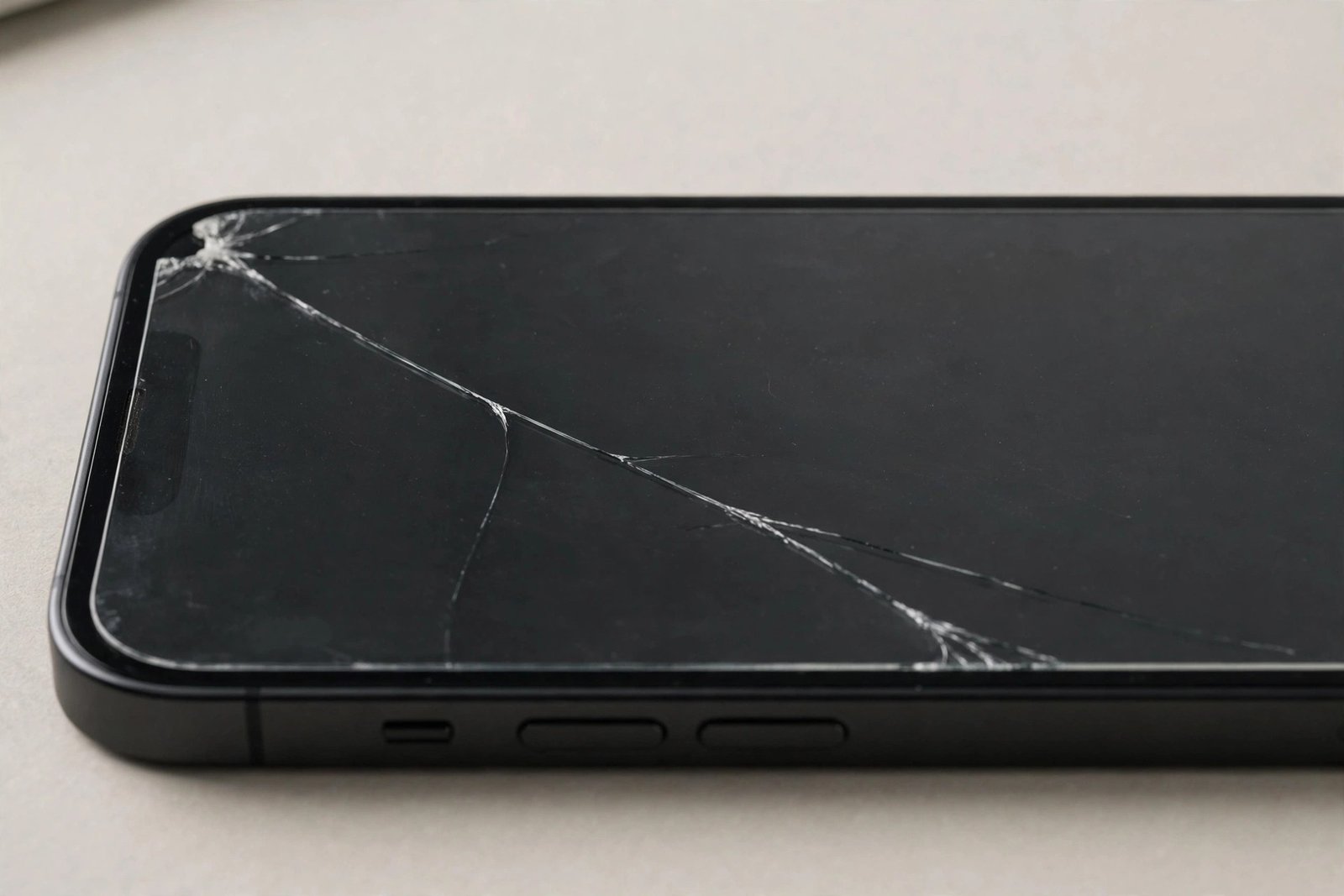
You pick up your phone and there it is: a crack across the screen protector that definitely was not there yesterday. No drop. No knock. No dramatic moment you can point to. The phone sat on your desk, rode in your pocket, and somehow the glass gave up. Cracked “for no reason” is one of the most common screen protector mysteries — and it almost always has a reason.
Glass rarely fails spontaneously. What feels like a crack from nowhere is usually the final step of a process that started days or weeks earlier: a tiny edge chip, a stressed corner, a cold night followed by a warm room. This guide explains the hidden causes so you can stop the next one happening.
Key Takeaways
- Protectors almost never crack truly spontaneously — the cause is usually accumulated micro-damage reaching a tipping point.
- Edge chips are the number one culprit: a tiny nick concentrates stress until a full crack propagates from it.
- A tight case can apply constant corner pressure that eventually exceeds the glass’s tolerance.
- Temperature swings — a freezing car, then a warm pocket — make glass expand and contract, exploiting any weak point.
- Occasionally the protector itself is at fault: manufacturing flaws in cheap glass create invisible stress points from day one.
The Edge Chip That Finally Let Go
Trace most mystery cracks back to their starting point and you will find a tiny chip on the protector’s edge — a flake a millimetre across, earned weeks ago from a set-down on a gritty surface, a slide across a desk, or a brush against keys. At the time it meant nothing. But a chip is a stress concentrator: every flex of the phone, every press of your thumb, focuses force at that notch instead of spreading it across the sheet.
Glass fails the way ice does — from a flaw, outward. The crack may creep invisibly for days as a hairline inside the chip, then run the full width of the protector in an instant when some ordinary moment — picking the phone up by one corner, pressing it into a tight pocket — applies the final load. The “cause” looks like nothing because the decisive damage happened long before.
Case Pressure and Pocket Pressure
Your case is supposed to protect the protector, but a snug case with stiff lips can press continuously on the protector’s corners and edges — exactly where the glass is least able to tolerate load. The pressure is small but constant, and it spikes whenever the case flexes: sitting down with the phone in a back pocket, the phone twisting slightly in a bag. Protectors have cracked overnight in cases that were slowly squeezing one corner past its limit.
Pockets add their own mechanics. A phone in a tight jeans pocket is bent and compressed with every step and every sit. Add a coin, a key, or the hard edge of a card wallet sharing the pocket, and you have a point load pressing through the display against a flexing sheet of thin glass. The crack that appears afterwards gets blamed on the sofa, the desk, the air — but the pocket did it.
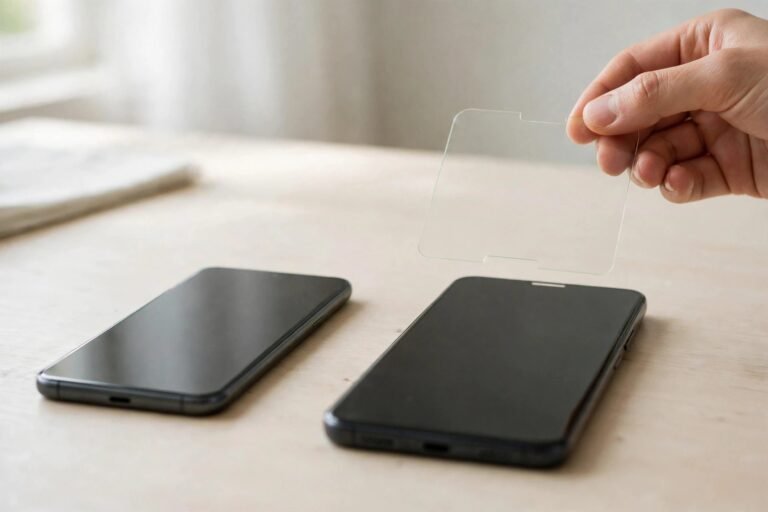
- Run a fingertip around your protector’s edges once a week. The moment you feel a chip or a rough spot, replace the protector — a chipped one is living on borrowed time, and a timely swap is far cheaper than the surprise crack during your busiest week.
Temperature Swings and Micro-Damage
Glass expands when warm and contracts when cold, and it does not do so evenly when part of it is bonded to a phone that is changing temperature at a different rate. A phone left in a freezing car overnight, then brought into a heated house and charged — charging warms the battery and the display stack — experiences real thermal stress. Sound glass shrugs this off; glass with a micro-flaw may not. The flaw decides where the stress goes, and the crack is the result.
Underneath all of this sits micro-damage accumulation. Every minor knock, every set-down slightly too hard, every grain of sand ground between protector and table leaves microscopic damage in the glass surface. Individually, nothing. Collectively, they lower the threshold until a load the protector would once have laughed at becomes the load that breaks it. This is why older protectors crack “easier” than new ones — they are, measurably, weaker than they were.
When It Really Is the Protector’s Fault
Sometimes the mystery crack is a manufacturing story. Cheap glass — and occasionally a bad batch from a decent brand — can carry internal stress from the cutting and tempering process, or edges that were finished roughly and left microscopically jagged. Such a protector is pre-loaded with its own failure points and can crack under loads that a sound protector handles trivially, sometimes within days of fitting.
The tell-tale signs: the crack appears very soon after installation, starts from an edge that has never been knocked, or appears in a protector on a phone that lives a genuinely gentle life. If a replacement from the same box cracks the same way, you have your answer — the batch is bad, and switching brands is the fix. Most reputable sellers will refund a protector that fails in its first days.
- When a protector cracks mysteriously, photograph where the crack starts before removing it. The origin point tells the story — edge chip, corner under case pressure, or mid-glass flaw — and that diagnosis is what stops the replacement dying the same death.
Frequently Asked Questions
Can a screen protector crack while the phone just sits there?
It can appear to. The final propagation often happens under a tiny load — a temperature shift, the phone settling, residual case pressure — rather than an impact. The real damage was almost certainly done earlier; the sitting still is just when the crack finished its journey.
Does a mystery crack mean my phone screen is damaged too?
Very unlikely. The protector is the sacrificial layer and absorbs the failure exactly as designed. Peel it off and check: if the display beneath is unmarked and touch works everywhere, the phone is fine. The protector did its job — quietly, and a little earlier than expected.
How can I stop it happening again?
Inspect edges weekly and replace at the first chip; avoid cases that visibly squeeze the protector’s corners; keep the phone out of back pockets and away from keys; and buy protectors from brands with finished, polished edges. You cannot eliminate micro-damage, but you can stop it accumulating into a surprise.
Glass keeps a diary of every knock it ever took — the “crack for no reason” is simply the day the last page filled up. Read the edges, respect the chips, and the next one will be no mystery at all.