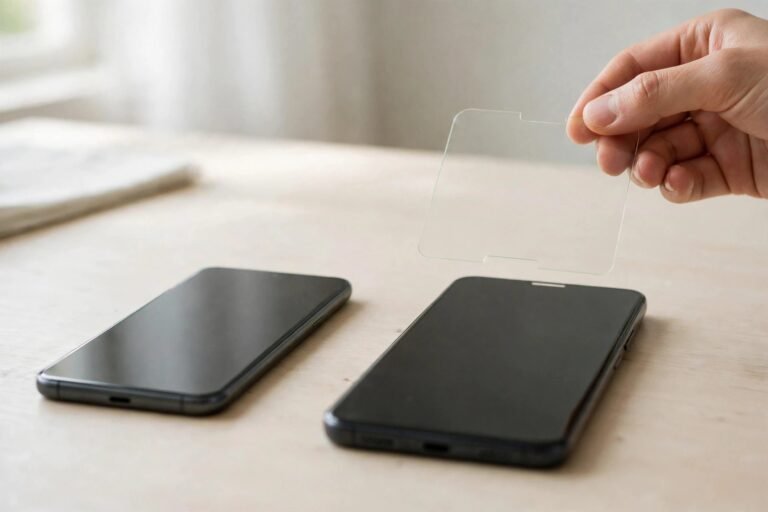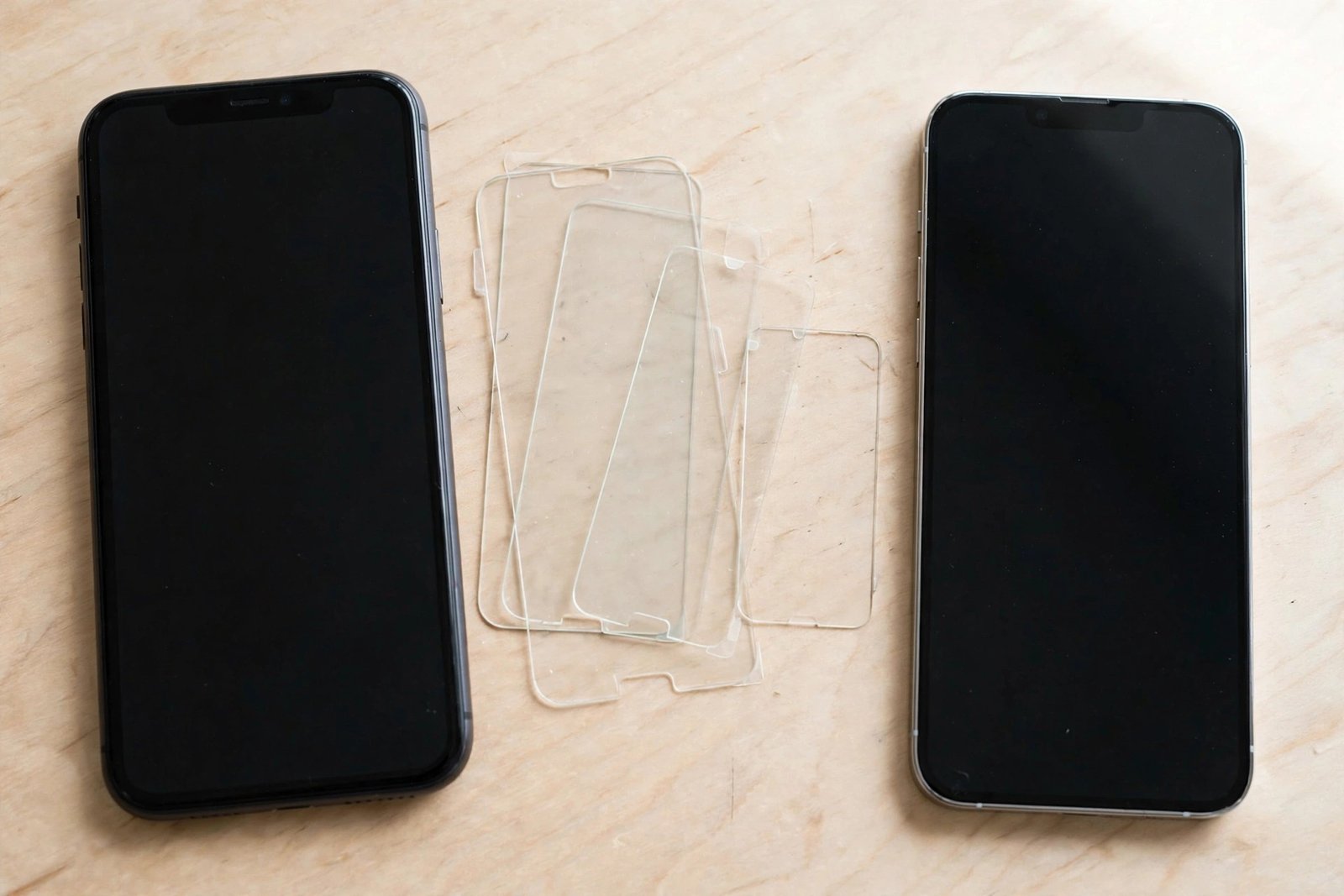
Here’s a pairing that catches people out precisely because it sounds like it should work: the iPhone 11 and the iPhone 13 both have 6.1-inch displays. Surely their screen protectors are interchangeable? They are not. Screens are measured corner to corner, but protectors are cut to the phone’s body — and the iPhone 13’s body is noticeably smaller than the iPhone 11’s.
If you’ve got a spare iPhone 11 protector and a new-to-you iPhone 13, this guide explains why the swap fails, what happens if you force it, and which protectors genuinely do fit the iPhone 13 — because it belongs to a completely different body family from the 11.
Key Takeaways
- Both phones have 6.1-inch displays, but the iPhone 11’s body is about 150.9 × 75.7 mm while the iPhone 13’s is about 146.7 × 71.5 mm.
- An iPhone 11 protector is roughly 4 mm taller and 4 mm wider than the 13’s screen — it overhangs everywhere and won’t seal.
- The iPhone 13 belongs to the 12 / 13 / 14 body family; the iPhone 11 belongs with the XR. The two families never cross-fit.
- The 13’s notch is smaller and its speaker slot sits differently, so cut-outs misalign even before size is considered.
- Protectors listed for the iPhone 12 and 13 are the correct, interchangeable fit for a 13.
Same Screen Size, Different Phone
The confusion starts with how Apple shrank the phone around the screen. The iPhone 11 uses an LCD display with relatively thick borders, so a 6.1-inch panel required a body about 150.9 mm tall and 75.7 mm wide. The iPhone 13 uses an OLED display with much slimmer borders, fitting the same 6.1-inch diagonal into a body of about 146.7 by 71.5 mm — a phone that is smaller in the hand in every direction. A screen protector follows the body and the display’s active area, not the diagonal printed on the box, so the 11’s protector is simply a bigger sheet of glass than the 13 can accept.
Even the details on the face disagree. Apple reduced the notch on the iPhone 13, making it narrower than the 11’s, and repositioned the earpiece speaker to the top edge of the frame. A protector cut for the 11 therefore puts its notch window and speaker cut-out in places that don’t correspond to anything on the 13 — you’d see the mismatch the moment you held the two together, before adhesion even enters the question.
What Goes Wrong If You Try It
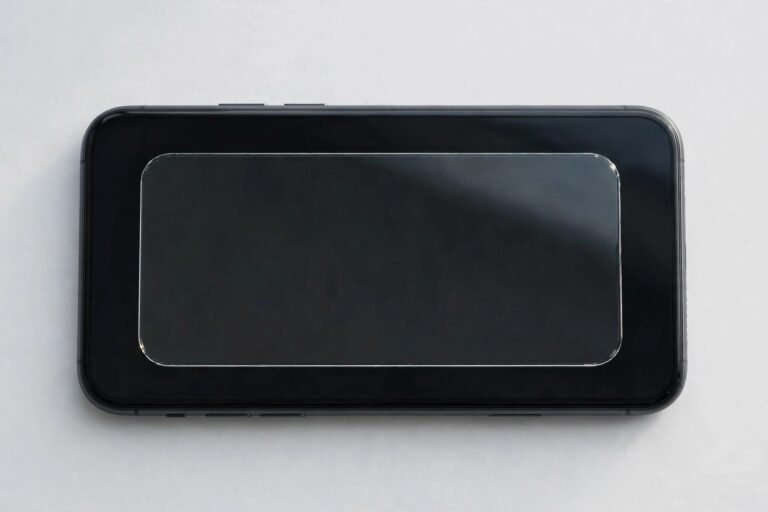
An iPhone 11 tempered glass protector laid on a 13 overhangs the flat part of the screen on all sides. Because the 13’s glass curves down at its edges, the overhanging rim of the protector has nothing to bond to: you get the familiar white-edged halo effect, dust creeping under the borders, and corners that lift the first time a case is snapped on — the case lip has an oversized sheet of glass to push against. Film protectors bend enough to physically go on, but the misaligned notch and the surplus material at every edge make for a sloppy, short-lived fit.
- Test any mystery protector before peeling the backing: hold it over the screen and check the notch window against the phone’s notch. On the 11-versus-13 swap, the size difference is obvious in two seconds — no adhesive wasted.
What Actually Fits Your iPhone 13
The iPhone 13 sits in the middle of the flat-edged body family Apple introduced with the iPhone 12. The 12 and 13 share identical body dimensions — 146.7 × 71.5 mm — so protectors are routinely sold as combined “iPhone 12 / 13” listings and fit either phone exactly. The iPhone 14 kept near-identical external dimensions too, and many 14 protectors are cross-listed with the 12 and 13; just confirm the listing names your model, since small cut-out details can vary between brands.
And if the spare protector in your drawer came from the iPhone 11, it hasn’t gone to waste for everyone: it fits the iPhone XR, which shares the 11’s body exactly. That’s the recurring pattern in Apple’s range — protectors travel within a body family and never across one. Learn which family your phone belongs to, and you’ll never buy the wrong glass again.
- Shopping for a 13? The combined “12 / 13” listing is the one to trust. Be wary of any listing bundling the 13 with the 11 or XR — those are different body sizes, and a protector claiming both has been cut for neither.
Frequently Asked Questions
Will an iPhone 13 protector fit an iPhone 11?
No — the reverse swap fails too, just in the opposite direction. A 13 protector on an 11 is about 4 mm too short and too narrow, leaving a border of exposed screen around the display and cut-outs that don’t match the 11’s wider notch. It would stick, but it wouldn’t protect the edges where damage usually starts.
Does an iPhone 12 protector really fit the 13?
Yes. The iPhone 12 and 13 have identical body dimensions, which is why manufacturers sell a single combined listing for both. The 13’s notch is slightly smaller than the 12’s, but protector notch windows are cut with enough tolerance that this makes no practical difference — a 12/13 protector aligns correctly on either phone.
Why do both phones get called “6.1-inch” if they’re different sizes?
Because 6.1 inches describes only the diagonal of the visible display, and the two displays achieve it with different shapes and borders. The iPhone 11’s LCD has thicker bezels and more rounded screen corners, so its panel needs a bigger body around it; the 13’s OLED trims those borders down. Protectors care about the whole outline, not one diagonal measurement.
A shared screen size is a coincidence of one diagonal line — the iPhone 11 and 13 are different phones in different body families, and their protectors were never going to swap.