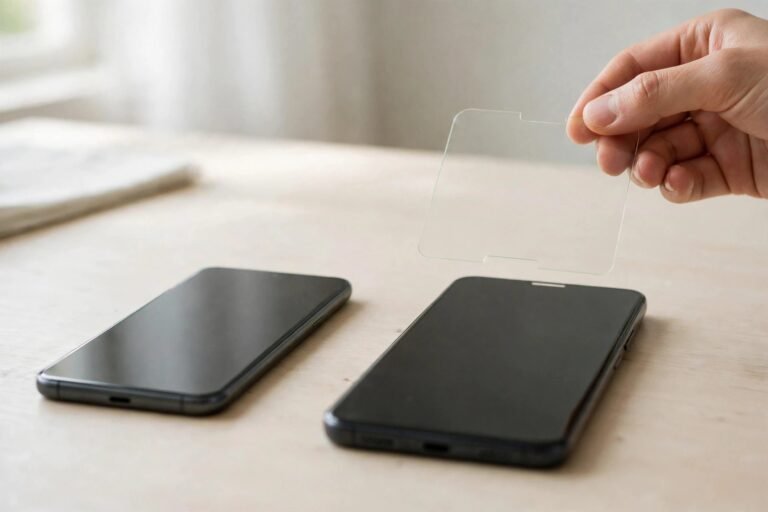
Privacy screen protectors are a clever piece of engineering: a micro-louvre layer built into the glass narrows the viewing angle so the person next to you on the train sees a dark screen while you see everything clearly. But that same technology changes the light reaching your eyes — the display runs dimmer, the viewing angle is narrower, and some users report more eye fatigue after switching. So does a privacy screen protector actually affect your eyes, and should you worry?
The honest answer is nuanced. A privacy protector does not emit anything harmful or change the fundamental light your screen produces. What it does is force you to run the screen brighter and hold it more precisely — and those two habits are what can lead to tired eyes. Here is what actually happens, what the evidence says, and how to use a privacy protector without straining your eyes.
Key Takeaways
- Privacy protectors do not damage your eyes — but they dim the display noticeably, typically cutting perceived brightness by a third or more.
- Most users compensate by raising screen brightness, which increases glare and battery drain and can contribute to eye fatigue.
- The narrowed viewing angle means you must hold the phone square-on; off-angle viewing causes dimming and colour shift that strain the eyes.
- There is no solid evidence that privacy filters cause eye damage — eye strain from them is a comfort issue, not a health hazard.
- Mitigations that work: higher brightness in well-lit rooms, larger text sizes, the 20-20-20 rule, and removing the protector when privacy is not needed.
How the Privacy Layer Changes the Light
A privacy protector works like the blinds on a window. Microscopic vertical louvres are embedded in the glass: light travelling straight out from the display passes through, while light heading off to the sides is blocked. That is what keeps a neighbour’s eyes off your messages. But those louvres also block a share of the straight-on light, so the screen looks dimmer to you as well — reviews and measurements consistently show a meaningful brightness reduction even when you are looking dead-on.
The display underneath is unchanged; it still emits the same spectrum of light, including blue light. The protector simply passes less of it through. Some privacy protectors are combined with blue-light filtering coatings, but the privacy layer itself is not a blue-light filter — do not buy one expecting that benefit unless it is explicitly advertised.
Why Your Eyes May Feel More Tired
Almost nobody uses a privacy protector at their previous brightness setting. The first thing most people do is slide brightness up — often to near maximum — to recover readability. A brighter screen in a dim room increases the contrast between the display and your surroundings, and that contrast is one of the classic drivers of digital eye strain: dry eyes, headaches, and that heavy, tired feeling after an hour of scrolling.
The second factor is posture. With a clear protector you can glance at your phone at almost any angle; with a privacy layer, anything off-centre darkens quickly. So you hold the phone more rigidly, closer, and more squarely — subtle postural changes that add neck and eye effort over a long day. If you use your phone on a desk stand or glance at it while it lies flat, the dimming is worst of all.
- Instead of maxing out brightness, try increasing text size one notch. Larger text is easier to read at moderate brightness, and it does far more for eye comfort than a brighter screen does.
Is There Any Real Risk to Eye Health?
There is no credible evidence that privacy screen protectors cause eye damage. The light from your phone — even at high brightness — is far below levels that harm the retina, and a privacy layer only reduces what reaches your eyes further. What people experience is asthenopia: the clinical term for eye strain from sustained near work. It is uncomfortable but temporary, and it resolves with rest.
One caveat worth knowing: if you already have dry-eye issues or uncorrected vision, a dimmer display can make you squint and blink less, which aggravates both. That is not the protector harming your eyes — it is an existing condition made more noticeable. An eye test is a better fix than a different protector.
Privacy Protectors and Blue Light
A common misconception is that privacy protectors reduce blue light exposure. They do not — at least, not by design. The louvre layer is angle-selective, not wavelength-selective. If blue light at night concerns you, your phone’s built-in night mode or bedtime schedule is far more effective (and free) than any protector. Some manufacturers bundle a blue-light coating with the privacy layer, but that is a separate feature — check the product description rather than assuming.
Using a Privacy Protector Comfortably
If you need the privacy — for commuting, open-plan offices, or travel — you can absolutely use one without sore eyes. Match brightness to your environment rather than running maximum everywhere: bright rooms need more, dim rooms need less. Enable auto-brightness so the phone does this for you. Bump up text size, hold the phone at a comfortable distance, and take regular breaks using the 20-20-20 rule: every 20 minutes, look at something 20 feet away for 20 seconds.
Also consider when you actually need the privacy. Many users keep a privacy protector on permanently out of habit, even at home where nobody is shoulder-surfing. If eye comfort matters to you, there is no shame in using a clear protector day to day and accepting that privacy is a situational need, not a permanent one.
- Test a privacy protector for a full week before deciding. Eye strain often peaks in the first few days as you adjust your brightness and holding habits — what feels tiring on day two may feel normal by day seven.
Frequently Asked Questions
Can a privacy screen protector damage your eyesight?
No. There is no mechanism by which a privacy filter could damage eyesight — it only reduces the amount of light reaching your eyes, and screen light at any normal brightness is far below harmful levels. Eye strain and headaches are comfort issues that resolve with rest, not injuries.
Why do I get headaches with a privacy screen protector?
The most likely cause is the brightness habit: the dimmer display pushes you to run maximum brightness, and a very bright screen in a darker room is a classic headache trigger. Try lowering brightness to match the room, increasing text size, and taking regular screen breaks.
Does a privacy protector block blue light?
Not by itself. The privacy layer controls viewing angle, not light wavelength. Use your phone’s night mode for blue-light reduction, and only count on a protector for it if the product explicitly advertises a blue-light filtering coating.
A privacy protector will not harm your eyes — but it will make you work a little harder to see your screen. Use it when you genuinely need the privacy, tune your brightness and text size, and give yourself breaks; your eyes will thank you either way.