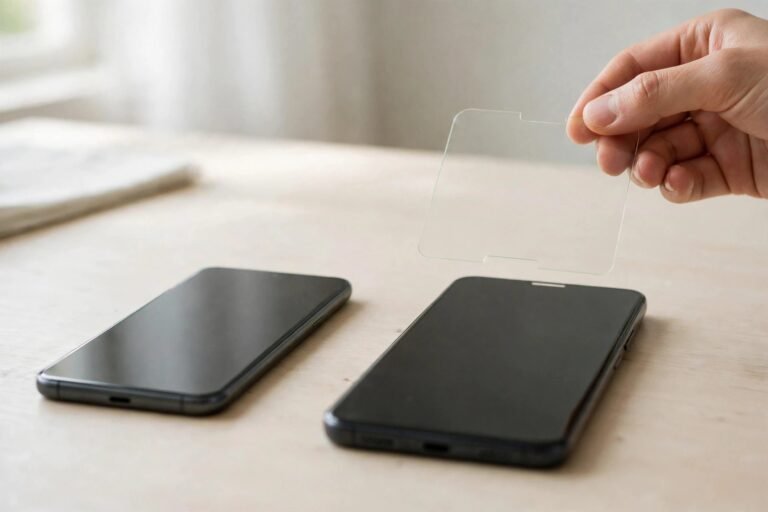
You’ve just bought a second-hand phone and the seller mentioned it “has a liquid screen protector on it”. Or perhaps you applied one yourself months ago and now you’re wondering whether it’s still there. The frustrating truth is that a liquid screen protector is invisible by design — there’s no sheet, no edge, and nothing to peel — so there’s no simple way to look at a phone and know for certain.
There are, however, some clues. This guide covers the signs that suggest a liquid coating is present and active, a simple droplet test you can try, and why — even with those clues — the sensible assumption is often that the coating has worn away.
Key Takeaways
- A liquid screen protector is a nano-coating cured onto the glass — it has no visible edge and can’t be seen or peeled off.
- The main clue is water behaviour: an active coating is hydrophobic, so water beads up into tight droplets instead of spreading flat.
- An active coating also feels noticeably slicker under your fingertip than worn or untreated glass.
- No home test is conclusive — beading and feel are indications, not proof.
- Liquid coatings wear off gradually over months of use and cleaning, so if a coating is old or its history is unknown, assume it has largely faded.
Why You Can’t See It
To understand the problem, it helps to know what a liquid screen protector actually is. Unlike tempered glass or film, it isn’t a physical layer you can point to. It’s a liquid — usually based on silicon dioxide — that you wipe over the screen, where it bonds to the glass at a microscopic level and cures into an extremely thin coating. Once cured, it changes the surface properties of the glass itself rather than sitting on top of it as a separate sheet.
That means all the usual ways of spotting a protector fail. There’s no edge to catch with a fingernail at the border of the screen, no slight step where a sheet ends, no cutout around the camera, and nothing to lift at a corner. Under normal light, a coated screen and an uncoated screen look identical. Anyone who tells you they can tell just by looking is guessing — the evidence has to come from how the surface behaves instead.
The Signs of an Active Coating
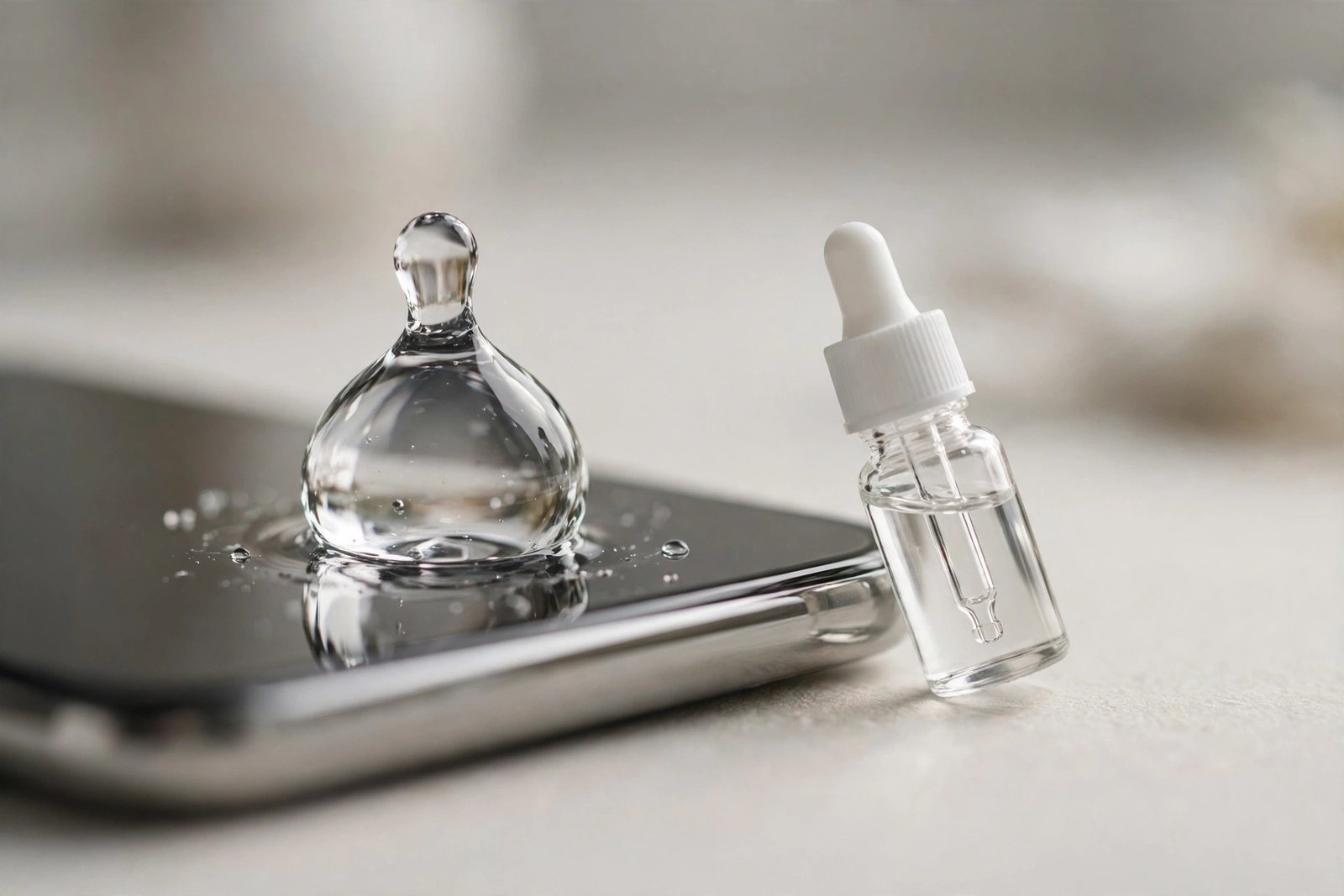
The most useful clue is water behaviour. A fresh liquid coating is hydrophobic: it repels water, so droplets sit on the surface as rounded, tight beads that roll around easily rather than spreading out into a flat film. Older, worn glass — especially glass whose original factory oleophobic coating has worn away — lets water spread and smear much more readily. If water consistently beads strongly across the whole screen, that’s a reasonable sign a coating is present and still active.
The second clue is feel. An active coating makes the glass feel exceptionally smooth and slick — your fingertip glides with very little drag, and fingerprints tend to wipe away more easily. Compare it with an older phone you know has never been coated and the difference can be quite noticeable. Neither test is proof on its own: a brand-new phone’s factory coating also beads water and feels slick, which is exactly why certainty is impossible.
- For a fair droplet comparison, clean the screen first with a microfibre cloth. Skin oils and grime suppress beading and can make a healthy coating look worn out — test on a clean screen, in the centre and near the edges, since coatings wear fastest where your thumbs spend their time.
The Droplet Test — and Its Limits
If you want to try the closest thing there is to a check, place a single small drop of water on the cleaned screen and look at its shape from the side. On a well-coated surface the drop stands up tall and rounded, with a steep contact angle. On worn or uncoated glass it flattens and spreads. For a comparison, repeat the test on a device you know has never had a coating applied, or on the back glass of the same phone if that was never treated.
Treat the result as an indication, not a verdict. Beading varies with how clean the glass is, how old the phone’s own factory coating is, and how the coating was applied in the first place — an unevenly applied liquid protector can bead in one spot and not another. There is no consumer tool that measures the coating directly, and even phone shops can’t give you a definitive answer; they use the same water and fingertip tests you can do at home.
- Bought a used phone and can’t verify the seller’s claim? Make your decision based on protection, not detection: a liquid coating — even a fresh one — adds only modest scratch resistance and no meaningful drop protection. If you want real cover, fit tempered glass; it can be applied over the top regardless of whether a coating is there.
When in Doubt, Assume It Has Worn Away
Here’s the practical reality that resolves most of these questions: liquid coatings are temporary. They wear down gradually through everyday friction — thumbs swiping, the phone sliding in and out of pockets, repeated cleaning — and most have lost much of their effect within a period of months rather than years, depending on how the phone is used and how the product was applied. So if a coating was applied a long time ago, or you simply don’t know the phone’s history, the odds favour it being largely gone, whatever the seller said.
That assumption is also the safe one to act on. Believing a worn-away coating is still protecting your screen leaves the glass exposed to scratches it can’t resist. Assuming it’s gone — and fitting a physical protector, or reapplying a coating if that’s your preference — costs little and guarantees the protection is actually there. With liquid protectors, peace of mind comes from what you do, not from what you can detect.
Frequently Asked Questions
Can I peel a liquid screen protector off?
No — there’s nothing to peel. A liquid protector is a coating bonded to the surface of the glass, not a sheet, so it can’t be lifted or removed in one piece. It simply wears away gradually with use and cleaning.
How long does a liquid screen protector last?
It varies by product and how heavily the phone is used, but the effect typically fades over a period of months. Heavy use, frequent cleaning and friction from cases and pockets all wear it faster, which is why sellers of these coatings usually recommend periodic reapplication.
Can a phone shop test whether a coating is present?
Not definitively. There’s no standard instrument check for it, so a shop would use the same observations described here — water beading and surface feel — and give you the same hedged answer. If a coating’s presence really matters to you, the only certainty is applying one (or a physical protector) yourself.
You can’t see a liquid screen protector, and no test can prove it’s there — strong water beading and a slick feel are clues, nothing more. If the coating is old or the phone’s history is unknown, assume it has faded and protect the screen in a way you can verify.