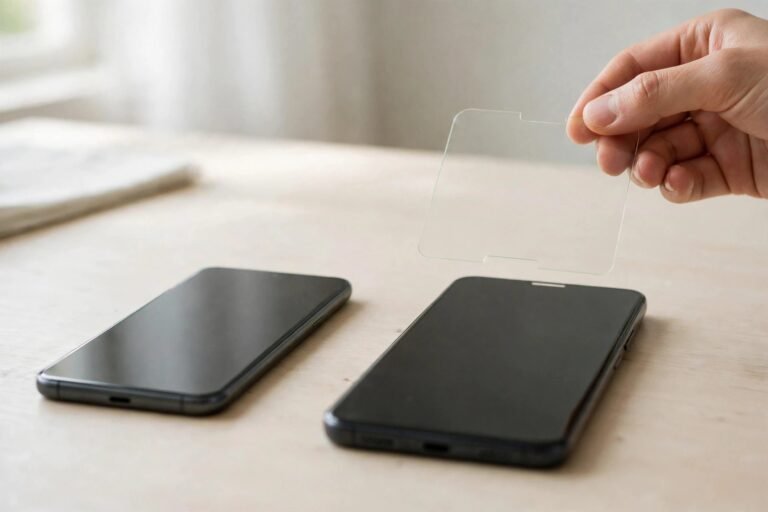
If you have upgraded from a Galaxy S22 Ultra to an S23 Ultra — or picked up the older phone as a second device — it is natural to wonder whether the spare screen protectors in your drawer will fit both. The two phones look almost identical, both carry a 6.8-inch curved display, and side by side most people cannot tell them apart. The short answer, though, is that an S23 Ultra protector should not be relied on to fit an S22 Ultra properly, and the same applies in reverse.
The reason is that screen protectors are not cut to the size of the display panel — they are cut to the shape of the whole front of the phone, including its curved edges. The S22 Ultra and S23 Ultra differ by fractions of a millimetre in width and height, and, more importantly, the curve of the glass at the edges is not the same. This guide explains where the differences lie, why tempered glass suffers most from them, and when a flexible film might just get away with it.
Key Takeaways
- Both phones have a 6.8-inch curved display, but the S23 Ultra is slightly wider (about 78.1 mm vs 77.9 mm) and has flatter sides and a gentler screen curve.
- Tempered glass is moulded to one model’s exact edge curve, so glass made for one Ultra often will not seal properly on the other.
- A poor seal shows up as a halo around the edges, lifting corners, dust creeping underneath and unreliable fingerprint unlocking.
- Flexible film and TPU protectors bend to fit either curve and may cross-fit approximately, but the outline and alignment will still be slightly off.
- The centred front camera hole is in much the same place on both phones, so camera alignment is rarely the problem — the edges are.
- Protectors are inexpensive; buying the model-specific version is always the sensible outcome.
Two Phones That Look Identical but Aren’t
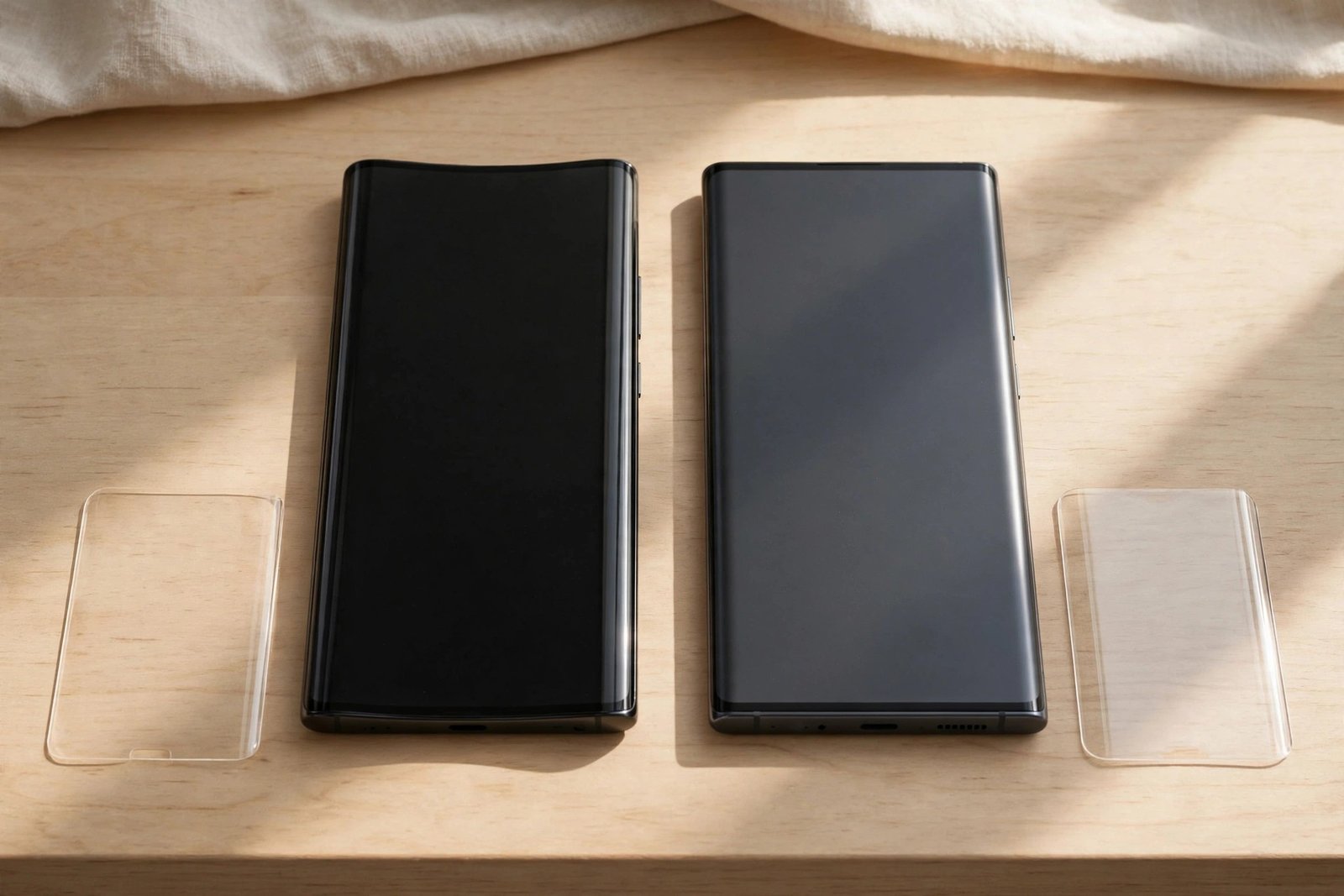
On paper the dimensions are close enough to invite the experiment. The Galaxy S22 Ultra measures roughly 163.3 × 77.9 × 8.9 mm, while the S23 Ultra comes in at about 163.4 × 78.1 × 8.9 mm. The newer phone is a fraction taller, about two-tenths of a millimetre wider, and built around a noticeably flatter frame. Those differences are invisible in the hand, but a sheet of glass notices every one of them.
The bigger issue is the shape of the display itself. Samsung softened the curve on the S23 Ultra: its screen edges slope away more gently, giving a slightly wider flat working area and a less dramatic waterfall effect than the S22 Ultra. A protector is shaped to match that slope precisely. Glass curved for the steeper S22 Ultra edge meets the flatter S23 Ultra screen at the wrong angle, and glass curved for the S23 Ultra cannot follow the S22 Ultra’s tighter bend. Either way, part of the protector is left hovering above the glass instead of bonded to it.
Why Tempered Glass Is the Fussy One
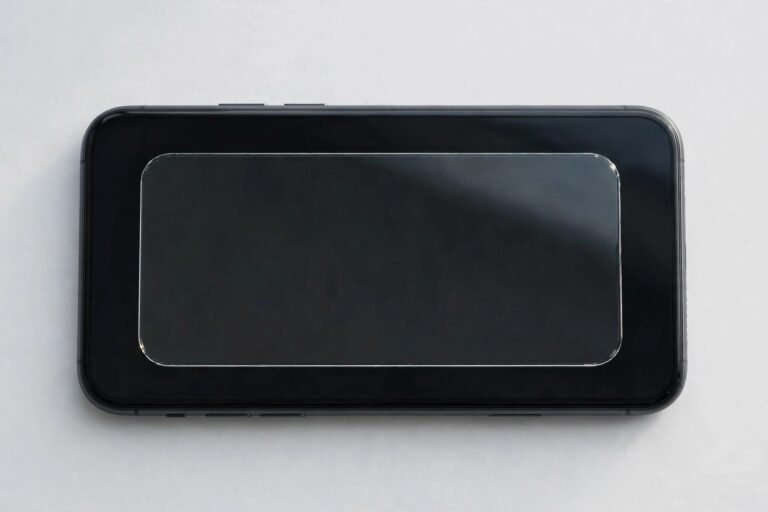
Tempered glass is rigid, which is exactly why it protects so well — and exactly why it cannot adapt to the wrong phone. The classic symptom is the halo effect: a pale, rainbow-edged band around the perimeter where the glass floats above the screen. Those unbonded edges collect dust and pocket lint, catch on cases, and eventually start to lift.
There is a second casualty: the fingerprint sensor. Both Ultras use an ultrasonic in-display reader, which has to send its signal through the protector. Glass that is sitting imperfectly — too much gap at the centre, or adhesive that has not wetted out evenly — can make unlocking slow or unreliable. Owners often blame the phone, when the real problem is a protector that was never shaped for it in the first place. Re-registering your fingerprints after fitting helps, but it cannot fix glass that physically does not match the screen.
- Before fitting any curved glass protector, lay it on the screen without peeling the backing and look along each edge against the light. If you can see daylight or a shadow gap at the sides, the curve is wrong for your phone — stop there rather than wasting the adhesive.
What About Film and TPU Protectors?
Flexible protectors are far more forgiving. A film or TPU protector made for the S22 Ultra can usually be persuaded onto an S23 Ultra, and vice versa, because the material simply bends to follow whichever curve it finds. The centred punch-hole camera sits in much the same position on both phones, so the most visible alignment point lines up well enough for everyday use.
Forgiving is not the same as correct, though. The outline is still cut for a slightly different body, so the film may run a fraction wide at the sides, where your case can catch and peel it, or fall a fraction short, leaving a sliver of screen edge exposed. Some sellers do cross-list film protectors for both models for precisely this reason, but a film sold specifically for your phone will always sit cleaner. Treat a cross-fitted film as a stopgap, not a permanent solution.
The Sensible Verdict
If you have unopened S22 Ultra glass protectors left over after upgrading, the honest advice is to pass them on with the old phone rather than force them onto the new one. A protector that does not seal properly protects poorly: its lifted edges invite the dust and impacts it is supposed to keep out. The modest saving is not worth a compromised screen on a flagship phone.
When you shop, check that the listing names your exact model — “S23 Ultra” or “S22 Ultra”, not just “Galaxy Ultra” or a screen size. If a listing claims one glass protector fits both generations, be sceptical: given the different edge curves, that claim is rarely true for tempered glass, however plausible it may be for film. Buy the one made for your phone, fit it once, and forget about it.
- After fitting a protector on either Ultra, re-register your fingerprints with the protector in place, and register the same finger twice at slightly different angles. This noticeably improves ultrasonic unlock speed and reliability.
Frequently Asked Questions
Is the S23 Ultra screen the same size as the S22 Ultra?
The displays are the same size — 6.8 inches, measured diagonally — and offer the same resolution. But the phones around them differ slightly in width and height, and the S23 Ultra’s screen has a gentler edge curve. A protector is shaped to the phone’s front, not the panel’s diagonal, which is why the same screen size does not mean interchangeable protectors.
Will a case-friendly S22 Ultra protector work on an S23 Ultra?
Case-friendly protectors are cut slightly smaller than the screen, which hides some of the size difference. A case-friendly film protector will often cross-fit acceptably. Case-friendly tempered glass is still risky, because the problem is not the outline but the curve: glass moulded for the S22 Ultra’s steeper edge still will not bond cleanly to the S23 Ultra’s flatter one.
Why does my S22 Ultra glass show a halo on my S23 Ultra?
The halo is the visible sign of a curve mismatch. The glass was shaped to the S22 Ultra’s edge radius, so on the S23 Ultra its edges hover above the screen instead of adhering, producing that pale, iridescent band. No amount of pressing will fix it, because the shapes genuinely differ — the remedy is a protector made for the S23 Ultra.
Same badge, same screen size, different shape: treat the S22 Ultra and S23 Ultra as the separate fittings they are, and your protector will seal first time.