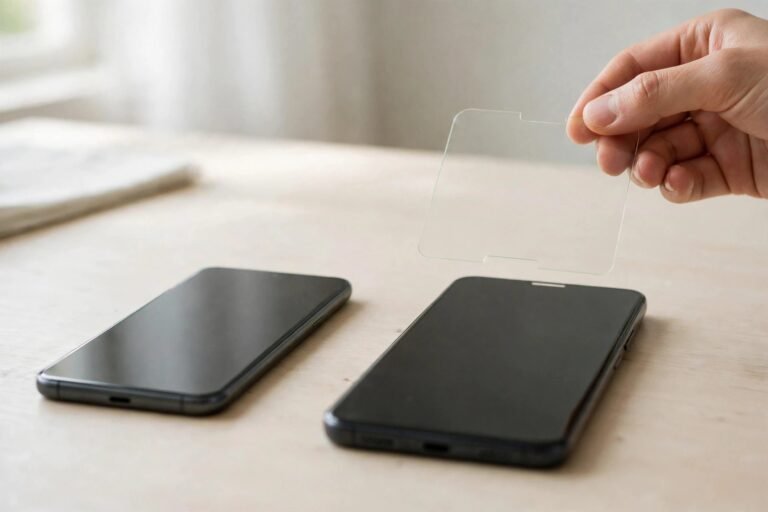
It’s a fair question. You fit a thin sheet of glass or plastic over a screen that already survived the manufacturer’s own testing, and you wonder whether it actually does anything — or whether it’s just a cheap comfort blanket. The honest answer is that a screen protector does work, but only at specific jobs, and it fails at others no matter what the packaging claims.
This guide explains what a protector genuinely does — acting as a sacrificial scratch layer and spreading impact energy when your phone lands badly — and where its limits lie, so you can decide whether one earns its place on your phone.
Key Takeaways
- A screen protector works mainly as a sacrificial layer: it takes the scratches and scuffs so your real screen doesn’t have to.
- Tempered glass can spread the energy of an impact across a wider area, which sometimes saves the screen underneath in a drop.
- No protector makes a phone drop-proof. Angle, surface and luck matter more than any accessory.
- Film protectors guard against scratches only — they offer almost no impact protection.
- A protector is cheap, replaceable insurance; a screen repair is neither. Check current repair prices for your model to see the gap.
- Protectors also help at resale time, because a flawless original screen is worth more than a scratched one.
What a Screen Protector Actually Does
The clearest way to understand a protector is to think of it as a wear layer. Keys, coins, grit and sand in your pocket are constantly trying to etch fine lines into your screen. Modern phone glass is hard, but it is not harder than quartz sand — and one grain dragged across the display can leave a permanent mark. A protector sits in the firing line instead. It accumulates the micro-scratches, and when it looks tired, you peel it off and the screen beneath is still pristine.
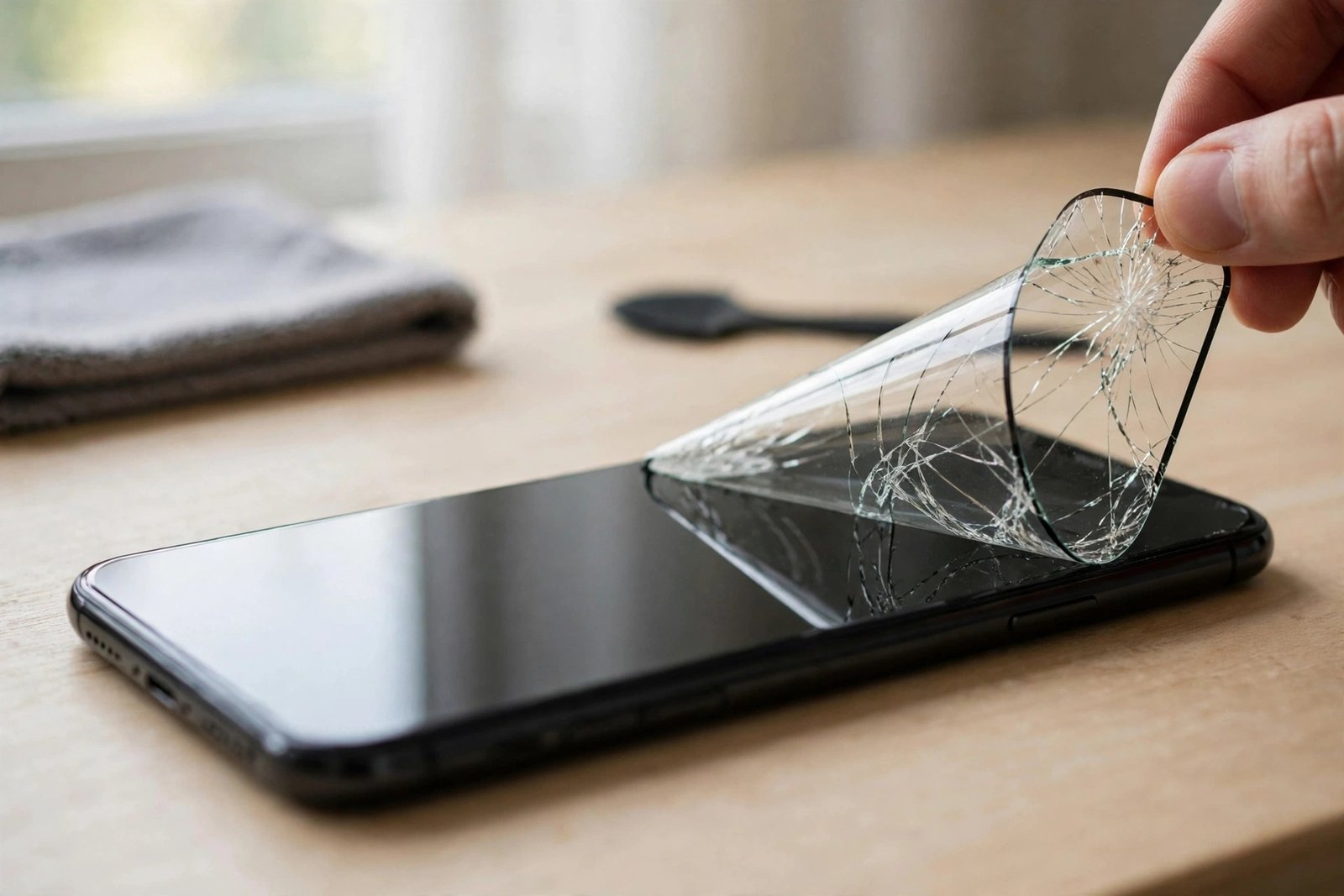
The second job is impact. When a phone lands face-down or on a corner, the force concentrates at the point of contact. A sheet of tempered glass bonded across the whole display distributes some of that energy sideways instead of letting it focus on one spot. Sometimes — not always — the protector cracks and absorbs enough of the blow that the screen survives. That cracking is not the protector failing; it is the protector spending itself so the screen doesn’t have to.
What It Cannot Do
A protector is a few tenths of a millimetre thick. It cannot change the physics of a phone dropped onto concrete from head height, and it offers little help when the phone lands on an exposed corner, because the force arrives through the frame rather than the face of the screen. Edge and corner impacts are where most real-world screen breaks happen, which is why a case with a raised lip matters at least as much as the protector itself.
Be sceptical of marketing numbers, too. Hardness ratings such as “9H” describe resistance to scratches from pencils of graded hardness — they say nothing about surviving drops. Drop-test videos are equally unreliable as evidence: phones dropped from the same height onto the same surface can survive ten times and shatter on the eleventh, depending on the exact angle. A protector improves your odds. It never guarantees the outcome.
- Pair the protector with a case that has a raised lip around the screen. The protector guards the face; the lip guards the corners — and corners are where most fatal drops begin.
Glass, Film and Liquid: How Much Protection Each Gives
Tempered glass gives you the full package: strong scratch resistance plus a genuine, if modest, contribution in a drop. PET or TPU film is a scratch shield only — it keeps keys and grit off the display but adds almost nothing when the phone falls. Liquid nano-coatings sit at the bottom of the scale: they can slightly improve resistance to very fine scuffs, but there is no physical layer to sacrifice, so treat any drop-protection claims for them with real caution.
None of this means everyone needs the maximum. If your phone lives in a padded bag and rarely leaves a desk, a film may be all the protection you realistically need. If it shares a pocket with keys and regularly meets gravel, glass earns its keep.
- Judging value is simple maths: compare the price of a multi-pack of protectors with a single screen repair for your model. Check current repair prices first — the difference usually settles the argument.
So, Does It Work? The Honest Verdict
Yes — within limits you should understand. A screen protector reliably prevents the slow, certain damage of scratches and scuffs, and tempered glass meaningfully improves your chances in some drops. What it does not do is make your phone indestructible. Treat it as inexpensive, replaceable insurance with known exclusions, combine it with a decent case, and it does its job very well.
Frequently Asked Questions
Can a screen protector guarantee my screen won’t crack?
No. Nothing fitted to the outside of a phone can guarantee that. A protector improves the odds — particularly in face-down drops — but corner impacts and hard surfaces can still break the screen underneath an intact-looking protector.
If my protector cracked, does that mean it saved my screen?
Very likely, yes. A cracked protector usually means it absorbed and spread energy that would otherwise have concentrated on the display. Peel it off, check the screen carefully under a bright light, and fit a fresh one — a cracked protector offers little further protection.
Do I still need a protector if my phone has toughened glass?
Toughened glass resists cracking better than ordinary glass, but it still scratches — sand and grit are harder than any phone glass. If you care about keeping the screen flawless, or about resale value, a protector remains worthwhile.
A screen protector works — not as armour, but as a sacrificial skin that takes the daily damage and sometimes the big hit, so your screen doesn’t have to.