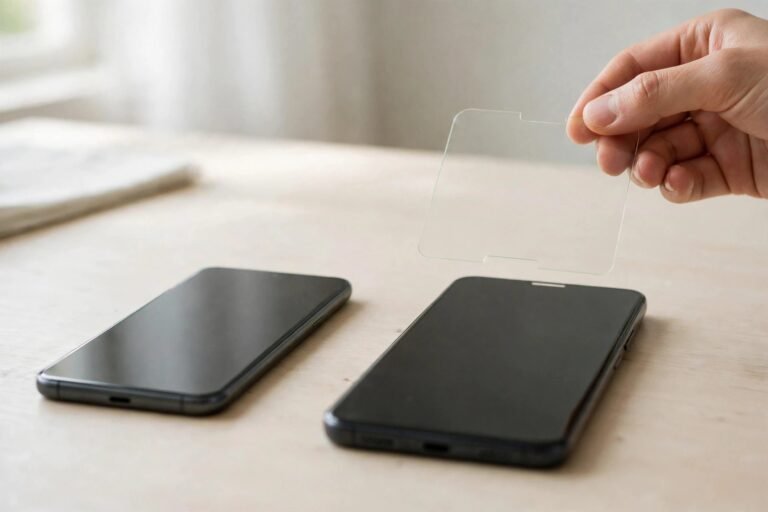
Your protector went on crooked, trapped a bubble, or has to come off while your phone is repaired — and now you are wondering whether the same protector can go back on again, rather than reaching for a new one. The short answer: sometimes, briefly, and with lowered expectations. Reapplying the same protector is a race against dust and adhesive fatigue.
This guide separates the two situations people usually mean — repositioning a protector moments after fitting it, and removing a protector and refitting it days or weeks later. The first often works. The second rarely ends well, and this guide explains why, plus the technique that gives a reapply its best possible chance if you decide to try.
Key Takeaways
- A protector lifted within the first minute or two can usually be repositioned once, successfully.
- Once the adhesive has fully set and been worn, refitting the same protector usually means weak edges, trapped dust, and bubbles.
- Dust is the real enemy — the exposed adhesive side collects particles from the moment it leaves the screen.
- Film protectors reapply worse than glass — they stretch, crease, and distort when peeled.
- Lift with tape, never a fingernail or blade — prising at a corner bends glass and kills that corner’s adhesion permanently.
- Because protectors come in multipacks and cost little, a fresh one is almost always the better answer.
Scenario One: Repositioning Straight After Fitting
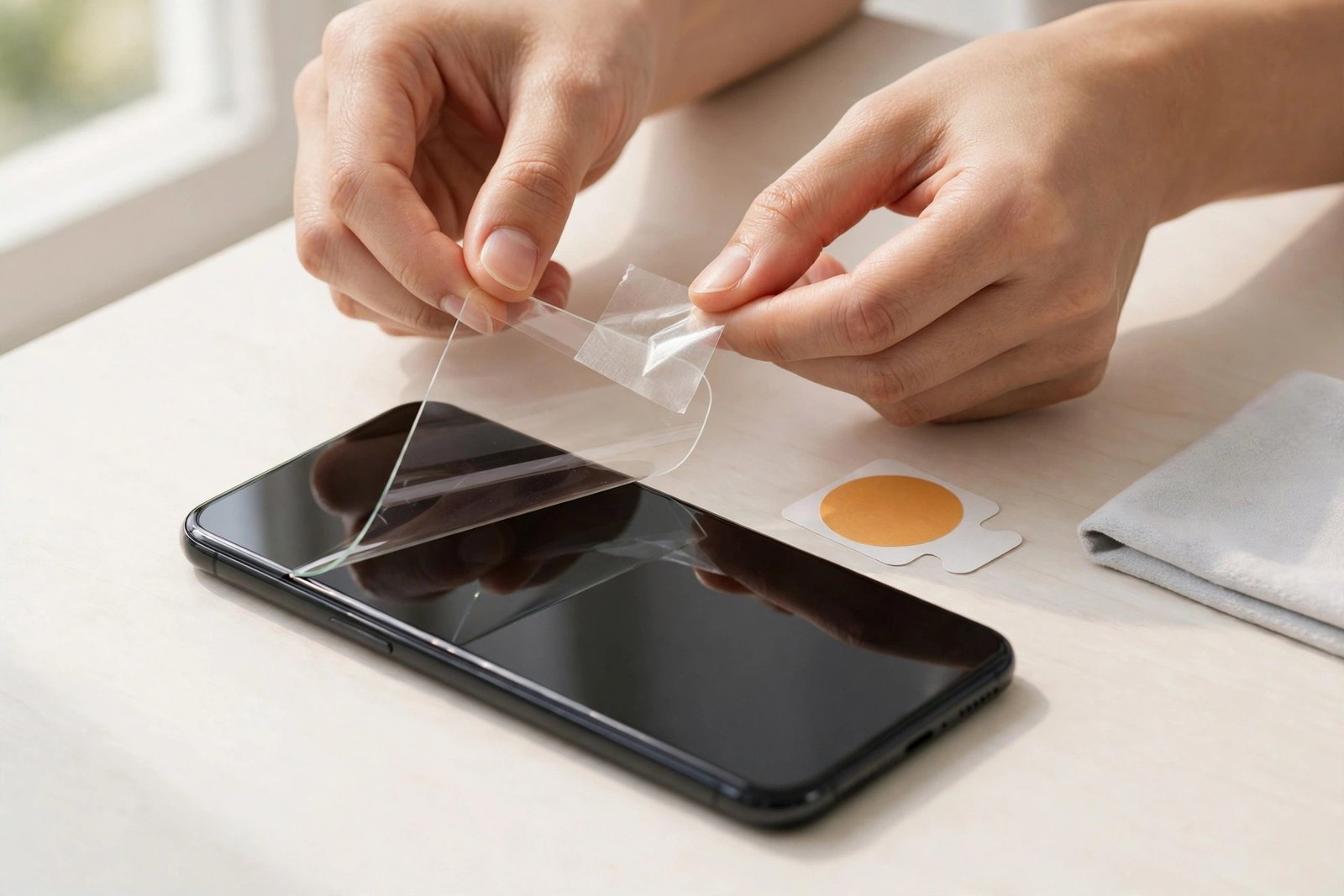
If you have just laid the protector down and spotted a misalignment or a trapped speck, act quickly and you can usually save it. In the first minute or two, the adhesive has not fully bonded, and tempered glass in particular tolerates one careful lift and re-drop. Work a piece of sticky tape under the nearest corner, raise the glass slowly and evenly, deal with the problem — a dab with a dust-removal sticker for a speck, a breath of patience for alignment — and lower it again from one edge.
The discipline is in stopping at one. Each lift exposes the adhesive to airborne dust and weakens the bond slightly. A protector lifted three or four times during one install session will almost always show it later, in an edge that never quite seals.
Scenario Two: Refitting a Protector That Has Been On for a While
This is the version that usually disappoints. A protector that has lived on a phone for weeks has adhesive that has cured, collected micro-debris at its edges, and moulded itself to the screen. Peeling it off stretches and stresses that layer unevenly. The moment it is off, its sticky face is a dust magnet — and unlike a fresh protector, it has no protective backing film keeping it clean while you work.
People most often attempt this during a phone repair, a deep clean, or a case swap. The result, typically: edges that lift within hours, a halo that never settles, and dust sealed under the glass that no amount of pressing will shift. It is not a matter of skill. The materials have changed since the first fitting, and they do not change back.
- If a protector must come off for a repair, stick its adhesive side to a clean sheet of plain paper or the backing film from a new protector the moment it leaves the phone. Storing it sticky-side protected is the only way to keep a reapply even theoretically possible.
Glass vs Film: Which Reapplies Better?
Tempered glass is the better candidate, for one reason: it is rigid. It peels off in one flat piece without distorting, so if the adhesive survives and stays clean, the geometry of the refit is at least correct. Its weakness is the corner you lifted — bend the glass even slightly while prising and that corner will never adhere again.
Film protectors fare far worse. PET and TPU films stretch as they peel, so the piece you refit is subtly a different shape from the one you removed. Creases formed during removal are permanent, and the thin adhesive layer tears and thins in patches. A removed film protector should be considered spent, full stop.
If You Are Going to Try Anyway: The Best-Chance Method
Work in a steamy bathroom to suppress airborne dust, wash your hands, and clean the phone screen exactly as you would for a new install. Before refitting, inspect the protector’s adhesive side under a bright light; dab off any visible particles with a dust-removal sticker or clean tape — never fingers, never blowing on it. Lower it onto the screen from one edge in a single smooth motion, press from the centre outward, and then leave it alone for several hours so the weakened adhesive can grab whatever bond it still can.
Judge the result the next morning, not the next minute. If one edge is lifting or dust is sealed in, accept the verdict and fit a fresh protector — further lifting and pressing only makes it worse.
- Never wash a protector’s adhesive side to “restore” it. Water and soap break down the adhesive layer, and a washed protector will cloud, slip, and lift. A dust sticker is the only cleaning the sticky side should ever get.
Frequently Asked Questions
Can I take my protector off at night and put it back on in the morning?
You can physically do it, but you should not expect it to survive the process well. Each removal degrades the adhesive and invites dust, so repeated removal and refitting will quickly leave you with a protector that lifts at every edge. Protectors are designed to be fitted once.
My protector lifted at one corner — can I press it back down?
Pressing a corner that has only just lifted sometimes reseals it for a while, especially if no dust has got underneath. If the corner has been up for days, dust will already be on the adhesive, and pressing merely seals the dirt in. At that point replacement is the honest fix.
Is it ever worth reapplying instead of using a new protector?
Only in narrow circumstances: repositioning during the same install, or refitting a protector for an unusual or discontinued device where no replacement exists. In every normal case, the spare from the multipack gives a cleaner, stronger result for very little money.
A screen protector is a one-fitting product wearing a removable disguise. Correct it quickly and it may forgive you; remove it properly and it almost certainly will not — and with a fresh one costing so little, it rarely needs to.