

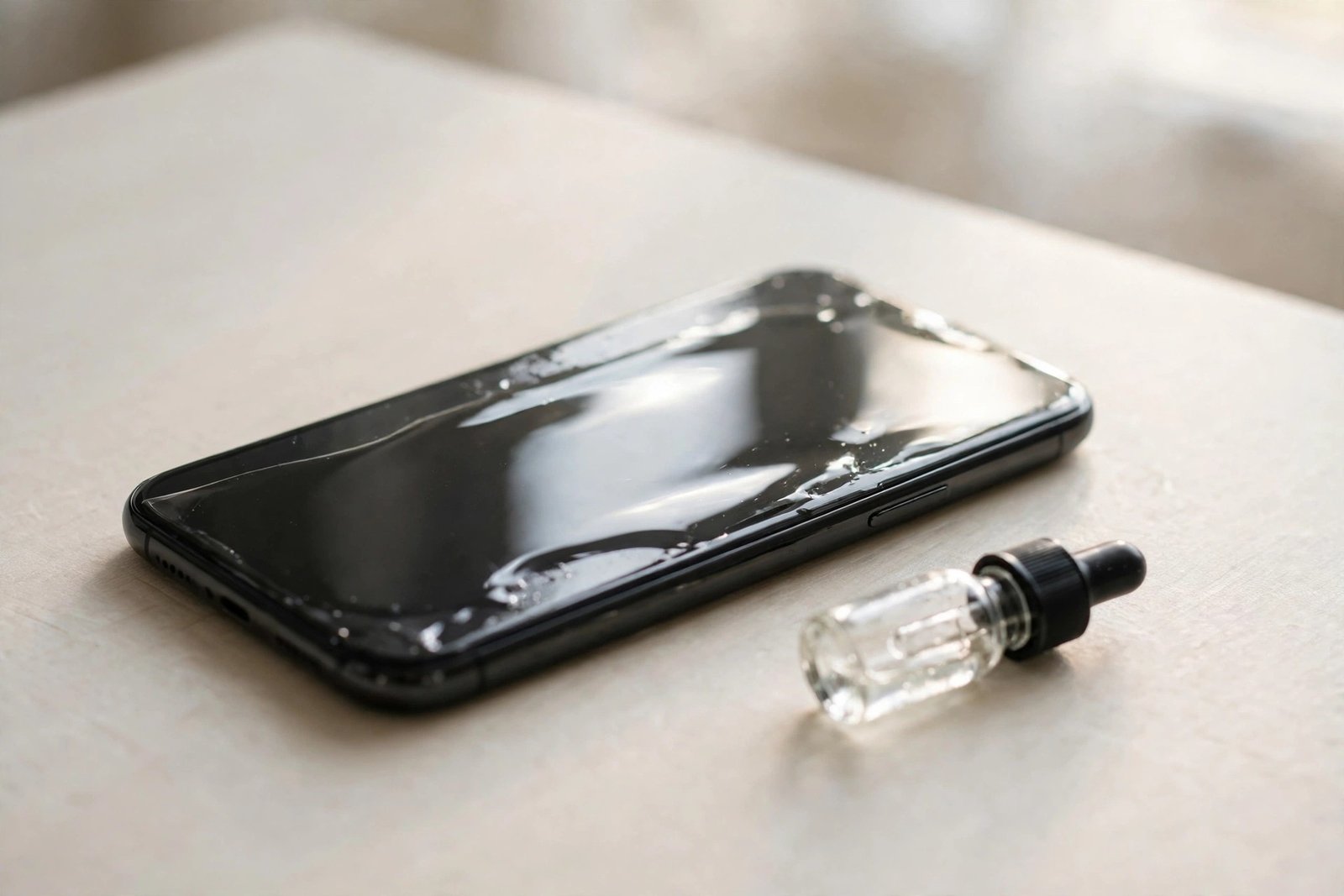
If you’ve ever tried to peel off a liquid glass screen protector, you’ve already discovered the problem: there is nothing to peel. No corner lifts, no edge gives way, and no amount of picking with a fingernail finds a seam. That’s because a liquid glass protector isn’t a sheet of anything — and that changes everything about how it comes off.
This guide explains what a liquid glass coating actually is, why it can’t be removed the way tempered glass or film can, how it wears away in everyday use, and what your realistic options are if you want it gone sooner rather than later.
Key Takeaways
- Liquid glass is a cured nano coating bonded to your screen — there is no film or pane to lift off.
- It wears away gradually through friction, fastest where your thumbs and fingers sweep most.
- Most coatings fade to nothing over several months of normal use without you doing anything.
- Polishing can speed removal up, but aggressive abrasion risks the screen’s own factory coating underneath.
- In most situations the sensible answer is to leave it to wear off — removal is rarely necessary at all.
What Liquid Glass Actually Is
A liquid glass protector starts as a wipe-on liquid containing silicon dioxide nanoparticles suspended in a solvent. You spread it across the screen, the solvent evaporates, and the particles settle into the microscopic pores and valleys of the glass, then cure into a thin, hard layer — typically far thinner than a human hair. Once cured, that layer is effectively part of the surface. It isn’t stuck onto the glass like an adhesive film; it has filled and bonded with the top of the glass itself.
This is why every removal trick you know fails. There is no adhesive to soften with warmth, no edge to slide a card under, and no layer your fingernail can separate. Trying to “peel” a cured nano coating is like trying to peel the shine off a polished table — the thing you want to remove doesn’t exist as a separate sheet.
How It Comes Off in Everyday Life
The same friction that the coating resists is what eventually removes it. Every swipe, every slide in and out of a pocket, every wipe with a cloth takes a microscopic amount off the surface. The wear is uneven: the areas under your thumbs, the swipe-up zone at the bottom of the screen, and anywhere a case lip rubs will thin out first, while the less-touched corners and edges hold on longest.
Manufacturers usually quote a lifespan of several months to around a year, and that figure is really a wear estimate rather than an expiry date. The coating doesn’t fail all at once — it fades in patches, and its water-beading and easy-clean properties fade with it. You may notice fingerprints becoming harder to wipe away in the centre of the screen while the edges still shed water nicely. That’s the map of the wear, drawn by your own hands.
- A quick water-drop test tells you how much coating remains: water beads up tightly on coated glass and spreads flat where the coating has worn through.
- Check the centre of the screen versus the corners — if both bead the same, most of your coating is still there.
Can You Speed Up Removal?
Technically, yes — anything that abrades the surface will take the coating with it, and fine polishing compounds will remove it fastest. This is, in fact, how professionals do it: a repair shop with a polishing machine can buff a coating off evenly in minutes. The catch is that polishing doesn’t know where the coating ends and your screen begins. Beneath the nano layer sits the factory oleophobic coating that makes your screen feel slick and resist fingerprints, and aggressive or uneven polishing can strip that too, leaving dull patches that smudge instantly and never feel right again.
Household shortcuts are worse. Solvents such as acetone or alcohol-based removers are sometimes suggested online, but the coating is mineral, not glue — solvents don’t dissolve it, and they can attack the factory coating, adhesives around the screen edges, and plastic trim. Abrasive pads and powders scratch in an uncontrolled way. If you genuinely need the coating gone — for example, before a screen repair — pay for machine polishing by a professional, where pressure and compound are controlled, rather than experimenting at the kitchen table.
When Removal Isn’t Really Necessary
Most reasons people want liquid glass gone don’t actually require removing it. Planning to fit a tempered glass protector over the top? A cured coating underneath rarely prevents adhesion, and many people run both without issue. Applying a fresh layer of liquid glass? New coating can go straight over old — the worn patches simply get topped up. Selling the phone? A partially worn invisible coating is not something a buyer can see or a grader can mark down.
The honest summary is that a liquid glass coating asks for a different mindset from a physical protector. You don’t remove it; you outlast it. It fades a little with every day of use, asks nothing of you in the meantime, and disappears entirely on its own schedule.
- If the uneven wear bothers you, a fresh top-up application evens the surface out — far safer than trying to strip the old layer back to bare glass.
- Before any screen repair, tell the technician a coating is fitted — it affects how adhesives and replacement parts bond.
Frequently Asked Questions
Does liquid glass come off completely on its own?
Yes, eventually. Friction from daily use wears the cured layer down until nothing measurable remains, usually over a period of months. High-contact areas clear first, so for a while the screen will be a patchwork of coated and uncoated zones before the whole surface evens out.
Will alcohol wipes or nail polish remover strip it?
No. The coating is a mineral layer, not a glue, so solvents have nothing to dissolve. Alcohol wipes are safe for routine cleaning and won’t meaningfully shorten the coating’s life, while stronger solvents risk damaging the factory oleophobic layer and the seals around the screen without removing the nano coating at all.
Can a repair shop remove it for me?
Yes — controlled machine polishing is the one reliable removal method, and a reputable repair shop can do it evenly without harming the glass. It is worth the small cost if the coating must come off for a repair or a warranty assessment; it is rarely worth it just for peace of mind.
You can’t peel what was never a sheet — so let friction do the work, polish only with professional help, and let the coating fade on its own terms.


