It is a tempting bit of logic: the case wraps the phone in armour, so the screen must be covered too — right? Many people buy a sturdy case and skip the screen protector entirely, reasoning that one layer of protection is enough. Sometimes they are right. Often, they are carrying a false sense of security into exactly the scenarios where screens actually break.
Cases and screen protectors defend against different threats, and understanding the split is the key to deciding whether you need both. This guide gives an honest assessment of what a case covers, what it leaves exposed, and the situations where a protector is still earning its place — plus the narrow cases where you can genuinely skip it.
Key Takeaways
- A case protects the corners, edges, and back; it does almost nothing for the display surface itself.
- The most common screen-killer — a face-down drop onto a hard, gritty surface — defeats most cases but not a screen protector.
- Scratches (keys, sand, grit in pockets) happen with or without a case; only a protector prevents them.
- A case with a raised front lip helps against flat drops but not against direct face-down impacts on uneven surfaces.
- For most people, case plus protector is the sensible combination; skipping the protector is reasonable only with careful habits and a raised-lip case.
What a Case Actually Protects
A good case is excellent at its job — which is structural protection. It absorbs the shock of corner and edge impacts, the most common drop geometry, preventing the frame from bending and the display from cracking from the sides. It guards the back glass and camera housing against scratches and shattering. It adds grip, so you drop the phone less in the first place. All of this is real and valuable.
What a case does not do is put anything between the display surface and the world. The screen remains fully exposed to every scratch source in your daily life: the keys in your pocket, the sand on the beach towel, the grit on the café table you set the phone down on face-first. A case cannot stop micro-scratches, because micro-scratches do not come from drops — they come from contact, and the display is in contact with the world all day long.
The Face-Down Drop: The Case’s Blind Spot
Here is the scenario that settles the argument for most people. Your phone slips from your hand and lands face-down on concrete, tile, or asphalt. A case with a raised front lip — the rim that stands slightly proud of the screen — helps if the surface is perfectly flat: the lip takes the impact and the display never touches. But real-world surfaces are rarely perfectly flat. A single protruding pebble, a grain of grit, a slightly uneven paving slab, and the lip’s protection is bypassed at exactly one point — with the full force of the fall concentrated there.
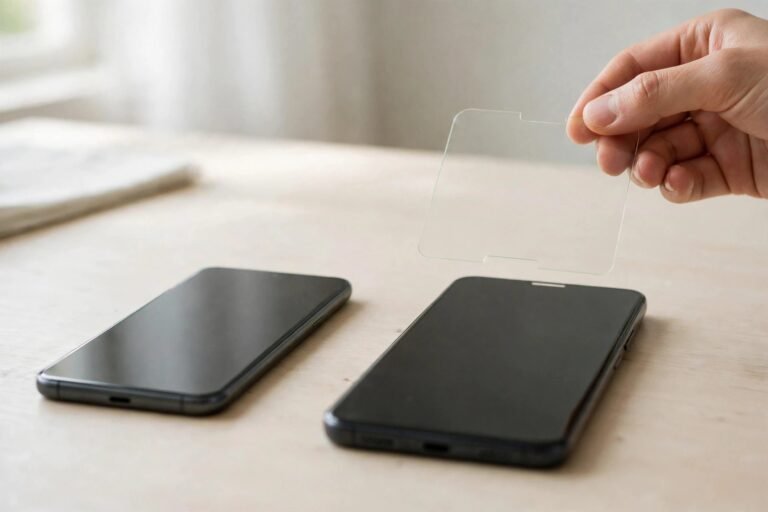
This is precisely the impact a screen protector is designed for. The tempered glass takes the point force and fractures sacrificially, sparing the display. The case did its part on the corners; the protector does its part on the face. Neither replaces the other because they were never defending the same thing.
- Check your case’s front lip height right now: lay the phone face-down on a table. If the display glass touches the table, the lip is decorative, not protective. A meaningful lip holds the screen visibly clear of a flat surface — and even then, it only helps on flat surfaces.
Scratches: The Case Can’t Help At All
Here is the argument most people underestimate, because scratches accumulate invisibly until one day the screen looks tired. Every time your phone goes into a pocket with keys, every time it slides across a table, every grain of sand at the beach — these abrade the display whether or not a case is on the phone. Cases do not cover the screen, so they cannot intervene. Over a two-year ownership, an unprotected display collects hundreds of micro-scratches that a protector would have taken instead.
This matters beyond cosmetics. A scratched display is harder to read in sunlight, shows fingerprints more, and measurably reduces resale or trade-in value — buyers and trade-in programmes grade screen condition harshly. A protector is cheap insurance for the single most valuable component of the phone.
When You Can Reasonably Skip the Protector
Honesty requires the other side. You can reasonably skip a screen protector if all of these are true: you use a case with a genuinely raised front lip; you never put the phone in pockets or bags with keys, coins, or grit; you are careful about setting it face-down on rough surfaces; and you accept that the display will accumulate micro-scratches over time, with the resale-value cost that implies. Some careful users meet all four conditions and do fine.
There are also device-specific exceptions. Folding phones have factory-fitted inner display protectors that should not be supplemented. Some rugged phones and certain smartwatches ship with raised bezels that genuinely recess the display. And if you upgrade every year and trade in through a programme that is lenient about micro-scratches, the economics shift — though even then, a protector costs less than the uncertainty.
- If you do run case-only, make it a habit to check the display monthly under bright angled light. Micro-scratches are invisible until they are suddenly everywhere — catching them early lets you add a protector before the damage affects readability or resale value.
Frequently Asked Questions
Does a phone case protect the screen from cracking?
Partially. A case with a raised lip protects against flat face-down drops and greatly reduces corner-impact cracks. But it cannot protect against point impacts on uneven surfaces or against scratches — those need a screen protector.
Is a screen protector redundant with a heavy-duty rugged case?
No — rugged cases are the best at corner and edge protection, but the display surface is still exposed to scratches and face-down point impacts. Even rugged-case users benefit from a protector; the two are complementary, not overlapping.
What about cases with built-in screen protectors?
Some rugged cases include a built-in plastic membrane over the display. These work — with caveats: the membrane is usually PET film rather than glass, it can dull the display slightly and trap dust, and on phones with under-display fingerprint sensors it may interfere with recognition. Many users end up removing the membrane and fitting tempered glass instead.
A case guards the body; a protector guards the face. One without the other is half a defence — and the screen is the most expensive half to leave exposed.