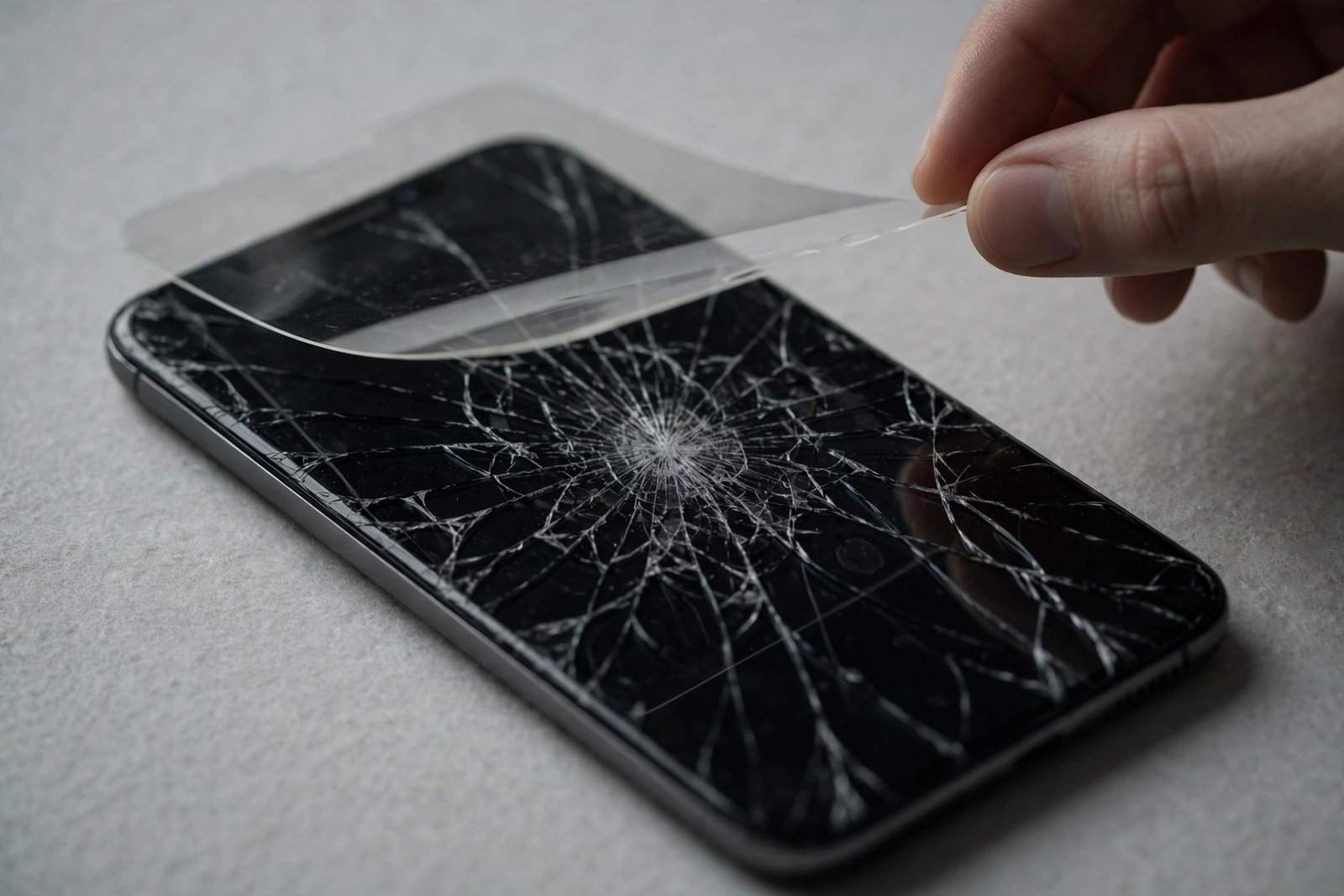
Your phone screen is cracked — a spiderweb from the corner, a single hairline across the middle, or a chip that’s starting to spread. A repair isn’t in the budget this month, so the thought arrives: what if I just fit a fresh screen protector over the top? Would it hide the cracks, hold everything together, and buy some time?
It’s a reasonable idea, and plenty of people do exactly this as a stopgap. A protector over a cracked screen can soften how cracks look and feel, and it can keep loose glass in place — but it cannot repair the damage, restore strength, or make the cracks vanish. Knowing precisely what it will and won’t do helps you decide whether it’s a sensible bridge to a repair or money spent hiding a problem that’s still growing.
Key Takeaways
- A protector over a cracked screen reduces the visibility of fine hairline cracks, but deep or spiderwebbed damage still shows through clearly.
- It holds loose fragments in place and covers sharp edges, which is its most genuinely useful job on a damaged screen.
- It does not restore any structural strength — the screen underneath is exactly as fragile as before.
- Adhesive struggles to bond over cracks, so expect bubbles and lifting along the fracture lines.
- Treat it as a short-term measure: cracks keep spreading, and touch or display problems can follow.
- If the crack is growing, the display shows lines or dead spots, or glass is coming away — skip the protector and prioritise repair.
What a Protector Can Hide — and What It Can’t
A single fine hairline crack is the best-case scenario. A protector’s adhesive layer fills and bridges the surface of a shallow fracture, and once a sheet of glass or film sits on top, the crack often becomes much harder to see at normal viewing angles — sometimes visible only when light catches it. Faint surface scratches and scuffs around the damage are masked even more effectively.
Set expectations lower for anything worse. Spiderweb cracks, cracks that branch, and chips with missing glass create an uneven surface that no protector can flatten or disguise; the pattern remains plainly visible through the sheet, just slightly muted. Discolouration, bright lines or dark spots in the display itself are panel damage, not surface damage, and a protector does nothing for those at all. Think of the protector as soft-focus, not an eraser.
The Real Benefit: Containment and Feel
Arguably the strongest reason to cover a cracked screen isn’t cosmetic at all. Cracked glass sheds. Tiny shards work loose, edges feel sharp under your thumb, and a crack you swipe across fifty times a day can irritate or nick skin. A protector acts as a containment layer: it holds fragments in place, smooths over sharp ridges, and gives your fingers a safe, even surface again.
It also slows the ingress of dust and moisture through the fractures, which matters if you’re stretching the phone’s life by weeks or months. What it cannot do is stop a crack from spreading — the stresses that propagate fractures work through the glass regardless of what’s stuck on top. A covered crack is a managed crack, not a healed one.
- Before fitting anything, back up the phone. A cracked screen can deteriorate suddenly, and the time to secure your photos and data is while the touchscreen still works.
- Run tape over loose areas first and lift gently — it picks up stray shards so they don’t get trapped under your new protector.
Fitting a Protector Over Cracks: What to Expect
Protectors are designed to bond to a perfectly flat surface, and a cracked screen isn’t one. Expect the adhesive to bridge over fracture lines rather than seal into them, leaving visible silvered lines and bubbles tracking the cracks no matter how carefully you fit it. Pressing hard to force adhesion is a mistake — pressure on fractured glass can extend the cracks or push fragments into the panel.
If you go ahead, clean the screen very gently with a dry microfibre cloth only; skip liquid cleaners, which can seep into cracks. Align the protector, let it settle under its own weight, and smooth from the least-damaged area outward with the lightest touch. A film protector conforms slightly better to an uneven surface than rigid tempered glass, though glass gives better containment of loose pieces. Either way, accept an imperfect finish as the cost of the stopgap.
When to Skip the Protector and Repair Instead
Some damage has passed the point where a cover-up makes sense. If cracks are actively spreading week to week, if pieces of glass are missing or lifting, if the touchscreen has dead zones, ghost touches or flickering, or if you can see lines, blotches or bleeding colours in the display, the phone needs repair — and money spent on a protector is money diverted from it. The same applies if the phone is no longer reliably water-resistant for your daily life, since a protector does not restore any sealing.
There’s also a safety line: a badly shattered screen that keeps shedding glass despite a cover should come out of daily use, especially around children. A protector is a plaster, not a cure — use it to make a stable, minor crack safer and tidier while you arrange a repair, not to indefinitely postpone one.
- Photograph the crack today, then weekly: comparing photos shows whether it’s stable or spreading, which tells you how urgent the repair really is.
- Keep the phone in a case with a raised lip while it’s cracked — it protects the weakened edges from the knocks most likely to finish the screen off.
Frequently Asked Questions
Will a tempered glass protector make my cracked screen look new again?
No. It can make a fine hairline crack much less noticeable and the surface feel smooth again, but branching cracks, chips and any display discolouration will still be visible. From a distance the phone looks tidier; up close, the damage is still there.
Can a protector stop a crack from spreading?
Not reliably. It may slightly slow surface-level spread by holding the top layer together, but the forces that extend cracks act through the glass itself. Assume a covered crack will continue to grow over time, and monitor it.
Is it safe to use a phone with a protector over a cracked screen?
Generally yes for minor, stable cracks — the protector actually improves safety by covering sharp edges and containing loose fragments. If glass is actively shedding, the screen is deeply shattered, or you’re getting cuts or irritation, stop using it and get the screen replaced.
A protector over a cracked screen is a tidy bandage: it hides fine cracks, smooths sharp edges and buys you time — but the screen underneath still needs a proper repair. Use the time it buys wisely.