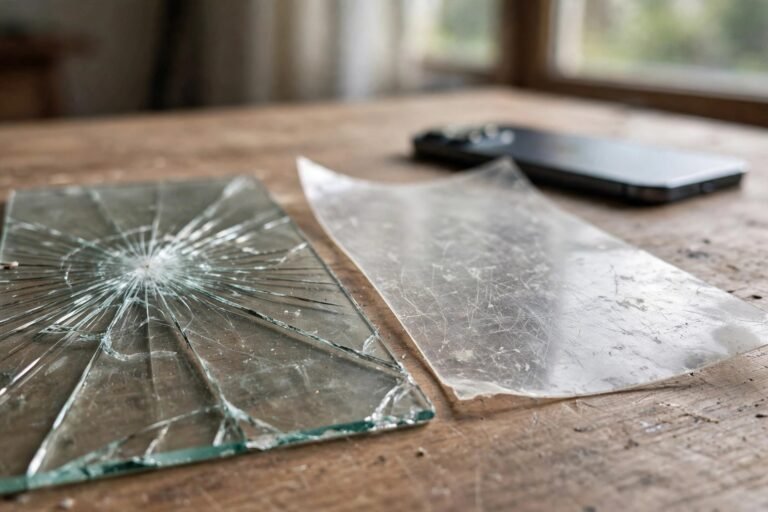
Tempered glass is the default screen protector for most phones, sold with bold promises — 9H hardness, military grades, bombproof-sounding claims. But is tempered glass actually good as a screen protector, or is it just well marketed? The fair answer is that it is genuinely excellent at some things and honestly limited at others.
This guide cuts through the packaging claims: what the 9H rating really means, why a protector that cracks is often a protector that worked, where tempered glass beats every alternative — and the situations where no thin sheet of glass can save your screen.
Key Takeaways
- The 9H rating is a pencil hardness scale, not a promise that nothing can scratch it.
- Tempered glass protects mainly by being sacrificial — it cracks so the screen doesn’t.
- It offers the best feel and clarity of any protector type — glass on glass.
- Its weaknesses are chipped edges and limited flex on strongly curved screens.
- It improves drop survival but cannot guarantee it — angle and surface decide the outcome.
- For most people, it remains the best all-round choice of protector.
What the 9H Hardness Claim Really Means
That 9H stamped on the box sounds like the top of the mineral hardness scale. It isn’t. The rating comes from a pencil test: technicians drag pencils of increasing hardness across a surface, and 9H — the hardest pencil — is the toughest grade in that particular test. It tells you the surface resists scratching from relatively soft, everyday materials, which is genuinely useful information.
What it does not mean is “scratch-proof”. On the mineral scale, tempered glass sits around the same level as your phone’s own screen glass. Sand, quartz dust, and some industrial abrasives are harder and will scratch it — just as they would scratch the bare screen. The honest way to think about hardness is this: tempered glass takes the scratches your screen would otherwise collect, and when it looks worn, you peel it off and the screen beneath is still pristine.
- Judge a protector by thickness, edge finishing, and fit rather than chasing the biggest hardness number on the box — those details differ far more between products.
- A protector covered in fine scratches after six months hasn’t failed — it has done its job visibly. That’s six months of wear your screen never took.
Where Tempered Glass Genuinely Shines
Its greatest strength is one you notice every time you pick up the phone: it feels like the screen itself. Because it is real glass with a similar surface coating, your finger glides exactly as it does on the bare display, touch response is unchanged, and the optical clarity is effectively perfect — no haze, no rainbow shimmer, no texture. People who dislike protectors usually dislike how film feels; glass removes that objection entirely.
Its second strength is sacrificial impact protection. When a phone lands badly, the protector absorbs and spreads the impact energy across its surface, and it frequently shatters so the screen doesn’t have to. A cracked protector after a nasty fall is not a defective protector — it is often a receipt proving the money was well spent. It also shrugs off the daily scuffs, keys-in-bag rub, and tabletop abrasion that slowly dull an unprotected screen.
Where It Falls Short
Tempered glass is rigid, and rigidity has consequences. Its edges are its vulnerable point: a knock on the border can chip or crack the pane starting from the edge, and those chips are the most common way these protectors die. It also struggles on strongly curved screens, where a flat sheet of glass cannot follow the curve — the result is either a smaller protector that leaves the curves exposed, or edges that never fully bond and lift.
And set expectations honestly about drops: a protector improves your odds; it does not repeal physics. A phone that lands corner-first on concrete can crack its screen straight through a protector, because the impact travels through the frame rather than the face. Tempered glass is also a little thicker and heavier than film, which occasionally matters with very tight cases or in-display fingerprint readers on some models — most modern versions handle both fine, but it is worth knowing.
- Pair tempered glass with a case that has a raised lip — the lip guards the protector’s vulnerable edges and the screen’s weaker corners at the same time.
- On a curved screen, choose a case-friendly size that sits inside the curve rather than fighting it — flat, fully bonded edges beat maximum coverage that lifts.
Frequently Asked Questions
Is tempered glass better than a plastic film protector?
For most people, yes. Glass wins on feel, clarity, and impact protection, and it is easier to install without bubbles. Film is thinner and can follow extreme curves better, and some flexible films can smooth out tiny scratches in themselves — but for everyday drop and scratch defence, glass is the stronger all-rounder.
My tempered glass cracked but my screen is fine. Did it work?
Very likely, yes. Absorbing an impact by cracking is precisely the sacrificial behaviour it is designed for. There is no way to prove the screen would have broken without it, but the energy went somewhere — and it went into a cheap, replaceable layer instead of the display.
How thick should a tempered glass protector be?
Most sit in a middle range that balances strength with case fit and touch feel. Thicker is not automatically better — very thick panes can interfere with cases and feel clunky at the edges. A clean fit, smooth rounded edges, and a good surface coating matter more than chasing maximum thickness.
Tempered glass isn’t magic, and it isn’t marketing fluff either — it’s a well-understood sacrificial layer with the best feel in the business. Know its edge and curve limits, and it’s the right protector for most phones.