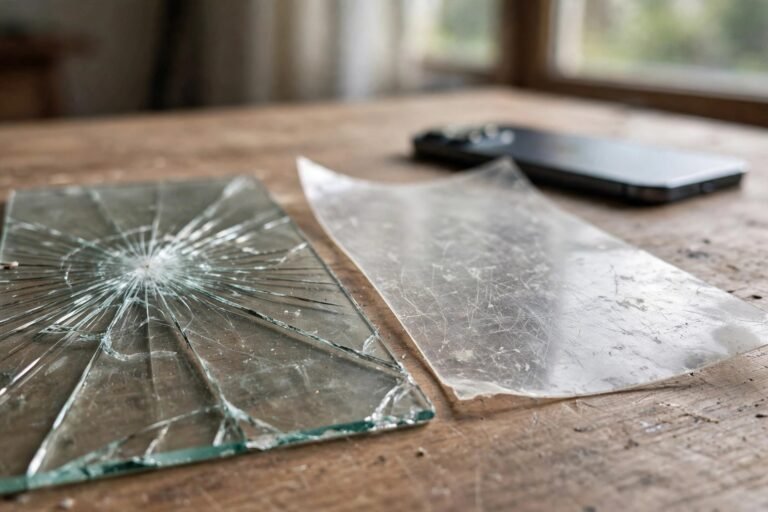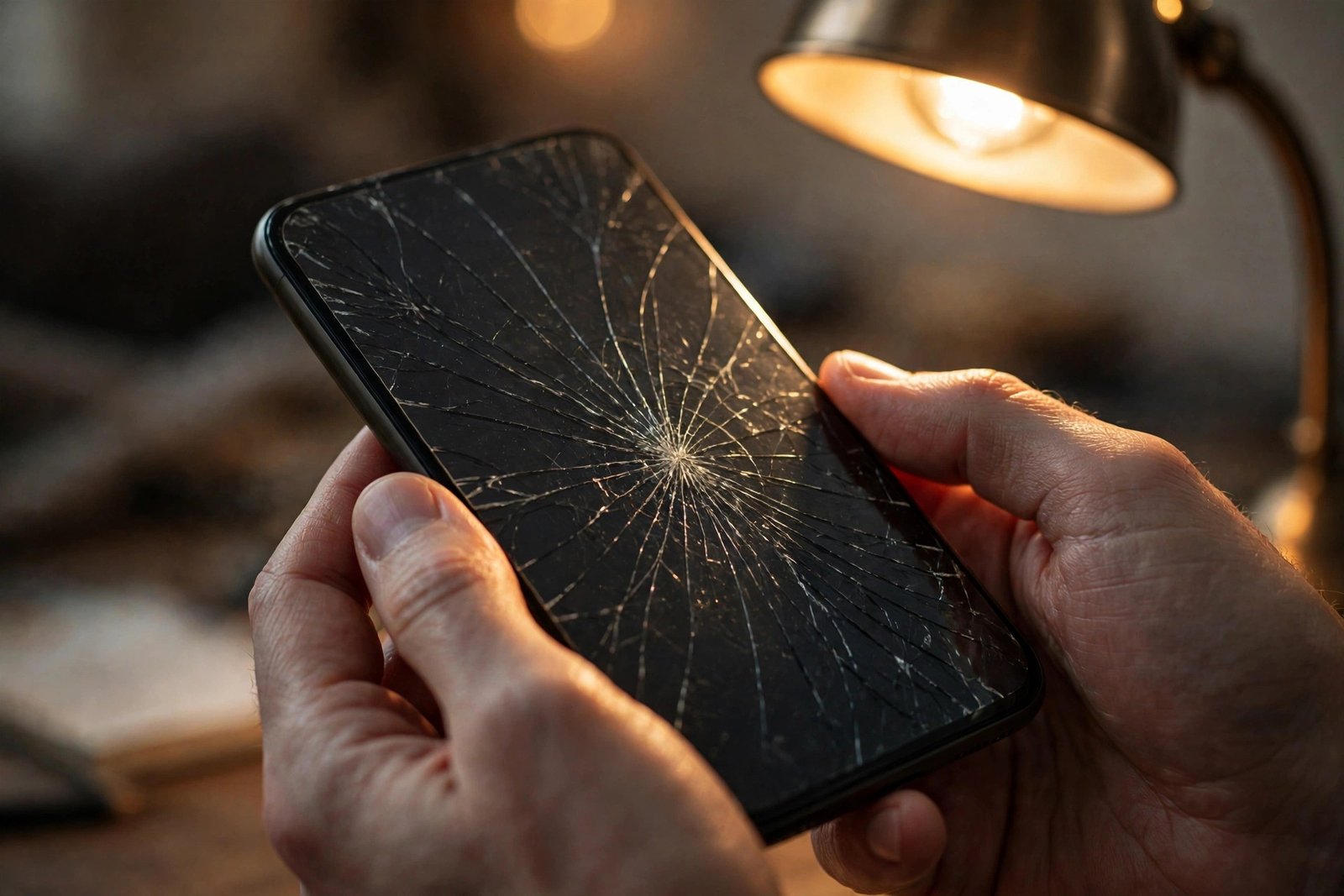
Your phone has slipped out of your hand, bounced once, and landed face-down. You pick it up with your heart thumping — and there it is: a crack across the display. Before the sinking feeling takes over, take a breath. In a large share of these moments, it is only the screen protector that has cracked, and the screen underneath is completely untouched.
That is, after all, exactly what a protector is for: it sacrifices itself so the screen doesn’t have to. This guide walks you through a calm five-minute check — look, feel, test, then decide — so you can work out which layer is damaged before you panic, book a repair, or spend anything.
Key Takeaways
- Don’t panic — a cracked protector doing its job looks almost identical to a cracked screen.
- A crack that stops at the protector’s edge is almost certainly only in the protector.
- Display problems — dead pixels, coloured lines, dark patches — point to the screen itself.
- If touch works perfectly everywhere, the odds are strongly in your favour.
- The fingernail test tells you which layer your nail is catching on.
- Peeling the protector off is the final proof — do it last, not first.
Step One: Look Closely (One Minute)
Start with your eyes, in good light. Turn the screen off first: on a dark display, cracks show up clearly as pale lines. Tilt the phone slowly under a lamp and watch how the crack behaves. A crack in a tempered glass protector tends to look bright and surface-level, with fine spider-webbing that sparkles as the light moves. Damage to the screen itself often looks deeper and duller, sitting visibly below the surface.
Now trace the crack to its ends. A protector is a separate sheet with its own border, usually a fraction of a millimetre inside the screen’s edge. If the crack stops dead at that border and does not continue onto the exposed glass near the speaker or edges, it lives in the protector. Then turn the screen on and look for warning signs: black spots, green or purple lines, flickering, or patches that don’t light up. Those live in the display panel itself, and they mean the screen is involved no matter what the surface looks like.
Step Two: Feel the Surface (One Minute)
Run a fingertip very lightly over the crack, then try the fingernail test: drag a nail gently across the crack line. If your nail catches and clicks at the crack, the broken layer is the top one — the one your nail can reach. Because the protector sits on top of the screen, a catchable crack is usually the protector announcing itself.
Also check the edges of the protector itself. Run your finger around its border. Protectors chip at their edges and corners first, and a chip at the border often sends hairline cracks wandering across the pane — classic protector behaviour. If the protector’s edge is chipped exactly where the phone landed, that is another reassuring clue that it absorbed the impact as designed.
- Work over a table, not your lap — if the protector is cracked glass, tiny fragments can shed while you handle the phone.
- Photograph the crack before you touch anything. If you later visit a repair shop, the photo shows the original damage clearly.
Step Three: Test Touch and Display (Two Minutes)
Now put the screen through its paces. Open an app with a plain background and drag an icon slowly across every part of the display, especially over and around the crack. If the icon follows your finger smoothly everywhere — no jumping, no dead zones, no touches registering on their own — the touch layer beneath the glass is working, which is a very good sign.
Finish by displaying a plain white screen, then a plain black one, at full brightness. Look for dead or stuck pixels, coloured speckles, lines that stay fixed in place, or shadowy patches. A healthy, even picture on both backgrounds, combined with perfect touch, means the panel underneath is almost certainly unharmed — and the crack you can see belongs to the replaceable layer on top.
Step Four: Decide — and the Final Proof
Add it up. Crack stops at the protector’s edge, nail catches on it, touch is flawless, display is clean: the protector cracked, the screen didn’t. Lines, dead pixels, dark patches, or touch problems: the screen is damaged too, and a repair assessment is the right next step. Mixed or uncertain results happen — a hard fall can crack both layers at once.
If you are still unsure, the final proof is simply to remove the protector. Cover a cracked glass pane with tape first so it lifts away in one piece, peel slowly from a corner, and inspect the bare screen. In most cases you’ll be greeted by flawless glass and a wave of relief. Fit a fresh protector straight away, and the whole episode becomes a story about the day your protector earned its keep.
- If the screen is damaged, back up your phone now, before it gets worse — touch faults and display damage can spread.
- Keep using a cracked protector in the meantime if the screen is fine — it still protects, though its sharp edges mean replacement shouldn’t wait long.
Frequently Asked Questions
Can a crack spread from the protector into the screen?
No. The two layers are separate; a crack in the protector cannot travel into the glass beneath it. What does happen is confusion — a crack that was in the screen all along, hidden under the protector’s damage, only becomes obvious when the protector comes off.
The crack is only in the protector. Can I leave it for now?
For a short while, yes — but don’t ignore it. A cracked protector has lost most of its protective strength, its edges can be sharp, and cracks collect dirt that makes the screen hard to read. Treat it as a prompt to replace it within days, not months.
My screen has a crack but everything still works. Is it safe to use?
Generally yes, with care. Cover it with a protector to keep moisture and dust out and to stop fragments lifting, and back up your data in case the damage worsens. Cracks can spread with temperature changes and everyday flexing, so plan the repair rather than forgetting about it.
Most cracked-phone dread ends with a cracked protector and a perfect screen beneath it. Look, feel, test — five calm minutes will tell you which one you’re dealing with.