

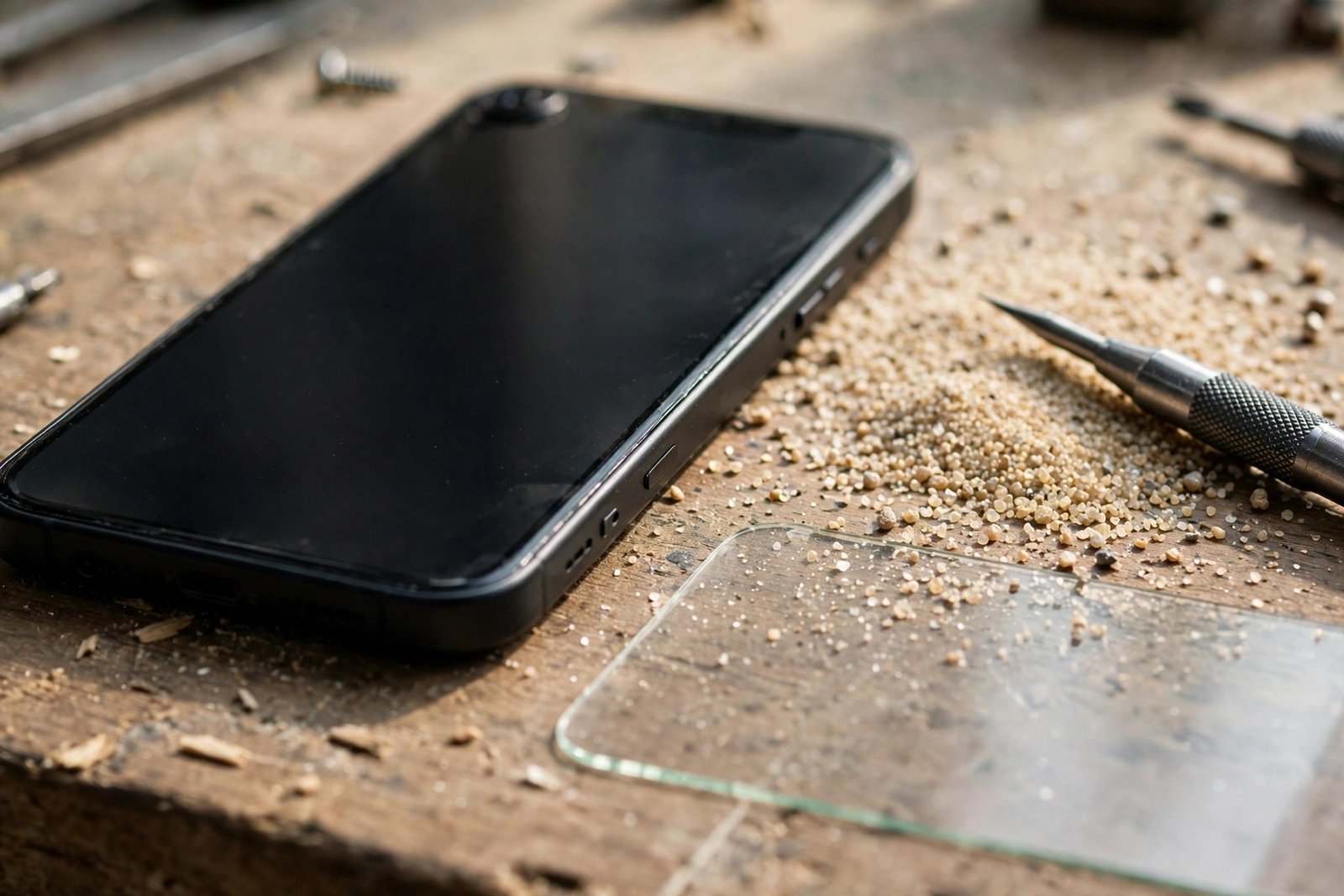
Let us deal in evidence rather than opinions. The iPhone 15’s front glass — Ceramic Shield — is among the toughest ever fitted to a phone, and the question of whether it needs a screen protector turns on two measurable things: how the glass performs when dropped, and how it performs when scratched. Those two tests tell very different stories.
This article walks through both sets of evidence: what drop testing shows about the iPhone 15’s crack resistance, what scratch testing shows about its hardness, and what those results mean for the protector decision in practice.
Key Takeaways
- In drop tests, the iPhone 15’s Ceramic Shield survives falls that cracked older iPhone glass — its crack resistance is genuinely class-leading.
- In scratch tests, it marks at roughly the same hardness level as rival flagship glass — visible scratches at Mohs level 6, deeper grooves at level 7.
- Crack resistance and scratch resistance are separate properties, and the iPhone 15 is strong in the first and ordinary in the second.
- The everyday damage the iPhone 15 actually suffers is micro-scratching and coating wear, not shattering.
- A protector on an iPhone 15 is therefore best understood as scratch insurance, not crack insurance.
The Drop Evidence: Crack Resistance Is Excellent
Start with the good news, because it is substantial. When the iPhone 15 range launched, independent testers dropped the phones onto concrete from pocket height, waist height and beyond — face-down, corner-first, and on their backs. The pattern across those tests was consistent: the front glass survived repeated drops that would historically have produced a spiderweb, often emerging with scuffed frame corners while the display stayed intact.
This matches how Ceramic Shield is made. Nano-ceramic crystals grown within the glass matrix make it harder for a crack to start and spread, and the material works with the frame to absorb impact energy. Nothing is indestructible — a corner-first landing on rough stone from head height can still defeat it — but measured purely on crack resistance, the iPhone 15 does not have an obvious weakness that a protector needs to fix. A thin sheet of tempered glass adds a little sacrificial protection, yet the phone’s own glass is doing most of that work already.
The Scratch Evidence: A Weaker Story
Now the standardised scratch tests. Testers use picks of increasing hardness on the Mohs scale, drawn across the glass with controlled pressure. On the iPhone 15, as on its recent predecessors and most flagship rivals, light scratches begin appearing at level 6, with deeper, clearly visible grooves at level 7. That result has been remarkably stable across several phone generations, despite all the progress in toughness.
What does that mean in the real world? Materials at level 7 and above — quartz is the everyday example — will cut the iPhone 15’s screen. Quartz is in sand, in much household and outdoor dust, in the grit that collects in pockets, bags and car interiors. Every one of those contacts is trivial on its own; together, over a year or two, they produce the fine haze of micro-scratches that nearly every unprotected phone eventually shows under a lamp. The evidence says the iPhone 15 has not escaped this. Its scratch profile is that of a normal, good smartphone — no better, no worse.
- Read drop-test headlines carefully. “Survived ten drops onto concrete” tells you about cracking — it says nothing about the scratches the same phone picked up being handled, wiped and carried between drops.
- The fastest way to grade your own screen: screen off, bright lamp, tilt slowly. What you see is your personal scratch evidence, and it accumulates from month one.
What the Protector Actually Does on an iPhone 15
Given the evidence, the protector’s job description on this phone is narrow and specific. It is not primarily there to stop cracks — Ceramic Shield handles that risk about as well as phone glass can. It is there to take the scratches: to be the surface that sand cuts, that pocket grit abrades, and whose fingerprint-resistant coating wears thin instead of the screen’s own.
It also covers the tail risks the lab numbers hide. Drop tests sample a handful of falls; your phone will meet angles, edges and surfaces no tester used. In those unlucky cases, a sacrificial layer that cracks first is not worthless — it is simply not the main reason to fit one. Buy it for the scratches you can predict, and treat any crack it ever absorbs as a bonus.
The Factual Verdict
Does the iPhone 15 need a screen protector? On crack evidence alone, you could argue it needs one less than any iPhone before it. On scratch evidence, it needs one exactly as much as they all did — which is to say, if you want the screen to look new in two years, yes; if faint cosmetic wear does not trouble you, no. The phone changed the crack conversation completely and the scratch conversation not at all.
- If you choose to go without, beach and building-site days are the exception — a temporary protector or a sealed pouch on high-grit days prevents the worst scratch damage an iPhone 15 can collect in a single afternoon.
- Already scratched? Fitting a protector now stops the count rising and can make existing micro-scratches less visible, since the adhesive fills them slightly.
Frequently Asked Questions
At what level does the iPhone 15 screen scratch in tests?
In Mohs hardness testing, the iPhone 15’s front glass typically shows lighter scratches at level 6 and deeper grooves at level 7 — in line with most flagship phone glass. That is why quartz-rich sand and grit, which sit at level 7 or above, are its main everyday enemy.
Can the iPhone 15 screen still crack at all?
Yes. Ceramic Shield improves the odds substantially, but it is not a guarantee. Corner impacts, rough stone, and drops from greater heights can still crack it, and the back glass — though strengthened in recent generations — has historically been the more vulnerable panel. Tough means tougher, never invincible.
Will a protector hide scratches my iPhone 15 already has?
Partially, yes. The adhesive layer of a tempered glass protector fills very fine micro-scratches, which makes many of them noticeably harder to see once the protector is on. Deeper scratches will still show. Either way, fitting one prevents the existing damage from being added to.
The evidence splits cleanly down the middle: the iPhone 15 is a champion against cracks and an ordinary phone against scratches — so the protector question is really a question about which kind of damage you actually expect.


