

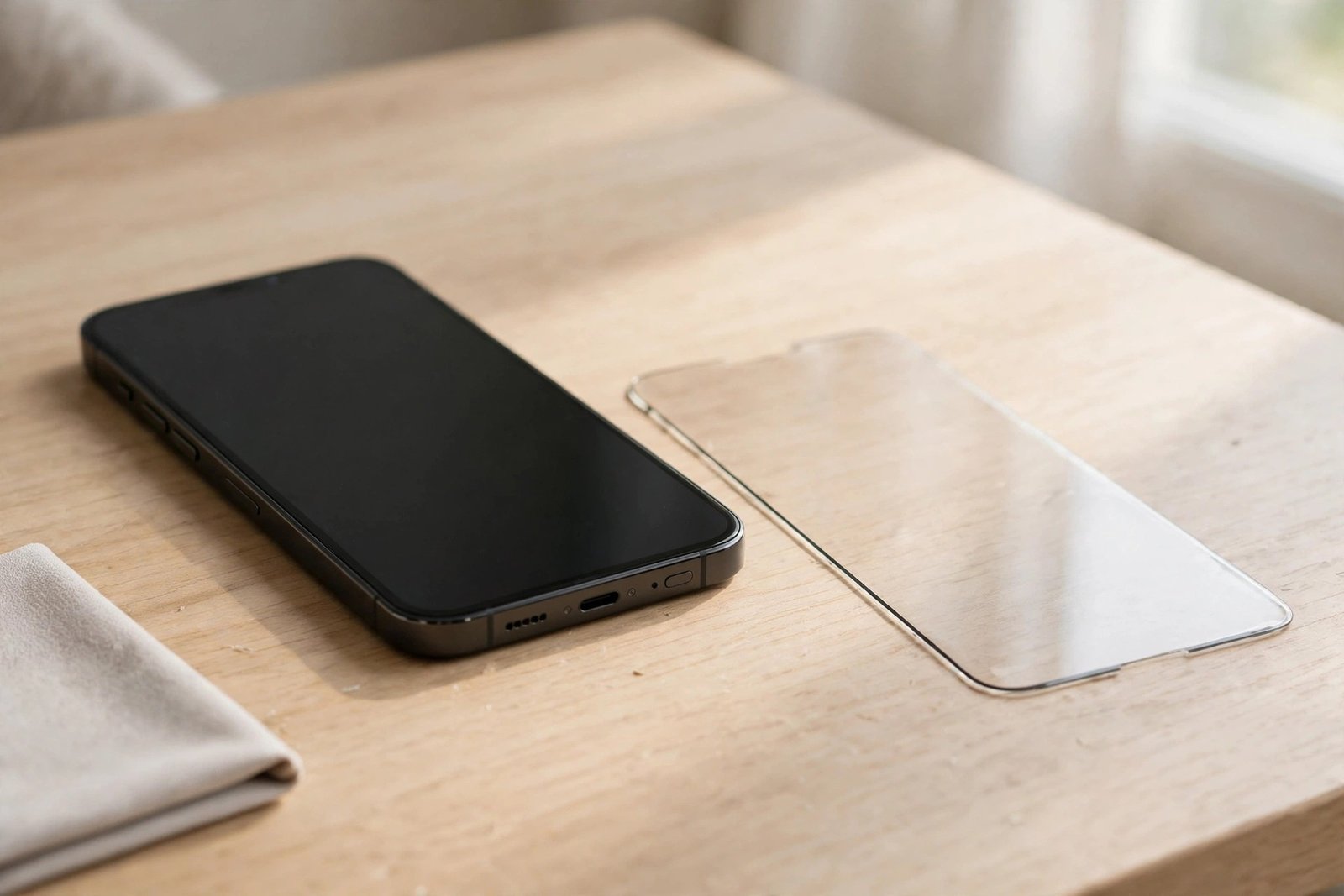
There are exactly two occasions when I take my screen protector off without a replacement in my other hand. The first is curiosity with a purpose: I want to inspect the real screen — after a bad drop, or before I sell the phone and need to describe its condition honestly. The second is the sale itself, when the buyer will want to see bare, unmarked glass. Both occasions taught me that taking a protector off is easy, but taking it off well — and managing the bare screen afterwards — is a small discipline of its own.
This guide covers my take-off routine when the protector is not being immediately replaced: the safe removal itself, what to do with the removed pane, and how I look after a bare screen for the hours or days until it is sold, repaired, or re-protected.
Key Takeaways
- Taking a protector off is reversible in decision, not in result — the pane rarely goes back on well, so I remove it only with a reason.
- Photograph the phone with the protector on before removal; it documents the screen’s protected history for a buyer or insurer.
- The removal itself is the standard one: corner lift, low angle, slow peel, with tape first if the pane is cracked.
- A removed pane is disposed of, not stored — dust ruins its adhesive within minutes of exposure.
- A bare screen needs case-on, pocket-alone discipline until it is covered again; this is when phones pick up their famous last-minute scratches.
- Before selling, a bare screen shown under a lamp is the strongest honest proof of condition I can offer a buyer.
Before I Take It Off: Photos and a Plan
Because a removed protector cannot meaningfully go back on, I treat the decision as one-way and prepare accordingly. If the phone is heading for sale, I photograph it first with the protector fitted, from a few angles and in good light — those pictures, plus the bare-screen photographs afterwards, tell a buyer the whole story: protected its entire life, and flawless underneath. If the take-off follows a heavy drop, I note which corner took the impact, because that is where I will look hardest once the pane is off.
I also decide, before peeling, what happens next. Is a fresh protector going on within the day? Is the phone being boxed for a buyer this week? Or am I simply going bare for a while because I miss the feel of the real glass? Each answer changes how careful the aftermath needs to be. The one plan I never make is “off now, decide later” — that is how screens meet keys.
The Take-Off Itself
The method is the familiar one, done unhurriedly. Case off, phone on a soft cloth. If the protector is cracked — after a drop, it often is — I cover it with clear tape first, so the fragments lift away as one sheet instead of scattering. Then I lift a corner with a fingernail, sliding it flat into the seam, and peel slowly at a low angle, supporting the freed glass so it cannot fold or snap. An intact pane rewards this patience by coming away in a single piece.
With the pane off, I clean the screen the gentle way: a microfibre cloth for adhesive traces, a barely damp pass for anything stubborn, then a dry buff. Then I inspect under a bright lamp, tilting the glass slowly. A hairline in the phone’s own screen catches the light differently from a surface mark — it stays visible from several angles and has a faint depth to it. Finding one is unwelcome, but finding it now, deliberately, is the entire point of the exercise.
- For a sale, I take the bare-screen photos immediately after cleaning, under a lamp at an angle — the same conditions a careful buyer will use to check it.
- If the inspection follows a drop, I test the touch response across the whole display too, drawing a continuous line in a notes app to find any dead zones.
Living With a Bare Screen
A phone that has been protected since day one going bare is, briefly, the most vulnerable phone I own — not because its glass is weak, but because my habits were built around a protector taking the knocks. For the bare interval, whatever its length, I change three habits. The case stays on, lip raised around the screen. The phone gets a pocket or compartment entirely to itself — no keys, no coins, no other phone. And it is never placed face-down, on any surface, for any reason.
If the bare period stretches beyond a few days, I usually end it early with a fresh protector. Modern screen glass is genuinely tough, but grit and quartz dust — the kind found in every pocket and on every beach — are still harder than it is, and the famous pre-sale scratch tends to arrive in exactly the week the phone was “only temporarily” unprotected. A cheap interim pane is better insurance than my good intentions.
- The removed pane goes straight into paper, taped shut, and into the bin — left on a desk, its exposed adhesive collects dust and its edges are a small hazard.
- Selling the phone? I mention in the listing that the screen was protected from new and photographed bare — it is a genuine selling point buyers respond to.
Frequently Asked Questions
Can I take my protector off just to look, then put it back?
You can try, but expect disappointment: once lifted, the adhesive picks up airborne dust and loses grip, so a refitted pane usually shows bubbles and lifting corners. If the look is important, I treat it as worth the price of a fresh protector and do the inspection properly, knowing the old pane is finished.
Should I remove the protector before selling my phone, or leave it on?
I remove it. A buyer cannot verify the screen’s condition through a worn, scratched protector, and many will assume the worst and haggle accordingly. A clean bare screen, inspected and photographed, removes the doubt entirely. If the protector is pristine and newly fitted, leaving it on as a bonus is the one reasonable exception.
Is it risky to use my phone with no protector at all?
It is a managed risk rather than a reckless one. With a case on, a dedicated pocket, and no face-down habits, a careful owner can run a bare screen for a long time. What I would not do is run one bare and caseless in a working pocket full of tools and grit — that combination collects damage on a schedule.
I take my protector off rarely and on purpose — photos taken, plan made, peel slow. The bare screen that follows is treated like what it is: the most valuable surface I own, temporarily without its bodyguard.


