

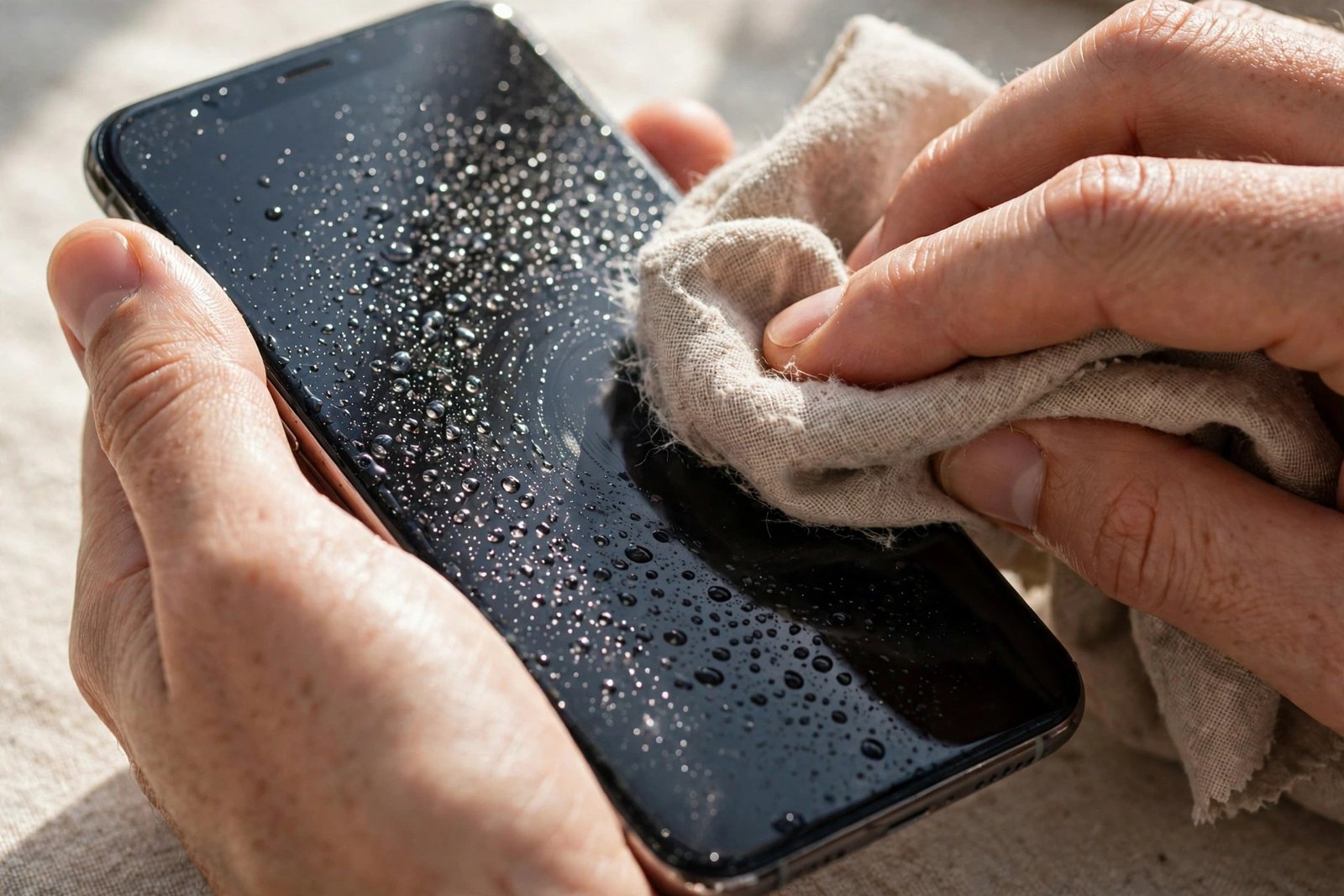
Liquid screen protectors — the wipe-on nano coatings sold as invisible armour — do not peel off like glass or film. There is nothing to grab, nothing to lift at the corner. So when the coating has worn patchy, or you want it gone before fitting a proper tempered glass pane, the obvious question is: how do you actually get it off? The honest answer is that you polish it off, gradually, the same way it was applied in reverse.
The good news is that a liquid coating is only nanometres thick and bonded lightly to the glass. It wears away on its own over months of swiping and pocket friction — removal is simply speeding that process up evenly, so no patch is left behind to interfere with whatever goes on next. This guide explains how the coating wears, how to buff it off completely, and how to prepare the bare glass afterwards.
Key Takeaways
- A liquid protector has no layer to peel — it is removed by gradual polishing, not lifting.
- The coating wears away naturally over months; removal just evens out and accelerates that wear.
- Use a microfibre cloth and patience, working in small circles — never abrasives, blades, or harsh solvents.
- The water-beading test tells you where coating remains: water sheets flat on bare glass, beads on coating.
- Strip it fully before fitting tempered glass — leftover patches cause uneven adhesion and bubbles.
- After removal the glass is genuinely bare, with no scratch protection at all — plan what goes on next.
How a Liquid Coating Actually Wears
A liquid protector is typically a silica-based coating applied as a wipe, which bonds to the surface of the glass and hardens into an ultra-thin layer. It fills microscopic pores, adds some scratch resistance and a slick, water-repellent feel — but it is measured in nanometres, not millimetres. Every swipe of your thumb, every slide in and out of a pocket, every wipe with a cloth removes a tiny amount of it. High-friction zones, like the thumb arc at the bottom of the screen and the area around the unlock point, wear through first.
That uneven wear is usually why people want it off. After several months a screen can feel grippy in worn patches and glassy elsewhere. Nothing has gone wrong — the coating is a consumable with a working life, commonly quoted at somewhere between six months and two years depending on the product and usage. Removal is not fighting the coating; it is finishing a job your thumbs already started.
Polishing the Coating Off, Evenly
Start by cleaning the screen thoroughly with a plain microfibre cloth so you are working on the coating itself, not on a layer of grease. Then, with a fresh section of cloth, polish the whole screen using small, firm circles and moderate pressure, working methodically from one corner across in overlapping bands. Keep going well past the point where it feels finished — the coating is invisible, so your arms, not your eyes, set the pace. Ten to fifteen minutes of steady polishing removes the bulk of a typical coating.
Resist shortcuts. Abrasive pads, metal polish, scouring powders and razor blades can all cut through a nano coating — and straight into the glass or its factory oleophobic layer beneath, leaving marks far worse than the coating ever caused. Strong solvents are likewise unnecessary and can damage seals and coatings elsewhere on the phone. If plain dry polishing feels slow, a cloth barely dampened with water is enough; the coating yields to friction, not chemistry. Work evenly over edges and cutouts, where coating lingers.
- Use two cloths: one for the polishing work, one clean and dry for the final check. A cloth loaded with removed coating just spreads residue back around.
- Polish in good light at a low angle. The slight difference in sheen between coated and bare glass is visible when light rakes across the surface.
Checking It Is Really Gone: The Water Test
Because the layer is invisible, you need a reliable way to know when you are done — and water gives you one. Put a few drops of clean water on the screen and tilt the phone. On glass still carrying the nano coating (or any hydrophobic layer), water pulls into tight beads and rolls around readily. On fully stripped, bare glass, the same drops flatten out and sheet, clinging in a film rather than beading. Test several spots — centre, corners, the thumb arc, around the cutouts.
Wherever water still beads, coating remains: go back to polishing that zone and test again. This step matters most if a tempered glass protector is going on next. Glass adhesive needs a uniformly clean surface; a surviving island of slick coating is exactly where the new pane will refuse to bond properly, leaving a bubble or a lifting patch that no amount of pressing will cure. Five extra minutes with the cloth is far cheaper than a spoiled install.
Preparing the Bare Glass Afterwards
Once the water test sheets flat everywhere, give the screen a final, gentle clean: a wipe with a clean microfibre cloth, then a pass with a dust-removal sticker if one is going on. Understand what you now have — completely bare glass. The nano layer took day-to-day micro-abrasion with it when it left, and the screen’s own factory coating may have thinned over the phone’s life too. Until something replaces it, the glass is at its most vulnerable to fine scratches from grit, keys and sand.
So decide the next step before you start polishing, not after. If you are recoating with a fresh liquid protector, apply it straight away to the freshly stripped glass, following the curing time before the phone goes back in a pocket. If you are upgrading to tempered glass, fit it the same session while the surface is pristine. If you are going without anything, accept the trade-off knowingly and keep the phone away from pockets shared with keys and coins — bare glass earns its scratches quickly.
- Going back to tempered glass? Polish, test, then fit in one sitting — every hour the stripped screen spends in a pocket is an hour of unprotected wear.
- If you plan to recoat in future, note the date you applied it. Recoating before the layer wears patchy is far easier than stripping a half-worn one later.
Frequently Asked Questions
Can I just fit tempered glass over a liquid coating?
Sometimes it works, but it is a gamble. A fresh, even coating can interfere with the glass adhesive and cause edge lifting or stubborn bubbles, and a half-worn coating is worse because adhesion varies across the screen. Stripping first with the polish-and-test method gives the glass a surface it can bond to uniformly.
Will polishing damage my screen or its factory coating?
A plain microfibre cloth and hand pressure will not harm the glass itself. The screen’s factory oleophobic coating does wear with polishing — but if you are removing a liquid layer, that surface coating has usually already worn thin in everyday use, and your new protector or recoat replaces its function.
How do I know if my liquid protector has worn off by itself?
The signs are a screen that feels less slick than it did, smudges that cling instead of wiping away easily, and water that sheets instead of beading. Use the drop test from this guide: if water sheets flat everywhere, the coating has effectively gone and there is nothing left to remove.
No peeling, no solvents, no drama — a liquid protector leaves the way it lived, one polish at a time. Test with water, prep the glass, and have its replacement ready.


