

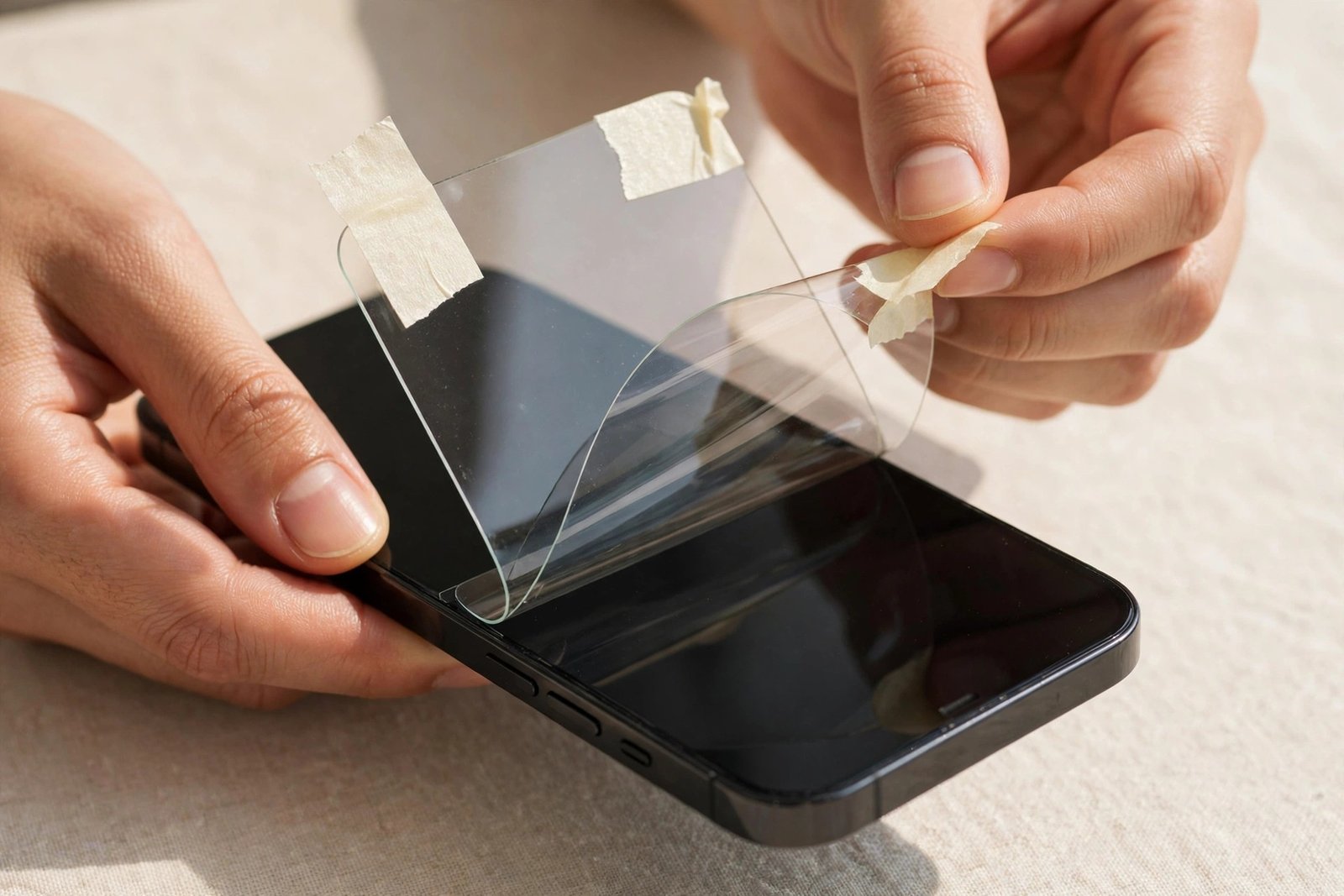
A tempered glass protector that comes off in one clean sheet is satisfying. One that breaks up mid-peel is not: the sheet flexes, fractures along new lines, and leaves glass slivers clinging to the screen. The difference between the two outcomes is rarely luck. It is technique — how the peel is started, the angle it travels at, and how the glass is supported while it moves.
This guide is about one goal: removing a glass protector in a single piece, intact or already cracked. It covers the tape-tab method that gives you a proper grip, the low-angle peel that keeps the sheet whole, and exactly what to do if the glass cracks further halfway through.
Key Takeaways
- The sheet stays whole when it is supported as it peels — a free-hanging corner concentrates all the stress in one line.
- Folded tape tabs on two corners give you a grip that fingers cannot, and keep your skin off the edges.
- Peel low and slow, nearly flat against the screen; a steep angle is what bends glass past breaking point.
- Already cracked? Cover the whole surface with tape first, so the pieces travel as one sheet, not twenty.
- If it cracks mid-peel, stop, tape the new crack, and continue — never press on a broken section with bare fingertips.
- Finish by sweeping the screen with tape to catch the invisible slivers your eyes will miss.
Why One Piece Matters
An intact sheet protects you twice over. Physically, you are handling one predictable object instead of loose fragments with sharp edges. Practically, a whole sheet takes its adhesive with it, leaving the screen nearly clean, while broken pieces leave islands of glass and glue behind. One-piece removal is faster, safer and tidier — and it is almost entirely a matter of how the peel is managed in the first ten seconds.
The enemy is concentrated bending. Tempered glass tolerates a gentle, even curve across its whole surface, but a sharp fold at one point — the corner you are pulling, while the rest is still bonded — exceeds what it can flex through and it snaps. Everything below is designed to spread that bend out: grip wide, pull low, and keep the freed part of the sheet supported rather than dangling.
Step 1: Tape the Surface and Make Your Tabs
If the protector is already cracked, begin by covering its entire surface with strips of ordinary sticky tape, overlapping them slightly and pressing them down firmly. The tape becomes a skin holding every fragment in its place, so the sheet behaves as one piece even though the glass inside it is not. If the glass is intact, you only need the tabs.
Now make two grip tabs. Fold a short length of tape back on itself at the end of a strip so you have a non-sticky handle, and fix one tab to each of the two bottom corners of the protector, wrapping them slightly underneath. These tabs are your steering: pulling both together lifts the sheet evenly, and they keep your fingertips away from the glass edges.
Step 2: Start the Peel from Both Bottom Corners
Take the phone out of its case and lay it flat on the table, screen up, over a sheet of paper or above a bin. Work a fingernail or the edge of a plastic card under one bottom corner until it releases — then do the same at the other bottom corner before going further. Starting both corners first matters: a peel that begins from two points spreads the lifting force across the full width of the sheet instead of twisting it from one side.
- Struggling to start a corner? A length of dental floss worked underneath in a gentle sawing motion separates glass from screen with zero scratch risk.
- Lift with the tabs, not your nails, once the corners are free — tabs pull evenly, nails pull at a point and invite a snap.
Step 3: The Low-Angle Peel
Pull both tabs together and draw the sheet back nearly flat against the screen, as though you were folding it back over itself. The freed glass should hover just above the surface it has left, supported by your tabs, never hanging in the air. Move slowly — a few millimetres a second — and let the bond line travel up the screen in a straight front. If one side races ahead of the other, ease off that tab and let the lagging side catch up; a diagonal bond line twists the sheet, and twist is what cracks it.
Resist the urge to speed up as the end approaches. The last third of the peel is where impatience snaps sheets, because the bonded area is small and every tug lands on less glass. Keep the same pace to the top edge, then lift the whole sheet away and lay it sticky-side up on the paper, out of harm’s way.
If It Cracks Mid-Peel
Sometimes, despite good technique, a sheet — especially an old or already damaged one — cracks partway. Stop immediately. Do not push a fingertip onto the broken section to encourage it. Lay a fresh strip of tape across the new crack and over the freed area, press it down around (not on) the break, and resume the same low, slow pull. The tape now carries the pieces, and the peel continues as one movement.
If a fragment detaches and stays on the screen, leave it until the main sheet is off, then lift it individually: press tape firmly onto it and peel it away at the same low angle. Check your fingertips before you touch your face or the bare screen — slivers are easy to carry — and wash your hands once the job is done.
- Afterwards, press a clean strip of tape over the whole bare screen and lift it off: it picks up the hair-fine slivers that are invisible against the glass.
- Roll the removed sheet inside its own tape before binning it, so no sharp edge is exposed for the next person who empties the bin.
Frequently Asked Questions
Why did my protector snap even though I pulled gently?
Usually because the bend was concentrated, not because the pull was strong: one corner lifted high while the rest stayed bonded, or the peel travelled diagonally and twisted the sheet. Age plays a part too — old glass that has absorbed knocks carries invisible micro-fractures and breaks along them at the first flex. The two-tab, low-angle method exists precisely to spread that stress evenly.
Is it safe to touch the removed glass with bare hands?
The face of a removed sheet is harmless; the edges and any fractured areas are where the sharp points live. Handle the sheet by its tape tabs or by the middle of its surface, keep broken sections taped, and wash your hands afterwards. If a sliver does prick your skin, treat it as you would any tiny splinter: clean the spot and check nothing remains.
Can I reuse a glass protector that came off in one piece?
It is tempting, since the sheet looks perfect — but the adhesive face will have picked up dust, fibres and skin oils during removal, and those show as bubbles and cloudy patches within hours of refitting. A one-piece removal is its own reward: a clean screen and no mess. Fit a fresh protector instead.
One piece is not luck — it is a wide grip, a low angle and a steady pace, held to the very top edge. Master those three and glass removal becomes the calmest job in phone care.


