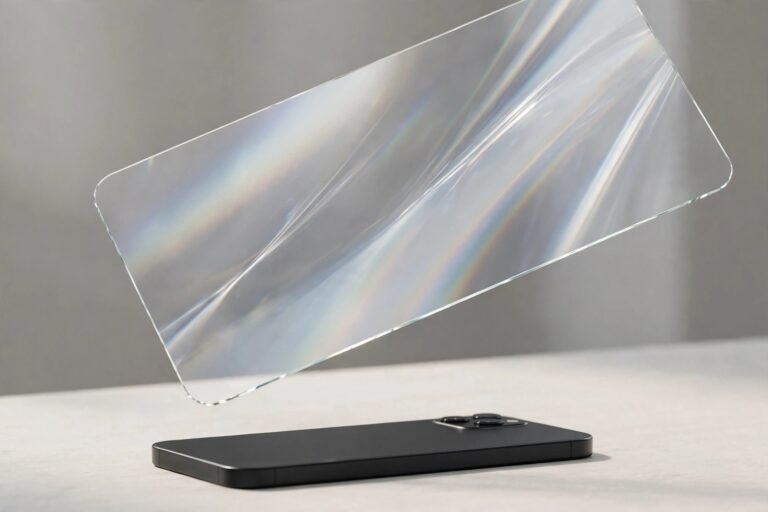
Tempered glass versus plastic film is the oldest argument in screen protection. Glass fans call film flimsy; film fans point out that their protector has never once shattered in a pocket. Both are half right. The two materials fail in completely different ways, age differently, and cost you money on very different schedules.
This head-to-head works through the differences that actually matter — scratch behaviour, drop behaviour, clarity over months of use, and the true cost per year once replacements are counted — then gives an honest verdict split by how you use your phone.
Key Takeaways
- Tempered glass resists scratches vastly better than plastic — keys and pocket grit mark film within weeks.
- On impact, glass shatters to absorb energy; plastic scuffs, dents and survives — but absorbs much less.
- Glass keeps its clarity until it breaks; plastic clouds and scratches gradually from the day it is fitted.
- Counted per year, costs are closer than they look: glass needs occasional replacement, film needs frequent replacement.
- The honest verdict is split — the better material depends on your drops, your pockets and your screen shape.
Scratches and Everyday Wear
Day to day, the biggest threat to your screen is not the dramatic drop — it is the slow grind of keys, coins, zip teeth and the fine grit that lives in every pocket and bag. Against that threat the materials are not close. Tempered glass is hardened to a level where common metals and sand slide off without leaving a mark. Plastic film is softer than the grit itself, so it collects fine scratches steadily, and within a month or two a film protector often looks hazier than the screen it is guarding.
That wear is cosmetic, and it is worth being clear about the trade: a scratched film has still done its job, because every one of those marks is a scratch your screen did not take. Some films are marketed as self-healing, and the softer coatings genuinely can smooth out the lightest scuffs with a little warmth — but deeper scores are permanent, and no film heals its way back to glass-like clarity.
Drop Behaviour: Shatter Versus Scuff
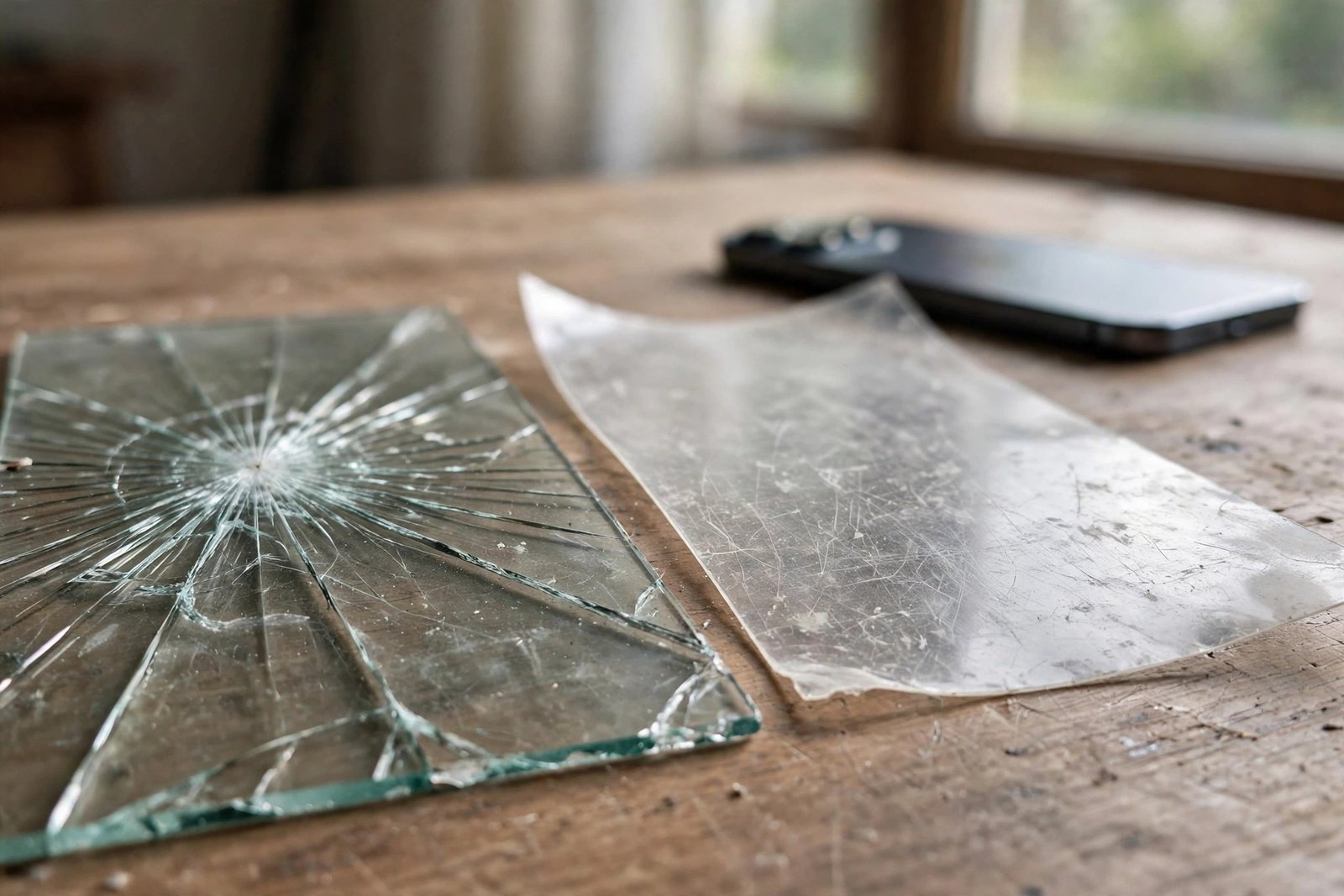
Drop the phone and the philosophies diverge completely. Tempered glass is rigid and brittle by design: a sharp impact concentrates force, the pane cracks across its surface, and in cracking it consumes energy that would otherwise drive into the screen. You peel off a spiderwebbed protector and, in the great majority of cases, find an unmarked display beneath. The protector died so the screen didn’t have to.
Plastic film does the opposite: it does not break at all. It dents, scuffs or creases at the impact point and carries on — convenient, and cheaper in the moment. But because it barely absorbs energy, a drop hard enough to threaten the screen will mostly threaten it straight through the film. Film excels at sliding, scraping falls across rough ground, where it takes the abrasion; against the classic corner-down drop onto concrete, glass is the stronger bodyguard.
- A cracked glass protector after one drop is not a defective protector — it is evidence the energy went into the pane instead of your screen.
- If you use film, keep expectations in proportion: it is scratch armour, not drop armour, so pair it with a case that has a raised lip.
Clarity Over Time and the Cost Per Year
Glass ages in a single dramatic moment; plastic ages a little every day. A glass pane looks and feels exactly like the bare screen until the instant it cracks. Film starts nearly as clear but accumulates micro-scratches, a faint texture, and sometimes yellowing or edge lifting, so by month six many owners are looking through a visibly tired layer. If image quality bothers you, that slow decline is a real cost, paid in enjoyment rather than money.
Money, though, is closer than the sticker prices suggest. Film is cheaper per unit but is typically replaced several times a year to stay presentable. Glass costs more per unit and may survive a year untouched — or crack in its first week if the phone takes a bad fall, after which it must be replaced, since a cracked pane protects poorly and feels awful. Over twelve months, a careful owner usually spends less on glass; a habitual dropper can spend less on film and a good case.
The Verdict, Split by Use Case
For a flat screen, a phone carried loose in pockets and bags, and an owner who hates visible wear, tempered glass is better than plastic in almost every respect that matters: harder, clearer, slicker, and willing to sacrifice itself in a fall. This is why it has become the default recommendation.
For a strongly curved or folding screen, glass often cannot fit properly at all, and film wins by default. Film also wins for owners who prioritise a feather-thin profile, matte anti-glare finishes, or simply the lowest possible spend on a phone they handle carefully. Neither material is a scam and neither is magic — each is the right tool for a different set of hands.
- Buy glass in multi-packs if you drop your phone often — the cracked pane is a consumable, and having the next one in a drawer removes the unprotected gap.
- Whichever you fit, note the date: replacing on a schedule (film every few months, glass at the first crack) keeps protection honest.
Frequently Asked Questions
Is plastic film ever genuinely the better choice?
Yes — on curved and folding screens where glass cannot adhere properly, when you want a matte anti-glare surface, or when you use a stylus heavily and prefer film’s slight paper-like resistance. In those roles film is not a compromise; it is the correct tool for the job.
Why does tempered glass crack so easily if it is supposed to be strong?
Because its strength is against scratches and surface pressure, not bending. A thin pane of glass is hard but not flexible, and a sharp, concentrated impact exploits that. The cracking is also functional: the fracture pattern spreads and absorbs the impact energy instead of passing it neatly into your screen.
How often should each type be replaced?
Replace glass the moment it cracks or its edges start lifting — a broken pane has spent its protective ability. Replace film when scratching and cloudiness build up, typically every three to six months, or sooner if it peels. In both cases, a fresh protector is cheap insurance compared with a screen.
Glass is armour that dies in battle; plastic is a raincoat that wears thin. Pick based on what actually threatens your phone, and you will not be disappointed by either.