Here’s a genuinely common moment of doubt: you fit a new screen protector, look at your phone — and can’t tell whether it’s actually on there. Or you pick up a second-hand phone and wonder whether the surface you’re touching is the screen itself or a protector someone fitted before you. Screen protectors are designed to be nearly invisible, so not being able to spot one is usually a sign of a good product, well fitted. But there are always tells.
This guide describes what a screen protector actually looks like — on the phone and in your hand — the visible differences between glass and film, and the reliable ways to tell whether a phone already has one fitted.
Key Takeaways
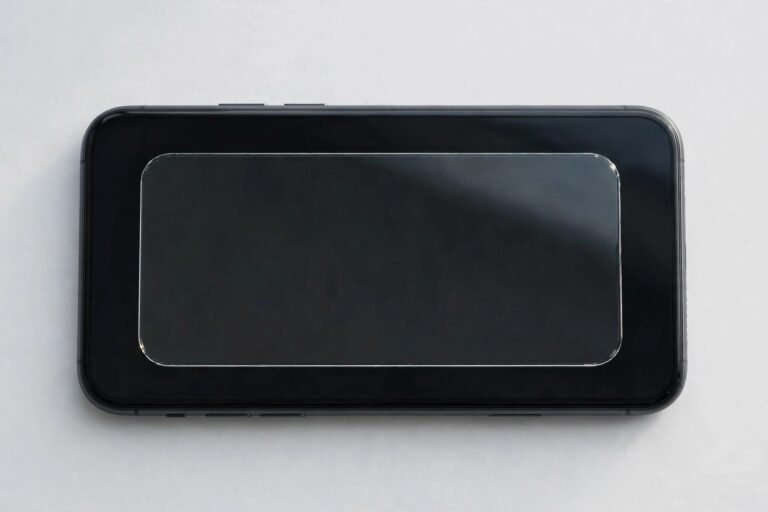
- A well-fitted protector is nearly invisible: a clear sheet that follows the screen’s outline, stopping a fraction short of the edges.
- The most reliable tell is the edge — run a fingernail across the screen boundary and you’ll feel a tiny step where the protector ends.
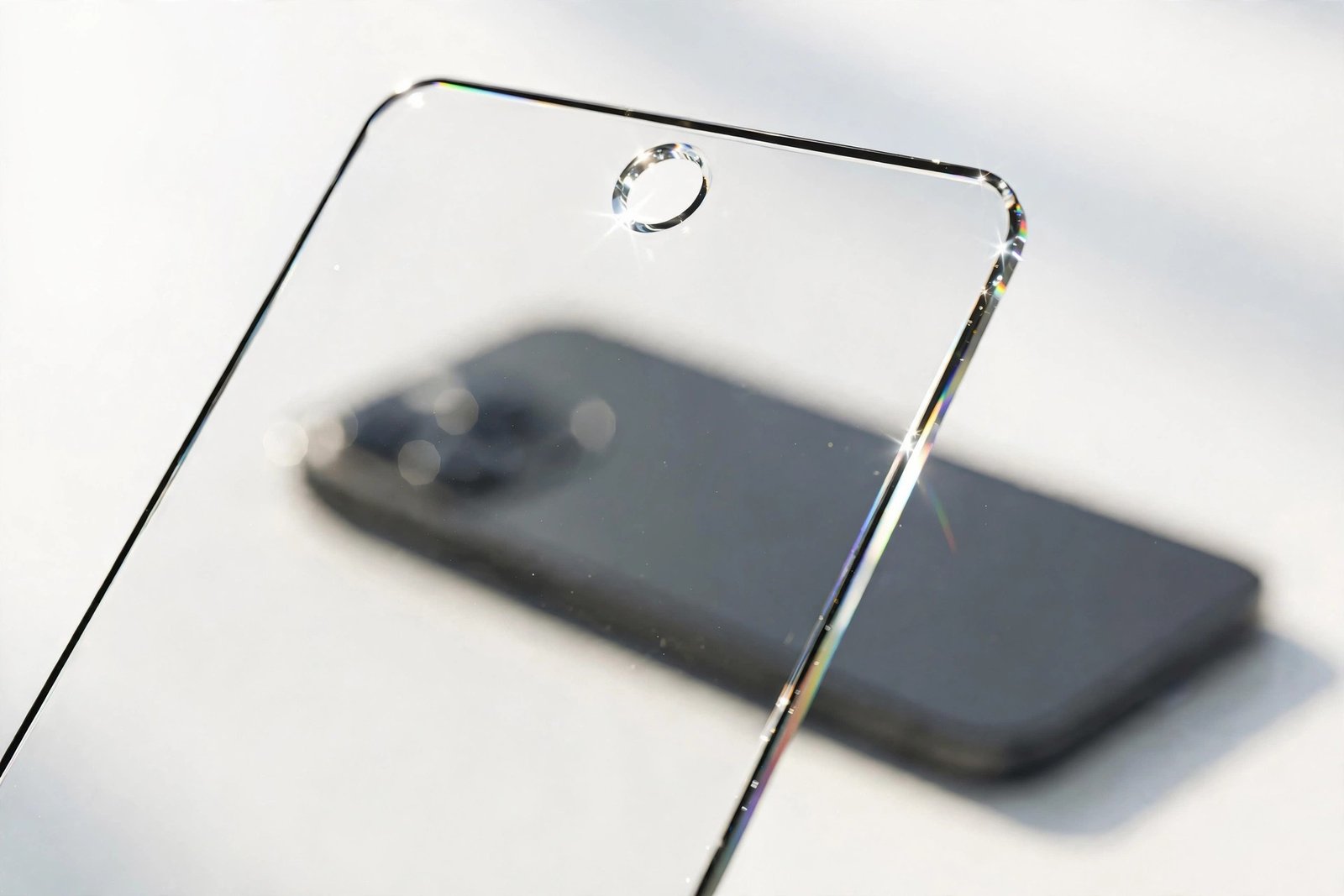
- Look at the top of the screen: a protector has its own cut-out or border around the camera and speaker that may not perfectly match the phone’s own.
- Tempered glass looks and feels like the screen itself — rigid, glossy, with a polished edge you can catch in the light. Film is thinner, slightly softer-looking, and may show a faint orange-peel texture.
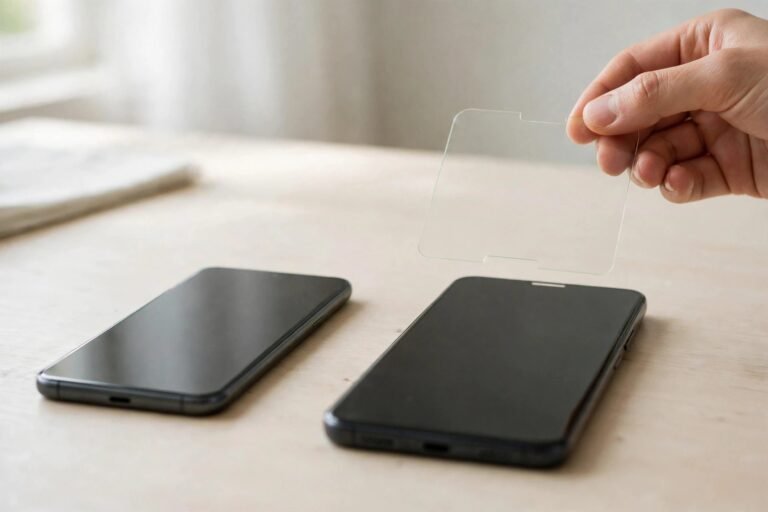
- Out of the box, a protector is a clear sheet on a stiff backing card, with a peel-off layer and usually tabs or an alignment frame.
On the Phone: What a Fitted Protector Looks Like
Hold the phone with the screen off, tilted toward a light. A fitted protector appears as a very slightly raised clear panel covering almost — but not quite — all of the front glass. There’s usually a hairline margin of a millimetre or two between the protector’s edge and the phone’s frame; that small gap is deliberate on “case-friendly” designs. On full-coverage models, the protector runs closer to the frame and often has a thin black printed border that mimics the screen’s own bezel, making it harder still to spot.
Around the front camera and earpiece you’ll see the protector’s own shaping: a small circular hole, a U-shaped notch, or a cut-out tracing the phone’s notch or camera island. Because the protector is a separate layer, this cut-out catches the light slightly differently from the glass beneath — at an angle, you can often see a faint outline or a hairline of dust gathered along it. Signs of age show here too: edges that have begun to lift look white or silvery where air has got underneath, and a worn protector shows fine scratches and a duller finish than the strip of bare glass near the frame.
Tempered Glass vs Film: The Visual Differences
Tempered glass is about a third of a millimetre thick — enough that its edge is a real, physical edge. Tilt the phone and you’ll catch a bright line of refracted light along it, and a fingernail dragged across the screen boundary clicks over a distinct step. The surface is glossy and perfectly flat, indistinguishable in use from the phone’s own glass, and if it has ever taken a hard knock you may see the giveaway: a crack pattern in a layer that sits on the screen, while the display underneath still works perfectly.
Film protectors (PET or TPU) are several times thinner, so their edge is far subtler — you may feel nothing at all, and spot one only by a faint change in reflections. Film has a slightly softer optical quality; TPU “self-healing” films in particular can show a mild orange-peel texture under raking light. Film also flexes: its corners sometimes lift in smooth curves rather than chipping, and fingernail marks can dent it temporarily. If the surface feels ever so slightly rubbery compared with glass, you’re touching film.
- The fingernail test is definitive: drag a nail gently from the phone’s frame toward the centre of the screen. If there’s a protector, you’ll feel a tiny lip or step where it begins. No step at all, anywhere around the edge, means you’re touching the bare screen.
In the Box: What a New Protector Looks Like
Before fitting, a tempered glass protector is a rigid, crystal-clear sheet — it looks like a piece of the phone’s screen cut out on its own — supplied stuck to a protective backing film on a card, often with numbered peel tabs, and sometimes mounted in or accompanied by a plastic alignment frame. It has real weight for its size and doesn’t bend. A film protector arrives as a flimsy transparent sheet, usually sandwiched between two backing layers marked “1” and “2” for the two-stage peel, and it curls and flops like cling film.
Speciality types have their own looks. Privacy protectors appear noticeably darker and greyish when viewed off-angle, though clear straight-on. Matte protectors have a frosted, satin finish that diffuses reflections even in the packet. Paper-feel protectors for tablets look like matte film with a subtly grainy surface. If you’re holding a completely clear, rigid sheet with a camera cut-out that matches your phone’s outline, that’s standard tempered glass.
How to Tell If a Phone Already Has One
Bringing it together: switch the screen off, tilt the phone under a lamp, and look for the edge line and the camera cut-out’s outline. Run a fingernail across the boundary near a corner — the spot where protectors most often start to lift and are easiest to detect. Check whether scratches or a crack stop abruptly at a line inside the frame; damage confined within a border is damage to a protector, not the screen. Finally, look at the earpiece area: two subtly mismatched outlines — the phone’s own recess and a cut-out on top of it — mean a protector is fitted.
- Buying a used phone? If you find a cracked protector, that’s good news, not bad — ask the seller if you may peel a corner. More often than not, the screen underneath is flawless, and you’ve just negotiated with full information.
Frequently Asked Questions
Can you see a screen protector once it’s on?
Barely. A quality protector, well fitted, is designed to disappear — you’d spot it mainly by its edge, its camera cut-out, or the way light catches its boundary at an angle. If you genuinely can’t tell, that means it was fitted well.
Does a screen protector change how the screen looks?
A clear glass protector makes no visible difference to brightness, colour, or sharpness in normal use. The exceptions are deliberate finishes: matte protectors soften reflections and slightly soften the image, and privacy protectors darken the view from the sides on purpose. Standard clear glass and film aim for — and achieve — invisibility.
What does a cracked screen protector look like vs a cracked screen?
A cracked protector shows cracks that stop at the protector’s edge, within the frame, and the display beneath remains bright and fully functional with no bleeding, dark patches, or dead lines. A cracked screen usually shows damage running to the frame’s edge and often display problems underneath. When in doubt, peel the protector off — that settles it instantly.
A screen protector looks like almost nothing at all — a whisper of an edge, a cut-out that catches the light. Learn those two tells and you’ll never wonder whether one is fitted again.