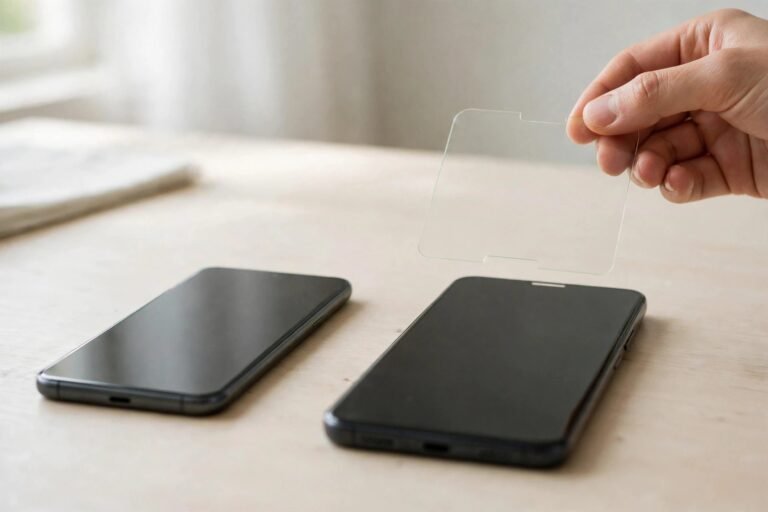
Before tempered glass took over the market, almost every screen protector sold was a thin plastic film — and that film was almost certainly PET. It is still the cheapest protector you can buy, still bundled free with many cases, and still the source of a reasonable question: what actually is a PET screen protector?
PET is a specific plastic with specific strengths. It will not do what tempered glass does, and it was never meant to. Understanding what it is — and what it is for — makes choosing between it, tempered glass and TPU straightforward.
Key Takeaways
- PET stands for polyethylene terephthalate — the same clear plastic used to make drinks bottles.
- A PET protector is a very thin film, roughly a tenth of a millimetre thick, that guards against scratches and scuffs only.
- It offers no meaningful impact protection: a drop that would crack glass will usually crack the screen beneath a PET film too.
- Clarity is its strong suit — a quality PET film is nearly invisible and barely changes the screen’s look or thickness.
- Tempered glass adds drop protection; TPU adds self-healing and curved-edge coverage. PET wins on thinness and price.
What PET Actually Is
Polyethylene terephthalate is one of the world’s most common plastics — the PET in a protector is the same polymer family as the bottle your water came in, produced as a precision film instead of a moulded container. As a screen protector it is a multi-layer sandwich: a hard-coated top surface that resists scratching (typically rated around 3H on the pencil hardness scale), the PET film itself providing the body, and a silicone adhesive layer that clings to the screen and can be peeled away without residue.
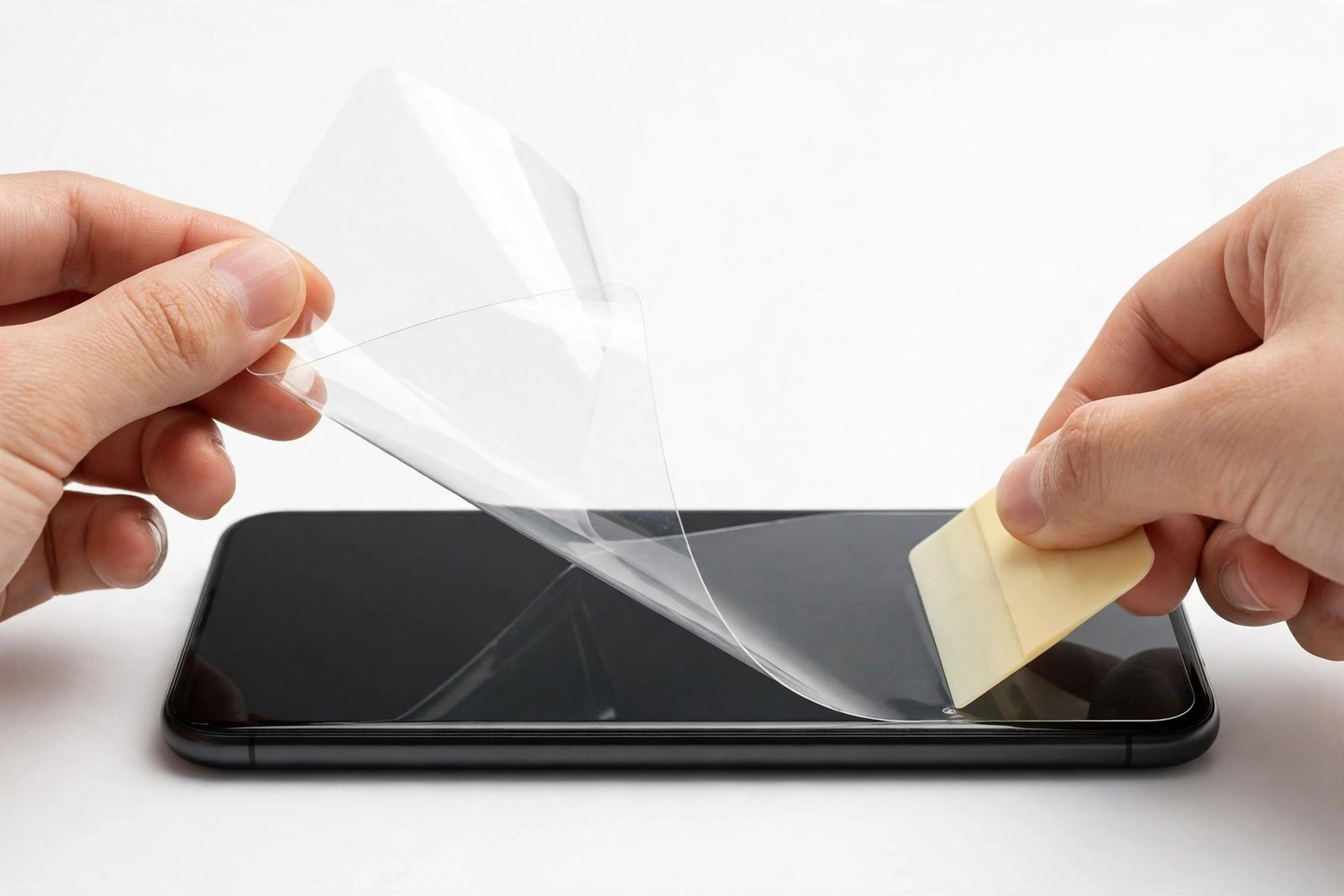
The finished article is astonishingly thin — around 0.1 mm — and completely flexible, which is why PET protectors arrive rolled or flat-packed in envelopes and are fitted with a squeegee rather than simply dropped into place like glass.
What a PET Protector Does Well
Scratch defence is the entire point, and at that job PET is genuinely good. Keys, coins, pens, the gritty contents of bags and pockets — the everyday abrasives that slowly haze an unprotected screen — are stopped at the film instead. Because the film takes the wear, the glass underneath stays pristine, which matters when you sell or hand the phone on.
PET’s thinness brings practical bonuses too. In-display fingerprint sensors read through it reliably, a stylus sits closer to the display with less parallax than through thick glass, and the film adds essentially no bulk, so every case fits as designed. Optical clarity is excellent — a well-fitted PET film disappears — and matte versions exist that cut glare for readers and artists.
- Fit PET film in a steamy bathroom and use two pieces of tape as hinges on one edge. Film shows every bubble and speck of dust far more than glass does, so the dust-free air and the hinge method earn their keep.
Where PET Falls Short
Impact is the obvious gap. PET has no tempered structure and almost no thickness, so it cannot absorb or spread the energy of a drop in any meaningful way. Drop a phone wearing PET onto concrete and the film may come through intact while the screen beneath it cracks — the two events are barely related.
Day to day, the film itself also wears. The hard coat resists scratching far better than bare plastic, but over a few months of pockets and wiping, fine marks and a slight haze accumulate on the film’s surface. Edges can begin to lift, and once dust gets under a lifted edge the film looks grubby quickly. Expect to replace a PET protector every few months to keep it looking clean — cheap, but a chore.
PET vs Tempered Glass vs TPU
Tempered glass is the protector most people picture: a rigid sheet, roughly 0.3 mm thick, that feels exactly like the screen itself and adds genuine impact protection by fracturing sacrificially. It is the best all-rounder, but it cannot bend, so on strongly curved screens its edges may not adhere. TPU is a soft, rubbery film at the other extreme: it can be wrapped around curves, is usually fitted wet, and its surface is slightly self-healing, so minor scratches fade. Against that, TPU can feel tacky to a fingertip and has a faint orange-peel texture that softens the display’s sharpness.
PET sits between them in feel and below both in protection: thinner and clearer than TPU, cheaper and easier to source than glass for obscure devices, but strictly a scratch shield. Think of the three as different tools — armour (glass), a stretchy skin (TPU), and a clear coat (PET).
- If your phone’s screen curves at the edges and glass protectors keep lifting, a PET or TPU film that follows the curve will stay put where glass can’t. A protector that remains attached protects better than a “stronger” one sitting in a drawer.
Who Should Still Choose PET
PET makes real sense in specific situations: a tablet that lives in a folio case and faces pens rather than drops; a child’s hand-me-down phone where the film can be replaced monthly for pennies; a stopgap on a brand-new phone while a glass protector is in the post; and older or obscure devices for which glass was never made. In those roles, its thinness, clarity and negligible price are exactly what is wanted.
Frequently Asked Questions
Will a PET screen protector stop my screen cracking if I drop the phone?
No. PET is scratch protection only — it is too thin and flexible to absorb impact energy. For drop protection you need tempered glass, and ideally a case as well.
Is PET the same as TPU?
No. They are different plastics with different behaviour: PET is a thin, relatively stiff film; TPU is softer and rubbery, usually wet-fitted, wraps around curved edges and can self-heal minor surface scratches.
How long does a PET screen protector last?
Typically a few months before fine scratches and haze build up on its surface. They are sold in multi-packs precisely because they are treated as a consumable — replaced regularly rather than fitted once.
PET is the original screen protector, and it still earns its place — as long as you ask it to do the job it was made for. Keep scratches off, keep expectations about drops at zero, and it is excellent value.