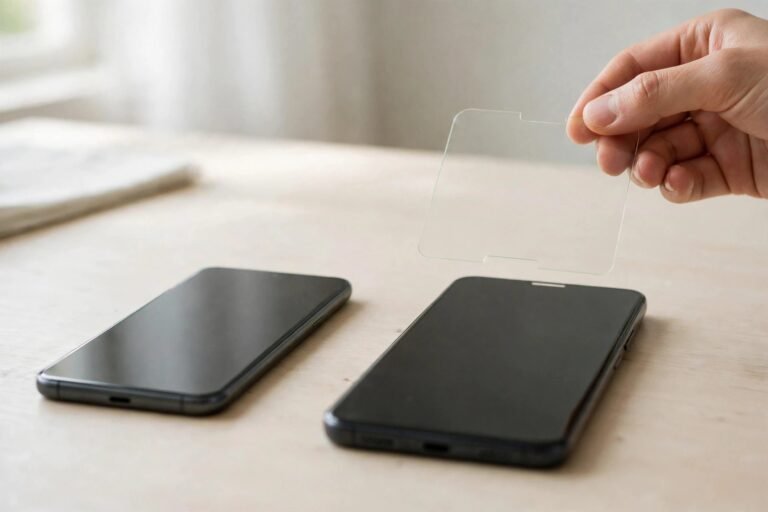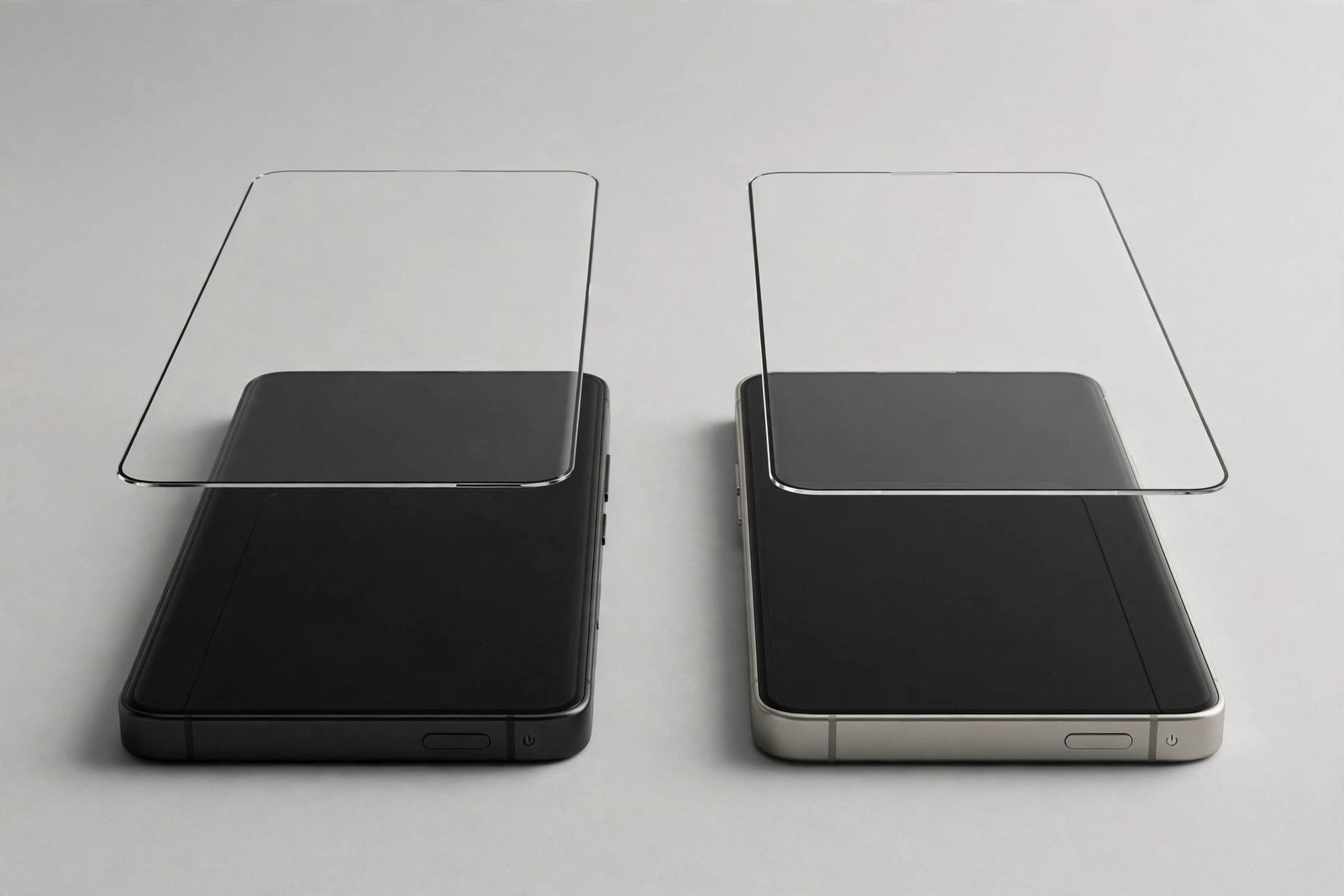
They look like twins. The Galaxy S22 and Galaxy S23 share the same design language, the same 6.1-inch display size, and nearly identical dimensions — so it’s natural to ask whether a spare S23 protector will fit your S22, or the other way round. The short answer is: not properly, and not officially. The longer answer explains why a gap of a fraction of a millimetre matters more than you’d expect.
Screen protectors are precision-cut accessories. They are made for one specific model’s screen, camera position and edge geometry — and Samsung changed all three, slightly, between these two generations. Here’s what differs and what happens if you try the swap anyway.
Key Takeaways
- The S22 and S23 are close but not identical: the S23 measures about 146.3 × 70.9 mm, the S22 about 146.0 × 70.6 mm — a difference of only a few tenths of a millimetre.
- Both phones have a 6.1-inch display, but the front camera position and edge curvature differ slightly between generations.
- Protectors are not officially interchangeable — reputable brands sell S22 and S23 protectors as separate products for a reason.
- A tempered glass S23 protector on an S22 will typically show misaligned camera cut-out or lifting edges; the mismatch is small but real.
- Thin film protectors are more forgiving than glass, but even they are not a recommended cross-fit.
- Always buy the protector listed for your exact model — and double-check S23 FE and S22 FE listings, which are different sizes again.
The Dimensions: Close, but Not the Same
On paper, the two phones are separated by very little. The Galaxy S23 is about 146.3 mm tall and 70.9 mm wide, while the Galaxy S22 is about 146.0 mm tall and 70.6 mm wide. Both carry a 6.1-inch display with the same resolution class. If protectors were loose-fitting accessories, that would be close enough — but they aren’t. A tempered glass protector is cut to match its target screen with tolerances well under a millimetre, because it has to sit inside the raised bezel, clear the case lip, and seal flat against the glass.
A difference of a few tenths of a millimetre in width means an S23 glass protector on an S22 is fractionally too wide for the flat area of the S22’s screen. It may overhang the very slight curve at the screen’s edge on one or both sides, which prevents the adhesive from sealing. The result is the familiar “halo” of unbonded edge, or a corner that lifts within days. The reverse swap — S22 glass on an S23 — leaves a slightly larger uncovered border and the same alignment problems described below.
The Camera Cut-Out Problem
The most visible mismatch is at the top of the screen. Both phones use a centred punch-hole front camera, but its exact position relative to the top edge differs slightly between the two models, as do the surrounding sensor placements and the earpiece slot. A protector cut for one phone places its camera opening where that phone’s camera sits — on the other phone, the opening sits a fraction off-centre from the lens.
In practice, a slightly misaligned cut-out rarely blocks the camera completely, because the opening is larger than the lens itself. What it does produce is a visibly off-centre ring around the camera, and in some cases a shadow or soft edge on selfies if the glass edge intrudes into the lens’s field of view. Full-coverage protectors with printed black borders make the mismatch more obvious still, because the border is printed to follow one specific model’s bezel line.
- Before peeling the backing off any protector, hold it over your screen without removing the film and check the camera opening against the lens. If it isn’t perfectly concentric, you have the wrong model’s protector — returning it unopened is far easier than removing a fitted one.
Edge Curvature and the Fingerprint Sensor
Both phones have mostly flat displays, but “mostly” is doing some work in that sentence. The way the glass rolls off into the frame — the edge profile — was subtly revised for the S23 generation. Protectors rely on the flat central area for adhesion, and a protector shaped for one edge profile may not seal cleanly on the other, particularly at the corners. This is also why some cross-fitted protectors seem fine on day one and start peeling a week later: the adhesive was never fully bonded at the edges to begin with.
Both models use an ultrasonic in-display fingerprint sensor, which reads through the protector. Ultrasonic sensors are more tolerant than optical ones, but a poorly seated protector with micro-gaps at the edges can still reduce reliability. If you do experiment with a cross-fit and unlocking becomes erratic, the protector — not the phone — is the first suspect. With the correct model-specific glass, re-registering your fingerprints after fitting restores normal performance.
So, Can You Get Away With It?
Honestly? Sometimes, briefly, with film. A flexible film protector tolerates small dimensional differences better than rigid glass, and an S23 film on an S22 (or vice versa) will usually lie flat and protect against scratches, albeit with a slightly off-centre camera opening. As an emergency measure while a correct protector is in the post, it’s defensible. Tempered glass is far less forgiving — the rigidity that makes it protective is exactly what makes a sub-millimetre mismatch show up as lifting edges and halos.
But “can get away with it” is not the same as “fits”. Neither Samsung nor protector manufacturers list the two models as interchangeable, warranties on the protector won’t contemplate the swap, and the small saving is rarely worth a protector that peels, misaligns or compromises the fingerprint sensor. Protectors for both models are inexpensive and widely available in multi-packs, so the correct one is easy to get. Buy the protector made for your phone, and keep the spare for the phone it actually belongs to.
- Watch out for “FE” models when ordering: the S23 FE and S21 FE have different dimensions from both the S22 and S23, and marketplace listings sometimes bundle them confusingly. Check the listing names your exact model before buying.
Frequently Asked Questions
Will an S23 case fit an S22 — and does that mean the protector fits too?
No to both, generally. The camera module design changed between the two phones, so cases are model-specific as well. Case and protector compatibility follow the same rule: near-identical dimensions do not make accessories interchangeable.
My S23 protector seems to fit my S22 fine. Is it OK to leave it?
If it has sealed flat, the camera opening is clear, and the fingerprint sensor works reliably, it is doing its job for now. Just be aware that marginal edge adhesion tends to fail over time — if lifting or a halo appears, replace it with the correct S22 protector rather than pressing it back down repeatedly.
Does the same apply to the S22+ and S23+?
Yes — the Plus models are also extremely close in size across the two generations (both around 6.6 inches) but are likewise not officially interchangeable, for the same reasons of cut-out placement and edge profile. Always match the protector to the exact model.
A third of a millimetre sounds like nothing — until it’s the difference between glass that seals and glass that peels. Match the protector to the phone, every time.