Liquid screen protectors are the most seductive idea in phone protection: wipe on an invisible coating, wait for it to cure, and — so the marketing goes — your screen is hardened against scratches and drops alike, with nothing to see, peel or bubble. No edges, no alignment trays, no visible protector at all. It is a wonderful pitch. The question is how much of it survives scrutiny.
The honest verdict is a split one. A liquid protector is a real but very thin coating that offers modest help against fine scratches, and essentially unproven help against the thing most people buy it for — a dropped phone. Understanding that gap between the pitch and the physics is the whole story.
Key Takeaways
- Liquid protectors are wipe-on nano coatings, typically based on silicon dioxide, that bond to the glass as an extremely thin hardened layer.
- Independent scrutiny consistently supports only modest scratch resistance — a small improvement over bare glass against light abrasion.
- Drop-protection claims are unproven: a coating measured in nanometres cannot absorb impact energy the way a sacrificial sheet of glass can.
- The genuine advantages are real: total invisibility, no bubbles or edges, and one product fits any screen shape, including curved ones.
- Some products are bundled with screen-repair guarantees whose terms vary enormously — read the small print before valuing them.
What a Liquid Protector Actually Is
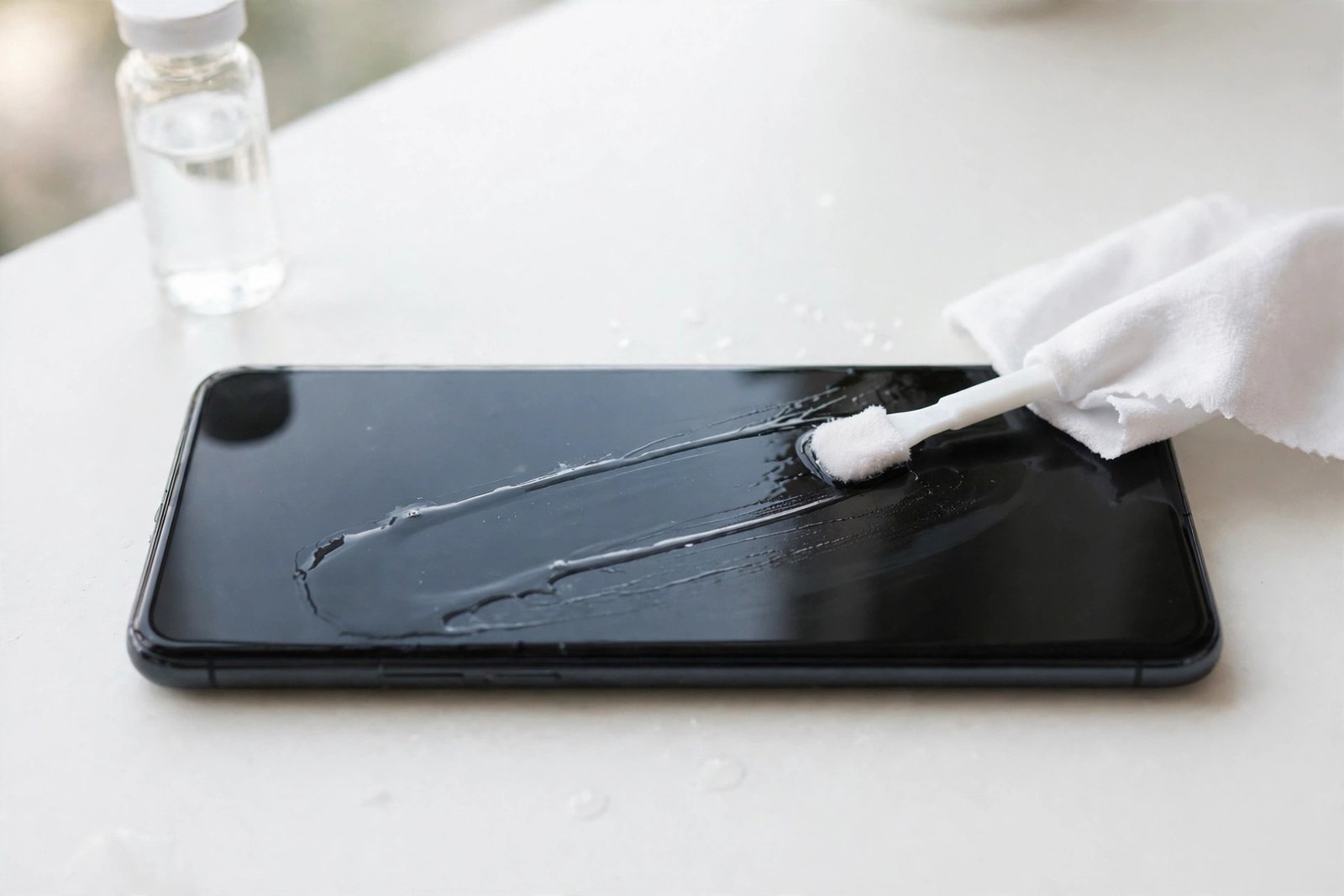
Most liquid protectors are solutions containing silicon dioxide — the main ingredient of glass itself. You wipe the liquid across a cleaned screen, it fills microscopic pores and imperfections in the glass surface as it cures, and it hardens into a coating so thin it is measured in nanometres. For comparison, a tempered glass protector is hundreds of thousands of times thicker.
That thinness explains both sides of the product. On the plus side, the coating is genuinely invisible, adds no bulk, follows curved edges perfectly, never lifts or bubbles, and doesn’t interfere with cases, touch response or fingerprint sensors. On the minus side, there is simply very little material there — and in protection, material is what does the work.
Scratches: The Modest, Defensible Claim
Where liquid protectors have a legitimate case is scratch resistance. A cured nano coating presents a slightly harder, smoother surface than the glass beneath, and testing by reviewers and independent testers generally finds a small real-world benefit: fine keys-and-coins type abrasion that might lightly mark bare glass is somewhat less likely to mark a coated screen. Some products also refresh the slick, fingerprint-resistant feel of a worn screen, which can make an older phone feel newer in the hand.
But keep the scale in mind. The improvement is incremental, not transformative — the same sand and grit that scratch glass will still scratch a coated screen, because sand is harder than both. And unlike a sheet protector, the coating wears away gradually with friction and cleaning over a period of months, cannot be visually inspected, and once it’s gone, it’s gone: there is no sacrificial layer left to peel off and reveal a pristine screen beneath.
- Be wary of hardness numbers in liquid protector marketing. A coating can test hard on a scratch scale yet be far too thin to matter in a fall — hardness and impact absorption are different properties.
- If you apply one, follow the curing instructions exactly and keep the phone unused for the stated period; an under-cured coating delivers even less than the modest protection promised.
Drops: Where the Claims Outrun the Physics
Impact protection is a game of energy absorption and spreading. A tempered glass protector works in a drop because it has substance: it spreads the force across its surface and destroys itself in the process, spending the energy. A nano coating has almost no substance to spend. There is no meaningful mechanism by which a layer a few hundred atoms thick cushions a phone striking concrete — and independent drop testing has not produced convincing evidence that coated screens survive falls that uncoated ones don’t.
This is why many liquid protectors are sold alongside a repair guarantee rather than on protection claims alone: register the product, and if your screen breaks within a set period, the scheme contributes toward repair. Treat these schemes as insurance products, not as evidence the coating works — and read them like insurance. Registration deadlines, claim windows, caps on the amount paid, exclusions and proof requirements vary widely between brands and change over time. A generous-sounding guarantee with a low cap or a registration step most buyers miss is worth far less than its headline suggests.
- If a guarantee is part of why you’re buying, register the product the same day you apply it and keep the proof of purchase — missed registration is the most common reason claims fail.
- Check whether the scheme pays a fixed amount, a percentage, or only at approved repairers; the differences decide what the guarantee is actually worth to you.
So Who Is a Liquid Protector Actually For?
Judged on what it can prove, a liquid protector suits a narrow but real audience: people who hate visible protectors, use a good case for drop protection, and want a little extra defence against the fine scratches of daily life — particularly on curved screens that glass protectors fit poorly. Used with those expectations, it is a reasonable product.
It is a poor choice as your only line of defence if drops are your main fear. For that job, the unglamorous combination of a tempered glass protector and a case with a raised lip remains what the evidence supports — a sacrificial layer you can see, test by touch, and replace for a small outlay when it does its job.
Frequently Asked Questions
Can a liquid protector be removed?
Not in the way a sheet protector can — there is nothing to peel. The coating wears away gradually through everyday friction and cleaning over a period of months. That is a double-edged property: you are never stuck with it, but you also cannot restore a pristine screen by removing it, and you cannot easily tell how much protection remains at any given moment.
Can I apply a glass protector over a liquid one?
Generally yes — once fully cured, a liquid coating underneath a tempered glass protector does no harm, and some people apply the coating first as a base layer. Just be aware the liquid layer adds little once glass is on top; the glass is doing the overwhelming majority of the protective work in that combination.
How long does a liquid protector last?
It fades rather than ends. Friction from pockets, bags and cleaning wears the coating down over months, and makers’ suggestions about reapplication intervals vary. Because the layer is invisible, there is no reliable home test for how much remains — if you rely on one, reapplying on the maker’s schedule is the only way to maintain whatever benefit it provides.
Liquid protectors work a little, invisibly, against scratches — and claim a lot, unproven, against drops. Buy one for the first job if you like, but never rely on it for the second.