You didn’t drop it. You’re sure you didn’t drop it. Yet this morning there’s a crack across your screen protector that definitely wasn’t there last night — and the mystery of a crack with no culprit is surprisingly unsettling. Take heart: protectors almost never crack for no reason. They crack for a reason you didn’t witness, and the glass itself usually keeps a record of what happened.
A “spontaneous” crack is really a delayed one. Somewhere in the protector there was a weakness — a microscopic edge chip, a pressure point, a flaw from the factory — and something ordinary finally pushed it past breaking point: a cold night, a tight case, a phone flexing in a pocket. This guide explains the four usual hidden causes and shows you how to find the crack’s origin point, which is where the real story is written.
Key Takeaways
- Glass doesn’t crack spontaneously — there’s always a stress source plus a flaw for it to start from.
- Temperature swings (a freezing car overnight, then a warm house) expand and contract glass and can finish off a weakened edge.
- A hidden edge chip from an old knock can sit invisibly for weeks before a crack finally runs from it.
- Constant pressure — a tight case lip, or in rare cases a swelling battery pushing from behind — loads the glass until it gives.
- Some protectors simply carry manufacturing flaws: uneven tempering or rough-cut edges that fail early.
- Find the origin point — where the crack’s lines converge — and it will point you to the cause.
Cause 1: Thermal Stress
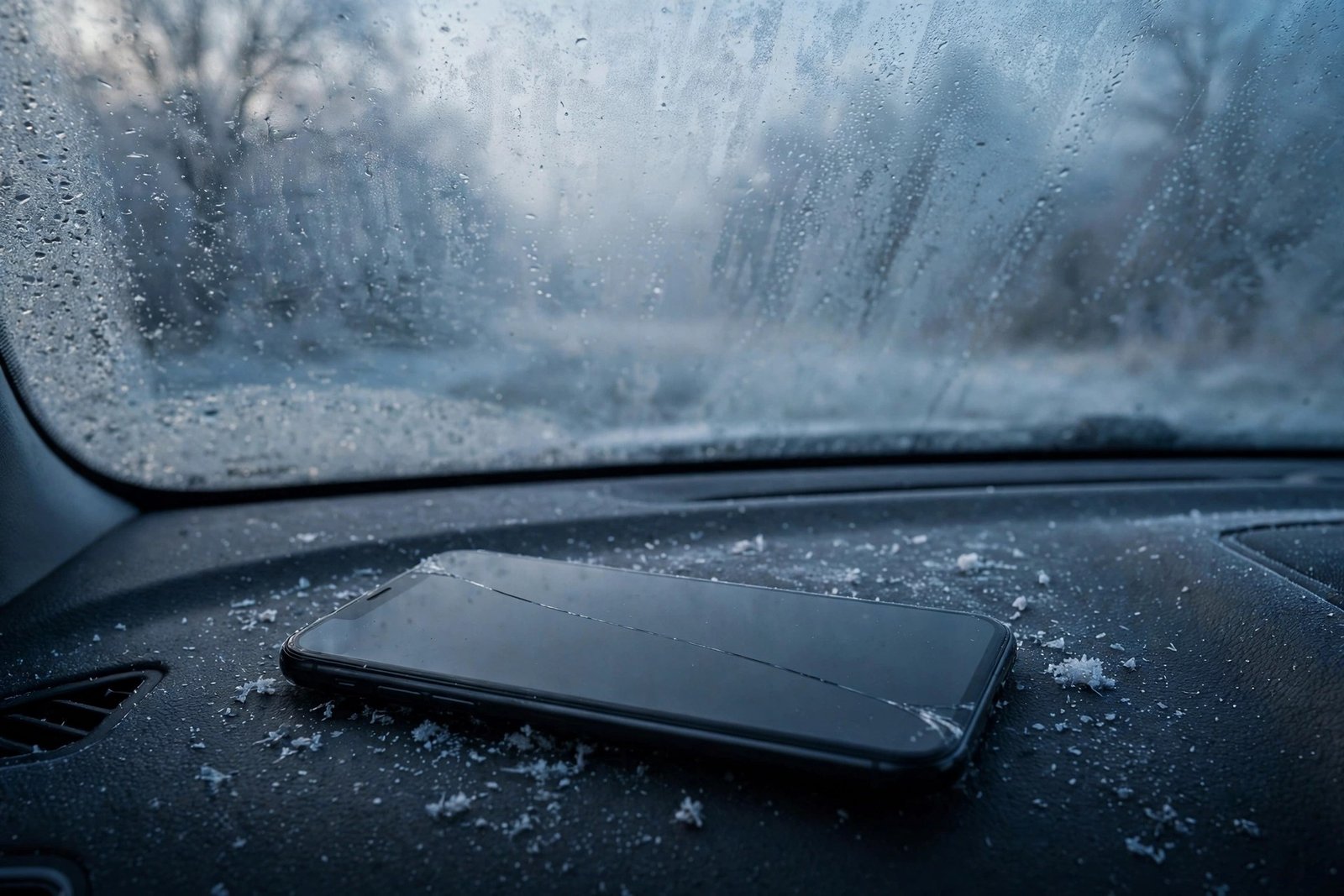
Glass expands when warm and contracts when cold, and it does so unevenly when one part of the sheet changes temperature faster than another. A phone left in a frosty car overnight, then brought into a heated house — or worse, placed on a warm dashboard in morning sun — experiences exactly that uneven stress. Healthy glass shrugs it off. Glass with a microscopic flaw at its edge may not: the flaw concentrates the stress until a crack runs, quietly, while the phone sits untouched on the table.
This is why so many “random” cracks are discovered in the morning or after a journey. If your crack appeared after a big temperature swing, thermal stress completing the work of an earlier weakness is the likeliest explanation.
Cause 2: The Hidden Edge Chip
Weeks ago, your phone clipped a table corner or landed edge-down on a hard floor. The protector seemed fine — and mostly, it was. But the impact knocked a microscopic chip out of the glass’s edge, too small to see and hidden under the case lip. Every day since, ordinary flexing has worked on that chip like a wedge in a log. Then one unremarkable moment — picking the phone up, pressing it into a pocket — the stored stress released and a crack ran the length of the sheet in an instant.
This delayed failure is the single most common “random” crack. The drop you forgot about was the cause; the quiet Tuesday morning was merely the completion.
- After any edge-first knock, inspect the protector’s edges with a fingernail even if it looks fine — a tiny chip you can feel is a crack scheduled for later.
- Cracks from thermal stress often start mid-edge rather than at a corner, where temperature differences bite hardest.
Cause 3: Constant Pressure — Case or Battery
Sometimes the stress isn’t an event but a condition. A case lip that presses hard on the protector’s edge loads that edge twenty-four hours a day; add a cold night or a minor knock and the loaded edge finally cracks, seemingly from nothing. Pressure from behind the screen tells a more serious story: a battery that has begun to swell pushes the display outward, flexing everything attached to it. If a protector cracks from the centre outward, or the screen itself looks slightly domed, or the case no longer fits flush, stop and have the phone inspected — a swelling battery is a genuine safety issue, not a protector problem.
Less dramatically, a phone habitually carried in a back pocket gets sat on, and repeated gentle flexing fatigues flawed glass in exactly the same way. The crack arrives on a quiet afternoon, but the bending happened a hundred times before.
Cause 4: Manufacturing Flaws — and Reading the Origin Point
Finally, some protectors are simply born weak. Uneven tempering leaves internal stresses locked into the sheet; rough cutting leaves edges full of micro-notches. Such a protector may crack under a temperature change or trivial flex that a well-made sheet would survive a hundred times. If a nearly new protector cracks with no knock, no case pressure, and no temperature drama, a factory flaw is the honest verdict — and a reason to switch brands rather than reorder the same one.
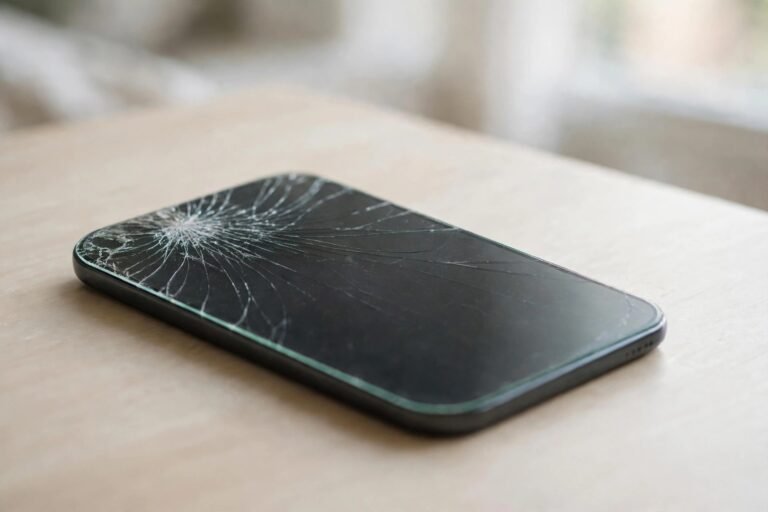
Whatever the cause, the glass tells you where to look. Examine the crack pattern: fracture lines radiate away from their origin, so trace them back to where they converge. A starburst or dense knot of lines marks an impact point. Lines sweeping in from one edge point to an edge chip or case pressure at that spot. A single clean line running from mid-edge suggests thermal stress. The origin is the diagnosis — and it tells you whether to change your case, your habits, your brand, or get the phone itself checked.
- Photograph the crack before removing the protector — once it’s off, the evidence of where it started is gone.
- If cracks keep originating from the same edge across several protectors, that edge is being loaded — check the case fit and what’s in the pocket or bag on that side.
Frequently Asked Questions
Can a screen protector crack from cold weather alone?
Cold alone rarely cracks healthy glass, but a sharp temperature change — freezing car to warm room — stresses the sheet, and that stress finds any existing flaw. So the weather is usually the trigger rather than the root cause. Avoid leaving your phone in a freezing car overnight where you can, and let a cold phone warm up gradually rather than on a heater.
My protector cracked but my phone was in its case the whole time. How?
A case guards against drops, not against the causes in this guide. Thermal stress passes straight through a case, a pre-existing edge chip keeps developing under one, and a tight case can itself be the pressure source. In a small number of cases the phone — not the protector — is flexing, which is worth checking if cracks keep recurring with different protectors.
Should I worry that the real screen will crack the same way?
Usually not — your phone’s display glass is tougher and better supported than a thin protector sheet, and it doesn’t carry the protector’s edge flaws. The exception is the pressure scenario: if a swelling battery is flexing the phone, the display is at risk too. Check for a domed screen, a case gap, or the phone rocking on a flat table, and get it inspected promptly if you find any.
A crack that appears from nowhere is really a story finishing itself — an old chip, a cold night, a constant squeeze. Read the origin point, fix the cause, and the next protector’s story should be a much duller one.