

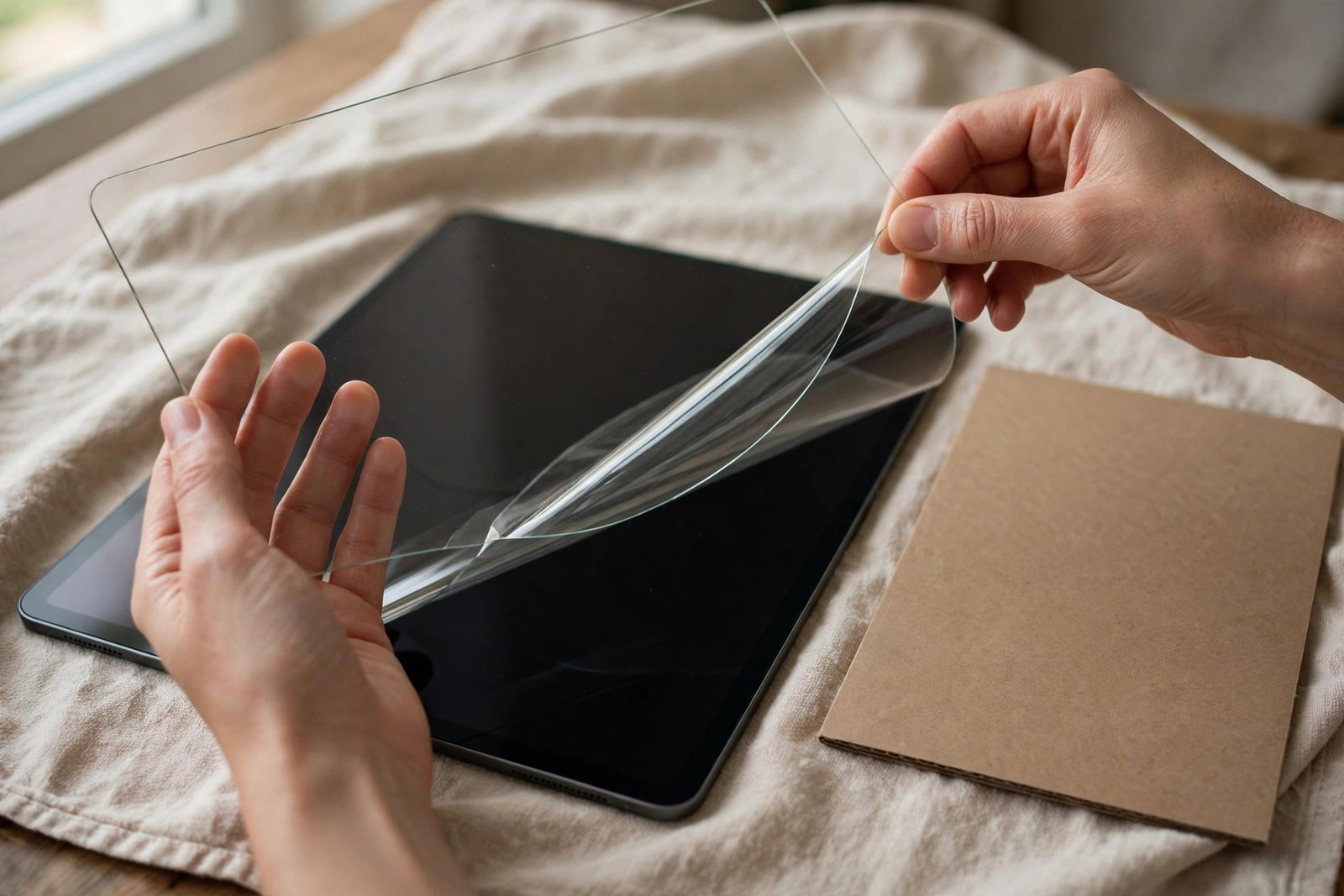
Everything about an iPad screen protector is the phone job scaled up — and the scaling changes the technique. A pane that spans ten or eleven inches has far more adhesive holding it, far more length to flex as it lifts, and far more opportunity to crack halfway across. The one-handed corner peel that works on a phone will fold a tablet pane, and a folding pane is a breaking pane.
This guide adapts removal to the big screen: a flat work surface, two hands working together, a low peel angle maintained across the full width, and a corner-to-corner path that keeps the freed glass supported at every moment.
Key Takeaways
- Work flat on a table, iPad face up on a soft cloth — never hold a tablet in one hand and peel with the other.
- Use both hands: one maintains the peel, the other supports the freed glass so it cannot bow or fold.
- Flex is the enemy. A large pane cracks where it bends, so keep the lifted section low, flat, and close to the screen.
- Travel corner to corner diagonally, freeing edges progressively rather than pulling straight down one side.
- Warmth scales up too — a big pane needs longer, more even warming than a phone screen.
- Have a landing spot ready: a sheet of cardboard or paper the size of the tablet, waiting beside it.
Set Up for a Big Pane
Clear a table properly — an iPad, its removed pane, and your tools need more room than you expect. Lay a large soft cloth or towel down and set the iPad face up in the middle of it. Beside it, place a sheet of cardboard or several sheets of paper at least as large as the tablet: that is where the freed pane will live, because a pane this size cannot simply be held in one hand while you reach for something.
Remove any case or cover first, and check the protector’s condition honestly. If it is cracked, scale up the taping step too: cover the whole surface with overlapping strips of wide tape, which on a screen this size is what stands between you and dozens of loose fragments. Wash and dry your hands, and make sure you can reach all four corners without leaning across the glass.
Warmth and the Starting Corner
Warm the screen gently and evenly. A hairdryer on its lowest setting, kept moving across the whole surface for up to a minute, does the job; a tablet’s larger glass mass holds warmth less evenly than a phone’s, so take your time and sweep rather than spot-heating one corner. Warm adhesive matters even more at this scale, because the total bond you are releasing is several times stronger.
Choose the starting corner as you would on a phone: the one with no cracks running into it and the first hint of lift, if any exists. Slide a fingernail flat into the seam, or the edge of a plastic card, and raise the corner a few millimetres. On a tablet, that first lift is where you establish your grip — slide a piece of tape onto the corner’s top surface as a handle if your fingers slip.
- If a section midway refuses to release, don’t pull harder across the span — work dental floss beneath that section with a sawing motion, as you would on a stubborn phone pane.
- Remove the protector with any pencil or accessories detached and the tablet switched off; a dark screen shows you the peel front and any trapped fragments clearly.
The Two-Handed, Corner-to-Corner Peel
Here is the heart of the technique. Your leading hand keeps the peel moving — gripping the freed edge and drawing it back at a low angle, folded close over the screen. Your second hand follows just behind the peel front, palm and fingers spread under the freed glass, carrying its weight. The freed pane should feel supported everywhere; if any part of it sags or bows visibly, stop and reposition your support hand before going further.
Work diagonally, from your starting corner towards the opposite one, freeing the two adjacent edges as you advance. Expect this to take several minutes. A large pane releases in a visible front that creeps across the screen; let it. Speed creates flex, flex creates a crack, and a crack across a ten-inch pane turns the rest of the job into shard management.
Landing the Pane and Finishing
As the final corner releases, transfer the pane — still with both hands, still flat — directly onto the waiting cardboard beside the tablet, sticky side up if you may refit it, or face down onto the paper if it is being taped, wrapped, and binned. Never set a large freed pane down across a table edge or lean it against anything; its own weight will bow and snap it.
Inspect the bare screen under a lamp before anything else happens: this is the clearest view of a big, expensive display you will ever get. Wipe it with a large microfibre cloth, check the corners for adhesive residue, and fit the replacement or cover the screen promptly — a bare tablet screen left face up collects dust across a very large target.
- Fitting the replacement is a two-person-or-two-hand job as well — keep the same table setup, because the alignment challenges scale up exactly like the removal ones did.
- If the old pane came off intact and clean, store it stuck to its cardboard sheet; it makes a perfectly serviceable emergency cover.
Frequently Asked Questions
Can one person remove an iPad protector alone?
Yes — most people do. The two-handed method is designed for one person: one hand peels, one supports. A second person genuinely helps for the largest models, mainly by managing the freed pane at the landing stage, but it is a convenience, not a requirement.
My iPad protector is a paper-feel matte one. Does anything change?
Matte paper-feel protectors are usually thin film rather than glass, so they flex safely and peel more easily — the support-hand technique matters less. They do stretch as they come off, though, so they rarely go back on flat; plan on a fresh one if you remove it.
The pane cracked halfway across despite everything. What now?
Stop peeling, lay tape over the crack and the remaining attached section, and continue from the opposite corner towards the break, so the two taped sections meet. Both halves come away under tape control, and a damp cloth sweep afterwards catches any stray fragments.
Big glass, same principles, larger stakes: flat surface, two hands, low angle, no flex. Give a tablet pane support at every moment and it will come away like it was never bonded at all.


