

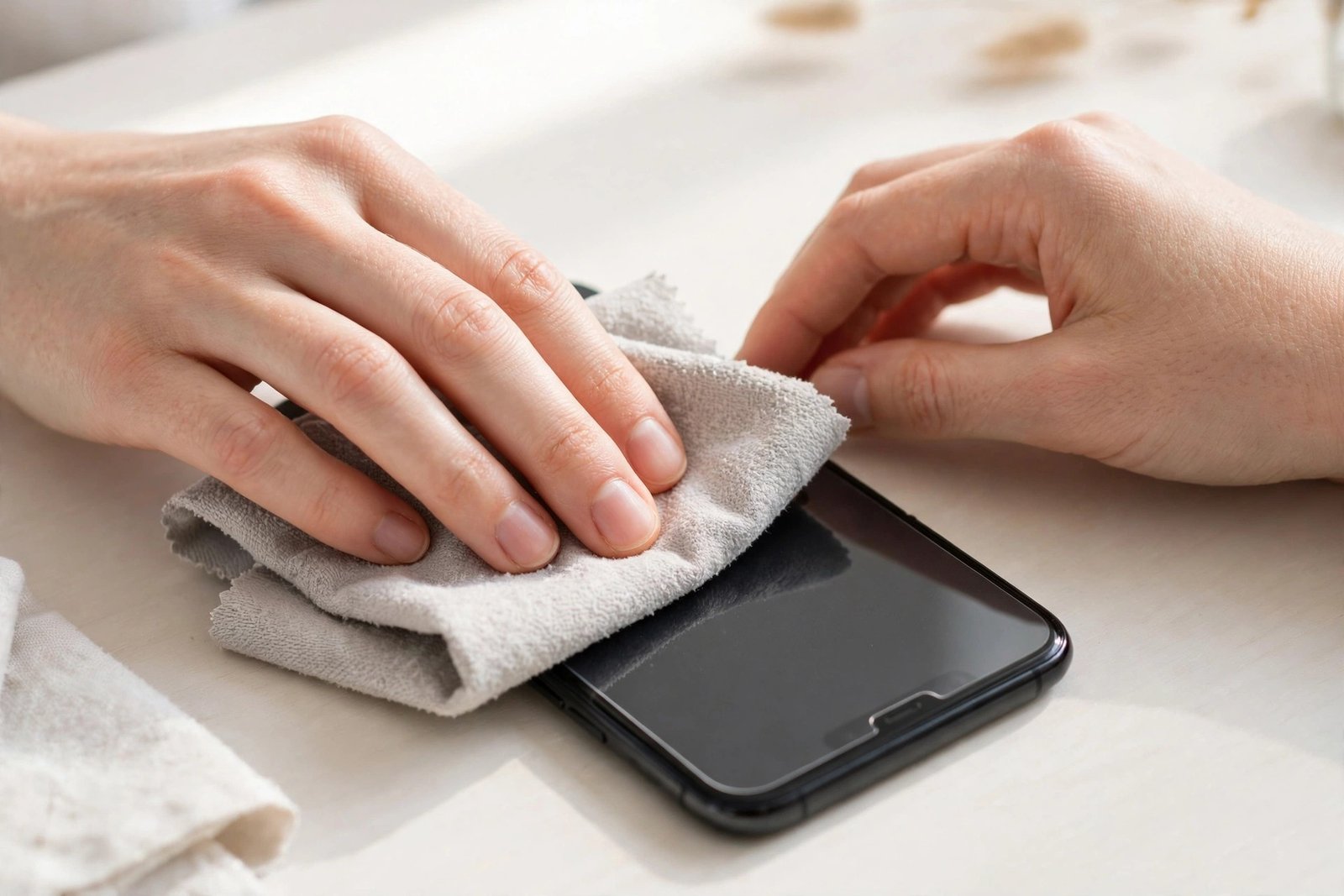
I used to think my screen protector was scratched to bits. Every time I looked at my phone under a bright light, I saw a dull, smeary film across the glass, and I assumed the protector itself had given up. Then I cleaned it properly — really properly, with the right cloth and a little patience — and the screen underneath the grime was clear, glossy and unmarked. My protector had not failed at all. It was simply dirty, and I had been cleaning it badly for months.
This is the routine I now follow to clean my own fitted protector, whether it is tempered glass or film. It covers the quick daily wipe that stops grease building up, the weekly deep clean that restores the slippery oleophobic feel, and the products I have learned to keep well away from my screen.
Key Takeaways
- A dry microfibre cloth handles most daily cleaning — it lifts grease without smearing it around.
- For stubborn grime, I use a cloth barely dampened with water — never soaked, never sprayed directly onto the phone.
- Window cleaner, kitchen sprays and alcohol-heavy products strip the oleophobic coating and leave the protector permanently dull.
- Most “scratches” I see on my protector are dried grease and pocket lint, not damage — they vanish with a proper clean.
- I clean the edges and camera cut-out too; grit gathers there and works its way under the protector.
- A protector that still looks cloudy after a deep clean has usually worn through its coating — that is replacement time, not a cleaning failure.
My Daily Wipe: Thirty Seconds, Dry Cloth
My everyday clean could not be simpler. I keep a clean microfibre cloth in my desk drawer and another by the bed, and I wipe the screen in small circles whenever fingerprints start to build up. The trick I learned is to use light pressure and a dry cloth. Pressing hard with a slightly greasy cloth does not clean the screen — it just relocates the grease into a thinner, more even layer of smear, which is honestly how my screen spent most of its first year.
I also lock the screen first. A dark display shows every fingerprint and smudge clearly, so I can see whether I am actually removing them, and I am not accidentally calling anyone or rearranging my home screen while I polish. If the cloth itself has picked up grit — mine lives loose in a bag some weeks — I shake it out or swap it before it touches the glass. A dirty cloth is a scratch risk, not a cleaning tool.
- I wash my microfibre cloths weekly, without fabric softener — softener coats the fibres and turns a good cloth into a smearing cloth.
- A cloth kept in a sealed bag or drawer stays grit-free far longer than one tossed loose into a pocket or handbag.
The Weekly Deep Clean
Once a week, or whenever the daily wipe stops making the screen feel slippery, I do the full version. I take the case off first — the rim where case meets glass collects a grey line of dust and skin oil that no amount of on-case wiping reaches. Then I dampen one corner of a clean microfibre cloth with plain water, wring it until it is barely damp, and wipe the whole protector in overlapping strokes. The moisture cuts through the built-up grease that dry wiping merely spreads.
Immediately afterwards I buff the screen dry with the dry half of the cloth. This second pass matters more than it sounds: leave the damp film to air-dry and it dries into streaks and water marks that look like a fresh problem. Buffed dry, the glass should feel smooth and slightly squeaky under my fingertip, the way it did on fitting day. Finally, I run the cloth around the edges and over the front camera — cut-outs and borders are where pocket grit settles, and grit left there eventually migrates under the protector’s edge.
What I Never Use on My Protector
The list of things I keep away from my screen is longer than the list of things I use, because almost every cleaning product in my kitchen is designed for a tougher job than this. Glass and window cleaners contain ammonia and solvents that attack the oleophobic coating — the invisible layer that makes fingerprints easy to wipe away. Strip that coating and the protector does not break, but it becomes a permanent fingerprint magnet that no cleaning will ever make feel new again.
I also avoid paper towels, tissues and my shirt sleeve. They feel soft, but their fibres are coarse at the scale that matters, and repeated use leaves a haze of micro-scratches. Antibacterial sprays and anything abrasive are out for the same reason. Plain water, a proper microfibre cloth, and patience have never once let me down — the fancy products only ever subtracted something.
- If my protector feels draggy even after a deep clean, I test it with a drop of water: on a healthy coating the drop beads up; on a worn one it spreads flat.
- Film protectors scuff more easily than glass, so I clean mine with even lighter pressure and a freshly washed cloth only.
Frequently Asked Questions
Can I use hand sanitiser or alcohol wipes on my protector?
I don’t. Occasional use will not shatter anything, but alcohol gradually degrades the oleophobic coating on both glass and film protectors, so the screen becomes harder to keep clean over time. If hygiene is the concern, a cloth dampened with water and a thorough buff does nearly as well for everyday grime.
My protector still looks cloudy after cleaning. Is it damaged?
Probably, yes — but gently. A protector whose coating has worn through, or a film covered in fine scuffs, will never come back fully clear no matter how carefully it is cleaned. The test I use: if the cloudiness is still there after a proper damp-and-buff clean, the protector has done its service and a fresh one will transform the phone.
How often should I clean my screen protector?
I wipe mine daily, almost without thinking, and deep clean it about once a week. If you work outdoors, cook with your phone nearby, or hand it to children, lean towards more often — grease and grit build up faster, and grit left sitting on the surface is what eventually scratches it.
My protector did not need replacing; it needed washing. A dry cloth daily, a damp one weekly, and nothing from the kitchen cupboard — that is the whole secret.


