

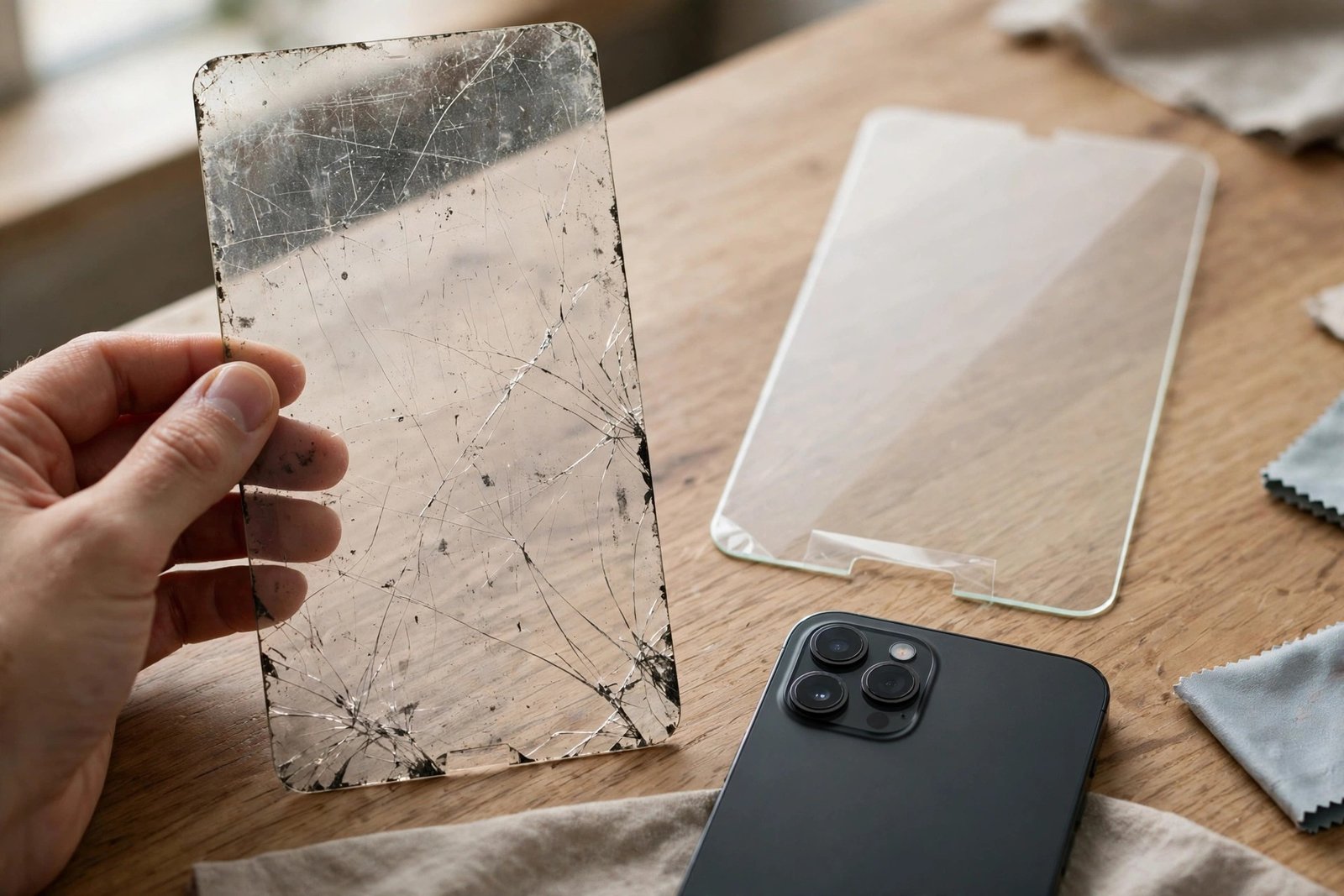
Screen protectors do not come with a service schedule, and they rarely fail all at once. Instead they fade — a corner lifts, the surface turns draggy, a chip appears at the edge — and owners end up asking the same question: is it time to replace this one yet? The useful answer is not a date. It is a set of signs you can check on the protector already on your phone.
This guide gives you those signs, the typical lifespans to expect from glass and film, and a simple way to stop guessing — so your protector is always replaced when it stops protecting, and not a month earlier or a drop too late.
Key Takeaways
- Judge the protector, not the calendar — condition signs are a far better trigger than any fixed interval.
- Replace immediately for cracks, deep scratches, chipped edges, or lifting that will not reseal.
- Typical lifespans: tempered glass 6–24 months of service, film 3–6 months before it visibly tires.
- A worn oleophobic coating — fingerprints cling, swipes feel squeaky — means the surface has done its time even if the pane looks intact.
- A protector that has taken a hard drop has spent its strength, whether or not you can see the damage.
- A six-monthly reminder and a spare in the drawer turn replacement into a five-minute job instead of a bare-screen week.
The Signs Your Protector Has Finished Its Job
Start with damage you can see. Any crack in tempered glass — even a single hairline in a corner — means the pane has already absorbed an impact and its structure is broken at exactly that line; cracked glass cannot spread the force of the next drop the way intact glass does. Chips along the edges belong in the same category: they are stress points, they can feel sharp, and they grow. Deep scratches matter too — the test is your fingernail. If a scratch catches it, distorts the display, or sits over the camera or fingerprint sensor, the protector is asking to retire.
Then check the signs you feel rather than see. Corners and edges that lift and will not stay down, however often you press them, mean the adhesive is finished and dust is already creeping underneath — grit trapped there can scratch the screen the protector was guarding. A surface that has turned draggy and squeaky, where fingerprints suddenly cling instead of wiping away, has worn through its oleophobic coating.
Typical Lifespans: Glass vs Film
Lifespan is measured in incidents more than months, but honest ranges help you calibrate. A tempered glass protector on a carefully handled phone can serve eighteen months to two years; on a phone that is dropped regularly, borrowed by children, or carried loose with keys, six months is a respectable innings, because each knock spends some of its strength. Glass rarely wears out gradually in the middle — it usually ends by event: a crack, a chip, a corner that gives up.
Film protectors live shorter, more visible lives. Expect three to six months before the surface shows it: fine scratches accumulate across the whole sheet, edges start to peel, and the film yellows slightly with age and sunlight. If you use film, treat it as a consumable you budget for a few times a year, and buy multi-packs accordingly — the screen underneath stays pristine, which is the entire point.
- After any hard drop onto a corner, inspect the protector under a lamp that evening — hairline cracks hide in normal light, and a spent pane looks deceptively fine.
- Run a fingertip slowly around all four edges once a month. Your fingers find lifting and chips long before your eyes do.
When Replacing Early Is Not Wasteful — and When It Is
It is tempting to keep a damaged protector on “a bit longer” to get your money’s worth, but the economics run the other way. A protector protects least in exactly the state people keep it longest: cracked, lifting, or scratched through its coating. The price difference between replacing it this week and next month is nothing; the price difference between replacing it and replacing the screen it failed to save is enormous. If a sign on the list above is present, replacing now is maintenance, not waste.
The opposite error exists too. An intact protector — clear, fully adhered, smooth to swipe — does not need replacing just because a date has passed or a newer model of protector has launched. The discipline is to judge the pane in front of you each time: signs present, replace; signs absent, carry on. That rule alone puts you ahead of both the panic-swappers and the keep-it-forever crowd.
A Simple System: Reminders and a Spare
Because protectors fade gradually, the check needs a trigger that is not your memory. Set a recurring six-month reminder — timed with something else you already do twice a year — and spend sixty seconds on the inspection above: edges with a fingertip, surface under a lamp, swipe feel, a look at the camera cutout. Six-monthly is frequent enough to catch everything on a protector’s timescale, and rare enough never to feel like a chore.
Pair the reminder with a spare protector kept at home. Most are sold in multi-packs for a reason: when the check finds a crack, the swap happens the same evening, on a clean screen, in one sitting — instead of a week of bare or broken glass while a delivery makes its way to you. Note the date each time you fit one, on the box of the spare. Those dates, over a couple of years, tell you your personal replacement interval more truthfully than any guide can, because they are written by your phone’s actual life.
- Photograph a new protector on fitting day. Comparing it with the same shot months later makes yellowing and edge wear obvious at a glance.
- Keep the spare somewhere you will actually find it — the drawer where the charging cables live beats the box in the loft every time.
Frequently Asked Questions
Can a screen protector wear out without visible damage?
Yes. The oleophobic coating that makes a protector feel slick and resist fingerprints is a surface treatment, and it abrades with every swipe. A pane can look perfect while its coating is gone — the giveaway is feel: fingerprints that cling, smears that need real effort to buff out, and a faint squeak under your thumb. That protector is due for replacement on comfort grounds alone.
My protector survived a drop with no crack. Should I replace it anyway?
Inspect it first. Tempered glass can absorb one impact invisibly and still be weakened, so check the edges and corners under a bright light for hairlines or chips, and press gently around the impact point. If you find any damage at all, replace it. If it is genuinely unmarked and fully adhered, keeping it is reasonable — just shorten the leash and check it again after the next knock.
Do protectors expire if I keep spares in a drawer?
Not meaningfully. An unfitted protector stored flat, in its packaging, away from heat and sunlight keeps its adhesive in good condition for a long time — far longer than the interval between your replacements. What ages a protector is life on the phone: impacts, abrasion, pocket heat and lifting edges, not the calendar on a shelf.
Replace on signs, not dates: cracks, chips, lifting edges, a draggy surface. Check twice a year, keep a spare in the drawer, and your screen never spends a day guarded by a protector that has already given everything it had.


