A tempered glass protector is a real pane of glass bonded to your phone, and it rewards being cleaned like glass — not scrubbed like plastic. Over months, fingerprints, dried splashes and a grey film of grime along the edges dull its clarity and make swipes feel sticky. Clean it the right way and you restore that smooth, just-fitted glide; clean it carelessly and you strip the very coating that made it feel good.
This guide is specifically about caring for tempered glass: how to restore clarity and glide, how to protect the oleophobic coating that repels fingerprints, and how to remove sticky residue and the grime that builds up along the pane’s edges. Everything here assumes the protector stays fitted to the phone — no removal, no refitting, just proper cleaning in place.
Key Takeaways
- Tempered glass cleans best with a microfibre cloth and plain water — most products sold for the job add risk, not results.
- The oleophobic coating is what makes glass feel slick. Harsh chemicals and rough cloths strip it, and it does not grow back.
- For sticky residue, patience beats solvents: warm water, time and gentle circular wiping dissolve most gluey spots.
- Grime collects in a dark line along the edges. Clean it with the cloth’s edge before it hardens and starts lifting the pane.
- Never use paper towels, tissues or your shirt — their fibres and trapped grit leave micro-scratches in the coating.
- A clean pane that still feels draggy is telling you the coating is worn — no amount of cleaning will restore it.
How Tempered Glass Differs From Film When Cleaning
Tempered glass is chemically strengthened and factory-coated, so it tolerates a firm wipe and a damp cloth without deforming — unlike film, it will not stretch, crease or cloud under pressure. What it cannot tolerate is abuse of its surface coating. The top few nanometres of the pane carry an oleophobic layer that makes oil bead up and wipes away easily. That layer is the difference between glass that feels premium and glass that feels like a cheap window, and it is far more delicate than the glass beneath it.
Glass also has hard, polished edges that trap a visible line of dirt. Because the pane sits a fraction of a millimetre above the screen, dust and dried moisture migrate to its rim and pack in. Film lies almost flush and hides this; glass announces it. A proper glass-cleaning routine therefore has two targets — the face, for clarity and glide, and the perimeter, before the build-up starts prising at the bond.
Restoring Clarity and That Smooth Glide
Begin dry. Blow or shake loose dust off the pane, then wipe with a clean microfibre cloth in slow circles. Most of the dullness on a glass protector is simply compacted skin oil, and the dry cloth lifts the bulk of it. Tilt the phone under a lamp as you work: smears you cannot see face-on show up clearly at an angle, and chasing them by sight beats wiping blind.
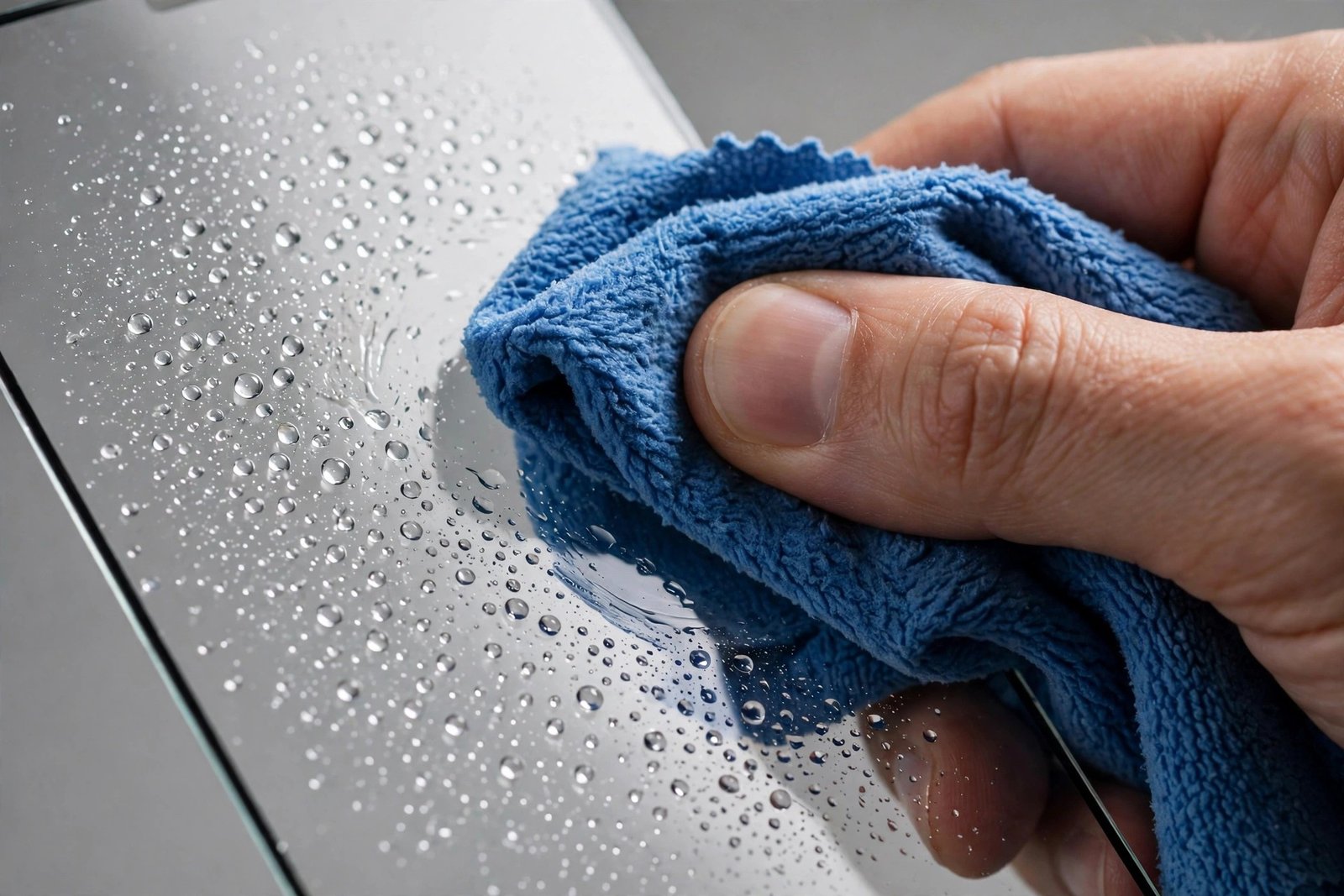
If the surface still drags, dampen a corner of the cloth with water — barely damp, never dripping — and repeat the circles. Water dissolves the salts and sugars that dry wiping only redistributes, which is why the pane suddenly squeaks clean and your fingertip glides again. Buff dry immediately afterwards. That restored glide is your confirmation the clean worked; a pane that feels slick in every direction is a pane with its coating intact and its surface genuinely clean.
- Test the coating with a drop of water. On healthy oleophobic glass it beads into a tight dome; on worn coating it spreads flat. It is the quickest way to tell dirt from damage.
- Use two cloths: one for the damp pass, one kept bone-dry purely for the final buff. A single cloth doing both jobs ends up half-damp and streaky.
Protecting the Oleophobic Coating
The coating wears out eventually no matter what you do, but careless cleaning can kill it in weeks. The main offenders are alcohol-based cleaners, disinfectant wipes, window spray and anything abrasive — each use dissolves or scours a little more of the layer away. The damage is invisible at first; you notice it only when fingerprints stop wiping off cleanly and the glass starts to feel grabby in patches, usually in the thumb-swipe zone where wear is heaviest.
To make the coating last, keep cleaning boring: microfibre, water, light pressure. Wash your cloths without fabric softener, which leaves a residue that transfers to the glass and mimics coating failure. And resist the urge to scrub at a stubborn spot — repeated hard rubbing on one area wears a dull patch into the coating that no later gentleness can undo. Gentle and frequent beats aggressive and rare, every time.
Removing Sticky Residue and Edge Grime
Sticky spots on glass usually come from outside the phone: tape adhesive from a package, a price sticker, food, or a child’s sticker pressed on as a joke. Reach for warm water first. Soak the spot through a damp cloth held against it for a minute, then work it with slow circles — most adhesives soften and roll away. A speck of ordinary washing-up liquid on the cloth, rinsed off thoroughly afterwards, handles what water alone cannot, and is far kinder than solvent-based removers.
For the grime line along the edges, fold the microfibre cloth to a firm edge, or wrap it over a fingernail, and run it along the pane’s rim with gentle pressure. Packed dirt softens with a slightly damper cloth; work in short sections and dry each as you go so moisture does not sit against the adhesive line. Finish by checking the earpiece and camera cut-outs, where residue collects in the corners. If the edge grime has already crept under the pane and the corner has lifted, cleaning has reached its limit — that is an adhesion problem, not a dirt problem.
- A wooden cocktail stick wrapped in a single layer of microfibre reaches the rim corners a fingertip cannot. Wood only, never metal, and never bare against the glass.
- Clean the edges before the face. Edge grit dragged across the pane by a face-first wipe is a common cause of fine scratches.
Frequently Asked Questions
Can I use glass cleaner spray on a tempered glass protector?
Despite the name match, household glass cleaner is a poor choice. Most formulas contain ammonia or alcohol, which attack the oleophobic coating rather than the glass itself. Water on a microfibre cloth achieves the same clarity without shortening the coating’s life.
My protector feels rough even after cleaning. What is wrong?
If the surface is spotless but still drags under your fingertip, the oleophobic coating has worn through in that area — common after a year or more of heavy use, and fastest where your thumb swipes. It cannot be cleaned back; when the feel bothers you, the pane is due for replacement.
How do I clean around a small chip in the glass edge?
Wipe towards the chip, never across and away from it, so the cloth does not catch and lever the damaged edge. Keep pressure light near the chip, and check afterwards that no fibres or moisture are lodged in it. A chipped pane is weakened — cleaning gently is fine, but plan its replacement.
Tempered glass asks for very little: a soft cloth, plain water, and respect for the coating that makes it feel invisible. Clean it gently and often, and the pane stays clear, slick and scratch-free for its whole working life.