

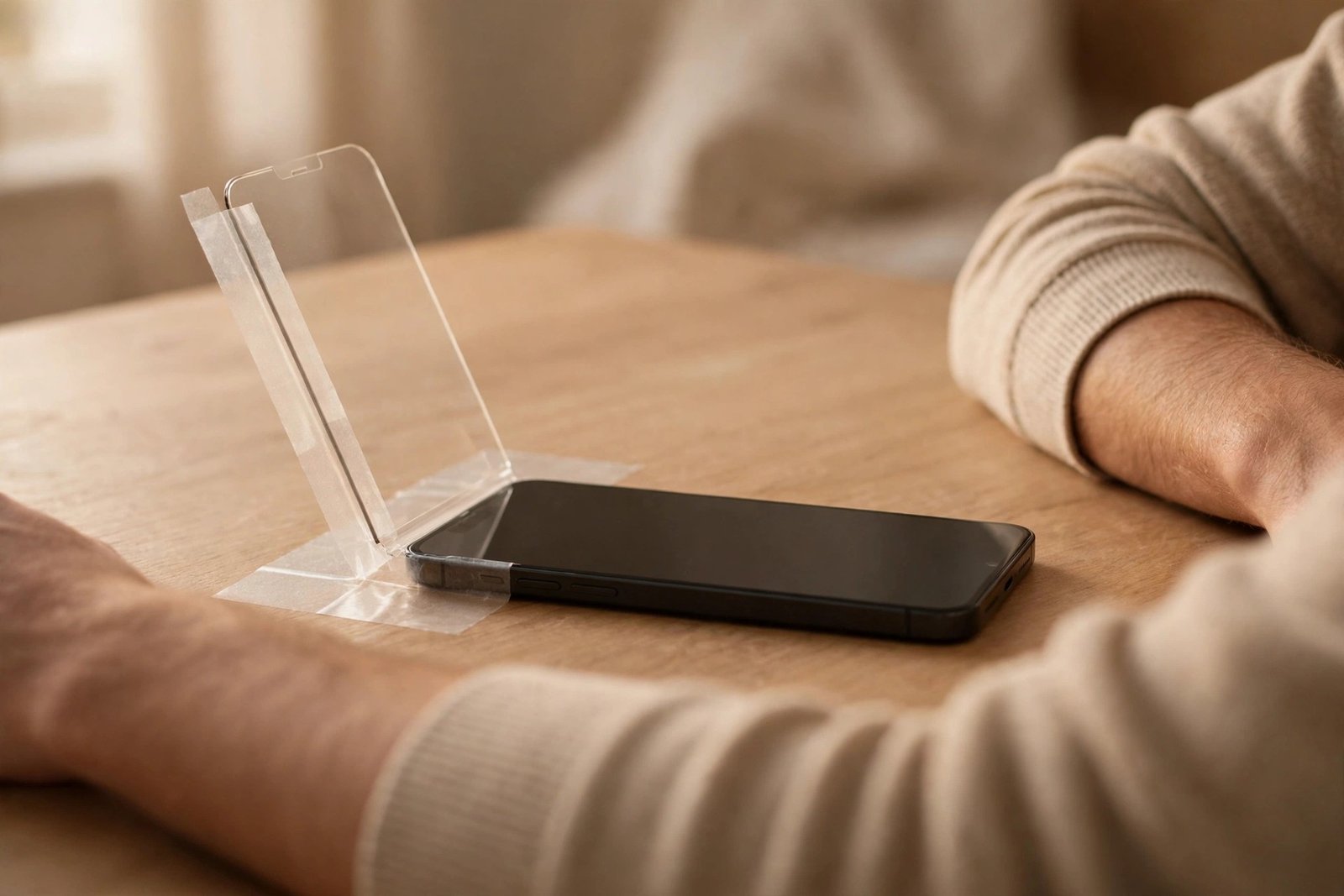
If your hands shake — from nerves, too much coffee, a medical condition, or simply a lifetime of never having had steady hands — freehand screen protector fitting feels designed to defeat you. You hover the glass over the screen, the tremor grows, the alignment drifts, and by the time it lands it is crooked and full of bubbles. So here is the secret this whole guide is built on: you do not need steady hands. You need a method that takes freehand alignment out of the job entirely.
Two systems do that — hinge tape and alignment frames — plus a few bracing tricks that calm whatever movement remains. With them, your hands never have to hold the protector in mid-air and judge its position. They just open and close a door that was aligned while everything was still and safe.
Key Takeaways
- You don’t need steady hands — you need a system that removes freehand alignment from the fitting.
- Hinge tape turns the protector into a book cover: position it once, slowly, then simply flip it down into place.
- An alignment tray or frame holds the glass perfectly registered; your only job is to let it drop in.
- Brace your forearms and elbows on the table — a supported arm shakes a fraction as much as a floating one.
- Work seated, with the phone flat on a non-slip surface and everything laid out before you peel anything.
- Use the protector’s guide stickers or tabs as handles — never pinch bare glass in mid-air.
Why Freehand Fitting Defeats Shaky Hands
A tremor is at its worst when a hand is unsupported, extended, and trying to hold still — which is precisely the posture freehand fitting demands. The longer you hover, the more the tremor builds, and the more you try to correct it, the worse it gets. Concentration does not fix this; it is a mechanical problem, not a focus problem. The answer is to change the mechanics: register the protector’s position while it is resting safely on the screen with its backing on, then use a hinge or a frame to guarantee that the real placement lands in exactly that registered spot, whatever your hands do in between.
Method 1: The Hinge Tape Technique
Place the protector on the screen with its backing still on and take all the time you need to nudge it into perfect position — speaker slot centred, camera cutout clear, margins even. Nothing is sticky yet, so there is no clock and no pressure. Now stick two strips of ordinary tape along one long edge, half on the protector and half wrapped around onto the back of the phone. The protector is now hinged like the cover of a book.
Lift the protector open on its hinge. Clean the screen properly — wet wipe, dry cloth, dust sticker. Peel the backing off the protector while it sits open. Then simply close the book: swing the protector down and it lands in exactly the position you registered, because the hinge never let it go anywhere else. Your hands contributed a single slow swinging motion — the steadiest movement anyone’s hands can make.
- Use two wide strips of tape for the hinge, spaced apart — a two-point hinge cannot twist as it closes, while a single narrow strip can skew the landing.
- Practise the flip twice with the backing still on. By the real attempt, the motion is muscle memory, and muscle memory does not shake.
Method 2: Alignment Frames and Trays
Many protectors now include a plastic alignment frame that clips over the phone, and for shaky hands it is close to magic. You clean the screen, peel the backing, and drop the glass into the frame — the frame’s walls put it in the only position it can occupy. There is no hovering, no judging, no correcting. If your protector did not include one, frames are sold inexpensively and many multipacks bundle them; for a repeat task like this, owning one is worth it. Combined with bracing (below), a frame makes even a pronounced tremor essentially irrelevant to the result.
Set Yourself Up: Seating, Bracing, Breathing
Whatever method you use, arrange the physics in your favour. Sit at a table with the phone on a non-slip mat or a folded towel so it cannot skate away. Rest both forearms on the table and let your elbows carry the weight of your arms — tremor lives in unsupported muscles. Position the phone near the table’s edge so your wrists can rest on the edge itself during any moment you must hold the protector. Lay out every item — wipes, cloth, stickers, tape — within easy reach before you start, so there is no mid-job rummaging with an exposed screen. And take the small things seriously: fit the protector when you are rested, not after the coffee that makes your hands buzz.
- When you must hold the protector, rest the heel of your hand on the table and pivot from it. A pivot is stable even when fingers are not — it turns a floating hand into a hinged one.
- A small suction cup pressed onto the protector’s face makes a handle that depends on neither grip strength nor pinch control — lift it off after placement with a gentle twist.
Frequently Asked Questions
My protector came with no frame and no hinge stickers. What now?
Make the hinge yourself from two strips of ordinary sticky tape, exactly as described in Method 1 — it works with any protector, costs nothing, and is the technique shops used for years before frames existed. Failing that, most protector brands sell frames separately, and a multipack with a frame included is a sensible next purchase if you fit protectors for family members too.
It still landed crooked. Can I redo it?
Yes, once — if you act within the first minute or so. If you used the hinge, leave the tape attached, swing the protector open, adjust its registered position slightly, clean the screen again, and close it a second time. The hinge makes the redo nearly as controlled as the first attempt. What you should avoid is freehand lifting and re-dropping “by eye” mid-panic: that reintroduces exactly the hovering the system was built to eliminate.
Is film easier than glass for unsteady hands?
Usually the opposite. Film has to be rolled down progressively while a squeegee chases the air out — a continuous, coordinated motion that gives a tremor many chances to fold in a bubble. Tempered glass with a frame or hinge is a single drop: far fewer moving parts. If you prefer film, use the hinge method and roll it down in short sections, re-bracing between each — but for most unsteady hands, glass plus a frame is the kindest combination.
Steadiness was never the requirement — registration is. Align the protector while nothing is sticky, let tape or a frame remember the position, brace everything that can be braced, and your hands only have to do the one calm motion left. The glass lands where you planned, however your hands felt on the way.


