

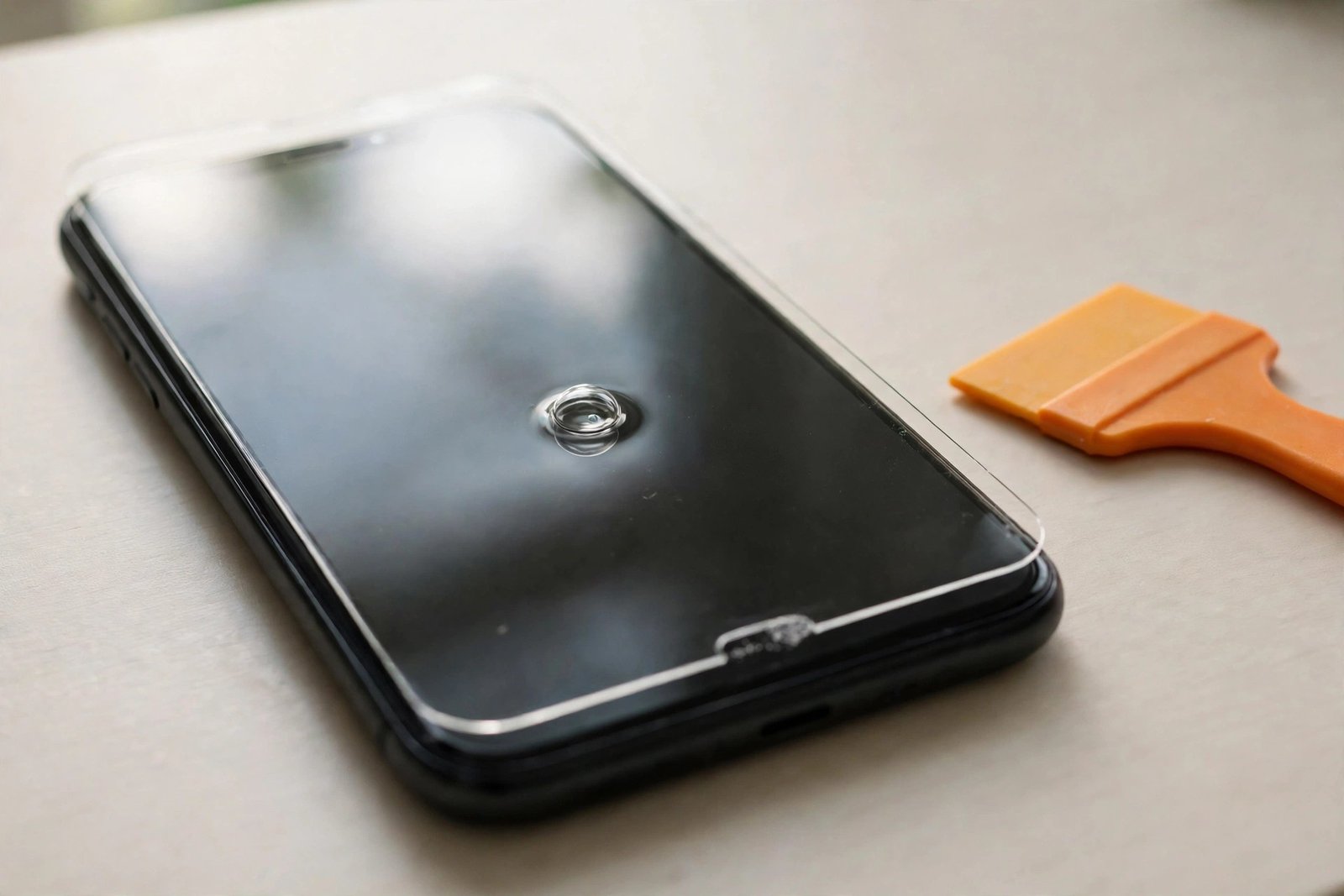
Edge bubbles are easy — the exit is right there. A bubble sitting in the centre of the screen is another matter entirely. It is the furthest point from every border, and a single heroic push towards the edge almost always fails: the pocket stretches, splits, or slides a few millimetres and settles again, smugly, in the middle of your display. Centre bubbles are not removed in one stroke. They are removed in stages.
This guide is devoted to that one stubborn location: the staged-stroke technique that walks a central pocket to the edge in a series of short hops, how resting between stages does half the work for you, and the hinge-lift fallback for the centre bubble that turns out to be dust in disguise.
Key Takeaways
- Centre bubbles fail under single strokes because the pocket has too far to travel and simply stretches or splits.
- Move the pocket in short hops, sealing the glass behind it after each hop so it cannot drift back.
- Choose the nearest edge — usually a long side, not the top or bottom — and commit to that route.
- Resting is a technique: leave the phone warm and flat for an hour between stages and pockets often creep nearer the edge alone.
- Keep the pocket in one piece — never scrub, which shatters it into a scattered constellation of micro-bubbles.
- A centre bubble that never moves at all is probably dust — fix it with the hinge-lift, not more strokes.
Why the Centre Defeats a Single Push
A bubble moves only while there is unbonded space ahead of it and sealed glass behind it. Near an edge, one stroke achieves both. In the centre, a long push runs out of control halfway: your pressure eases for an instant, the adhesive behind the pocket has not sealed, and the air redistributes itself — sometimes into two pockets, sometimes into a wide thin sheet that is even harder to herd. The distance is not the enemy; losing the seal behind the pocket is.
So the plan changes. Instead of escorting the bubble the whole way in one journey, you move it a centimetre at a time and lock in every gain. Think of it as walking a ladder across the screen: advance, seal, rest, advance again. It feels slower and finishes faster, because none of your progress is ever handed back.
The Staged-Stroke Technique
Wrap a card in microfibre cloth, or use a clean thumb. First, decide your exit: measure with your eyes which edge is genuinely nearest to the pocket — on most phones it is one of the long sides — and aim solely for it. Place the card just behind the bubble and press so the protector seals flat against the screen on the far side of your pressure. Now advance one to two centimetres, no more, keeping the pocket whole and ahead of the card.
Stop, and hold firm pressure for ten seconds exactly where you stopped, so the adhesive takes behind the pocket’s new position. Release slowly. The bubble should now sit noticeably closer to your chosen edge, in sealed territory it cannot retreat from. Repeat the hop: pressure behind, short advance, ten-second hold. Most centre bubbles reach the border in three to five hops and slip out with a final, gentle stroke along the edge.
- If the pocket starts splitting, stop and let it reunite — an hour’s rest often lets two halves merge back into one movable bubble.
- Work with the phone flat on a table, not in your hand; a flexing hand quietly unseals the glass behind your strokes.
Let Rest and Warmth Do the Middle Stages
Between sessions, put the phone somewhere warm and flat — a sunny windowsill’s shade, a warm room, on top of a recently used games console — and leave it for an hour or overnight. Adhesive keeps flowing at a microscopic pace, air migrates towards the nearest weakness, and centre pockets measurably drift and shrink between attempts. Many bubbles that survive two hops in the evening are simply gone by morning, or sitting within one short hop of the edge.
This is also why you should never begin centre-bubble surgery within the first day of fitting. The adhesive is still settling across the whole screen, and the pocket you are chasing may be on its own slow journey out. Give a fresh install 24 hours, then stage-stroke whatever remains.
- Take a photo before each rest period — comparing outlines is the only reliable way to see slow progress and know the method is working.
- Alternate hop sessions with rests rather than grinding on; three short sessions beat one long one for centre pockets.
The Hinge-Lift Fallback for a Bubble That Will Not Move
If a centre bubble has not shifted a millimetre after honest staging, it is telling you something: it is almost certainly a speck of dust anchoring the protector in a tiny tent, and air strokes will never move a tent. Fix it with the hinge method — tape along one long edge as a hinge, lift the protector from the opposite side just past the centre, dab the speck off the screen and the underside with a dust sticker, then lower the protector back along its hinge so your alignment survives. Do this in a steamy bathroom, slowly, and only on a fresh install whose adhesive still allows a clean lift.
Frequently Asked Questions
Why does my centre bubble keep splitting into two?
Because the stroke is too long or too fast, so the pocket stretches until it necks and parts. Shorten each hop to a centimetre, slow down, and hold the seal behind it for the full ten seconds. If it has already split, rest the phone for an hour — the halves frequently merge again as the adhesive settles.
Should I aim for the top edge or a side edge?
Whichever is genuinely closest to the bubble. On most phones held in portrait, a side edge is nearest to anything in the middle band of the screen, and every centimetre of travel you save is a hop you do not have to make. Commit to one route; changing direction mid-way lets the pocket wander back.
Can a needle prick release a centre bubble?
Do not do this. Piercing a protector leaves a permanent mark, can scratch the screen beneath, and on tempered glass can start a crack. A centre bubble always yields to staged strokes, rest, or — if it is dust — the hinge-lift. There is no bubble stubborn enough to justify a hole in your protector.
A centre bubble is a journey, not a battle: hop, seal, rest, repeat — and even the most stranded pocket eventually reaches the edge and leaves.


