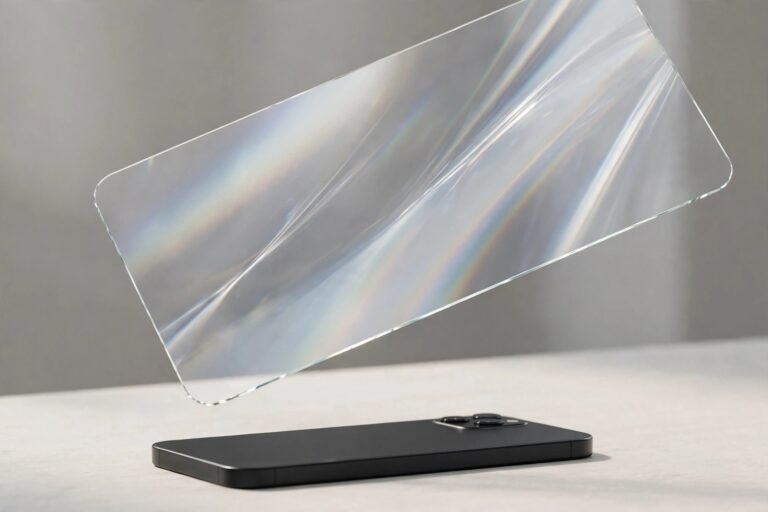
After a drop, the cracks staring back at you raise one urgent question: are they in the cheap protector you can replace in minutes, or in the screen itself? Stripping the protector off will tell you — but if it turns out to be undamaged underneath, you have wasted a perfectly good protector finding out.
Luckily, there are three reliable tests you can run without removing anything: the fingernail test, the edge test, and the torch test. Each takes under a minute, and together they identify which layer is cracked in the great majority of cases.
Key Takeaways
- If your fingernail catches in the crack, the fracture is in the top layer — the protector.
- Protector cracks stop exactly at the protector’s border; screen cracks pay no attention to that outline.
- A torch shone at a shallow angle makes surface cracks flare brightly while deeper ones stay dull.
- Run all three tests — agreement between them is far more trustworthy than any single clue.
- Be gentle: press and drag lightly, because cracked tempered glass can shed tiny fragments.
Test 1: The Fingernail Test
This is the quickest and most telling of the three. Wash and dry your hands, then draw the edge of a fingernail slowly and lightly across the crack, at right angles to its direction. A fracture in the protector is a break in the very surface your nail is touching, so your nail will catch, click or stutter as it crosses — you can feel the tiny cliff edge where the two sides of the crack meet.
A crack in the screen beneath, by contrast, hides under the protector’s unbroken surface. Your nail glides over it perfectly smoothly, however clearly you can see the line. That contrast — visible but not feelable — is the giveaway. Try several cracks, not just one: a hard fall can crack both layers, and the pattern may differ from line to line. Keep the pressure feather-light throughout; you are feeling for a catch, not scraping at the glass.
Test 2: The Edge Test — Where Does the Crack Stop?
Every protector has an outline, usually stopping a millimetre or two short of the phone’s edges and curving around the speaker and camera cutouts. That border is a diagnostic goldmine. Trace a crack slowly towards the edge of the protector and watch what happens when it gets there. A crack that ends precisely at the border — stopping as neatly as if it had hit a wall — is contained within the protector’s own material, because a fracture cannot stop that cleanly at a boundary it does not respect.
A crack in the screen knows nothing of the protector’s outline. It will run underneath the border and out the other side, continuing across the narrow margin of exposed glass between the protector’s edge and the bezel. Follow the line all the way: if it emerges beyond the protector, the screen is involved. This test is particularly decisive near the corners, where drops usually land and where the protector’s border is easy to see.
- Can’t see the protector’s border? It shows up instantly if you breathe on the screen — condensation gathers differently on the protector and the bare glass margin.
- Check around the camera and speaker cutouts too: cracks that terminate at a cutout’s edge are behaving like protector cracks.
Test 3: The Torch Test — Light at a Shallow Angle
For the final test, switch the phone’s screen off and darken the room. Take a torch — the light on another phone is ideal — and hold it almost flat against the screen’s surface, shining across the cracks rather than down at them. Surface fractures in the protector scatter this raking light and flare up as bright, glittering lines. Tilt the phone gently and the lines will flash on and off like the facets of cut glass.
Cracks in the screen beneath react differently: seen through the protector’s smooth surface, they look dimmer, deeper and slightly blurred, and they do not sparkle as the angle changes. On some displays they also throw faint coloured fringes, where the fractured layers split the light. Comparing how the same crack behaves under the torch from several directions makes the depth difference surprisingly easy to judge.
Reading the Three Results Together
Now combine your findings. Nail catches, crack stops at the border, lines flare brightly under the torch: the damage is in the protector only, and you can replace it with confidence. Nail glides smoothly, the crack crosses the border, and the lines stay dull: the screen is cracked, and you should back up your data and plan a repair.
Mixed results — some lines catch, others glide — usually mean both layers are cracked, which a heavy impact can certainly do. And if the tests still leave you genuinely unsure, the protector has to come off for a final answer; but by testing first, most people find they never need to guess, and an undamaged screen keeps its protector until it is truly worn out.
- Do the tests before cleaning the screen — dust settled into a surface crack actually makes it easier to feel with a fingernail and to see under the torch.
- If the protector is shattered into a spiderweb, lay clear tape over it before testing, so fragments stay put while you work.
Frequently Asked Questions
My nail catches on some cracks but not others. What does that mean?
Most likely, both layers are damaged: the catching cracks are in the protector, and the smooth ones are in the screen beneath. It can also mean some protector cracks are hairline and shallow. Either way, peel the protector off over a table and inspect the bare screen directly — the answer will be obvious.
The crack goes right up to the edge of the phone. Can I still use the edge test?
Yes — look at the narrow strip between the protector’s border and the bezel. If the crack is visible on that exposed strip of glass, it must be in the screen, because the protector does not cover that area at all. If the strip is clean and the crack halts at the border, it is a protector crack.
What if the protector is a flexible film rather than glass?
The edge and torch tests work just the same, because film has a border and a surface too. The fingernail test is less dramatic — film tends to tear or dent rather than crack — but a tear you can feel with a nail is still a top-layer injury, and a line you can see but not feel is still underneath.
Your fingernail, the protector’s own border, and a borrowed torch: three tests, no tools to buy, and no need to sacrifice a good protector just to find out the truth.