

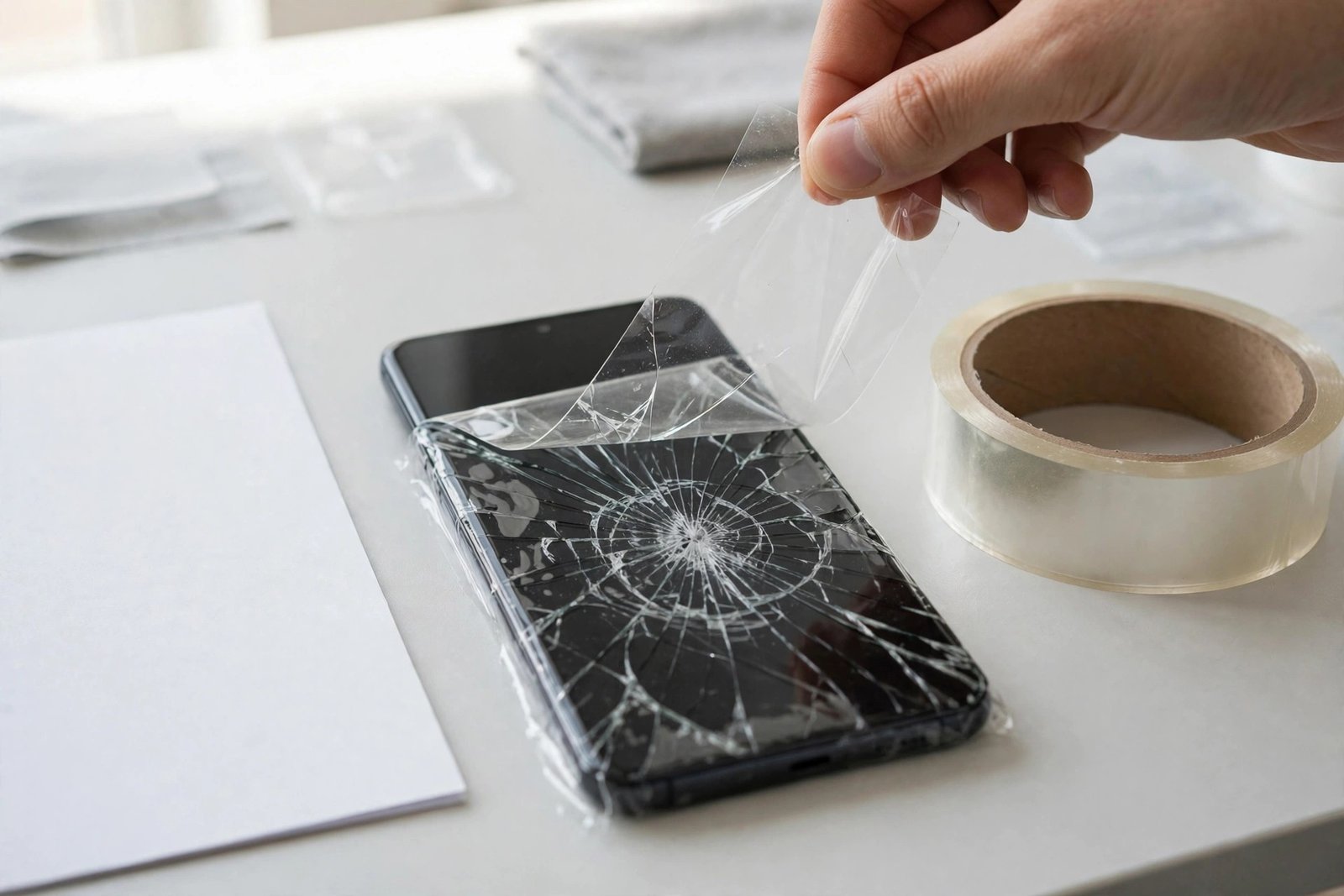
A screen protector is a sheet of glass bonded to your phone — and removing one, especially a cracked one, is a small glass-handling job. Done carelessly, it can scatter tiny shards across your desk, your hands, and the room. Done properly, it’s completely uneventful. This guide is about the safety side of removal: protecting your eyes and skin, keeping fragments contained, and disposing of the old pane responsibly.
The removal technique itself is simple. What makes it safe is everything around it — where you work, what you wear, how you handle the fragments, and where the glass ends up when you’re finished.
Key Takeaways
- Work at a clear table, phone face-up and flat — never over your lap, a bed, or carpet where shards vanish.
- Keep children and pets out of the room until every fragment is wrapped and binned.
- If the pane is cracked, tape its whole face before lifting anything — this one step prevents nearly all scatter.
- Pick up strays with sticky tape, never bare fingers or a palm sweep.
- Wrap the removed glass before binning it — loose shards in household rubbish are a hazard to whoever handles it next.
- Wash your hands afterwards; fine glass dust is an irritant you don’t want near your eyes.
Set Up a Safe Workspace
Choose a hard, flat table with good light and clear everything else off it. Hard surfaces matter: a fragment dropped on a tabletop glints and can be found, while one dropped into carpet or bedding disappears until a bare foot or a small hand finds it. Put a sheet of paper or a tray beside the phone to receive the removed pane, and have a bin within arm’s reach so you’re never carrying loose glass across the room.
If you wear glasses for close work, put them on — they double as basic eye protection while you hunt for hairline cracks and tiny slivers. Roll up loose sleeves, tie back long hair, and if the protector is badly shattered, consider thin household gloves for the fragment-handling stages; your grip on the phone itself is better bare-handed, so many people do the peel ungloved and glove up only for the clean-up.
Contain the Glass Before You Lift It
For an intact protector, ordinary care is enough: warm the edges, start one corner, peel slowly and low. For a cracked protector, add the single most important safety step in this guide — cover the entire face with wide sticky tape, overlapping the strips so no crack line is exposed, and press it down firmly. The tape binds the fragments into one sheet that lifts away together instead of shedding pieces.
Even with an intact pane, peel over the table, not over yourself, and support the freed glass so it can’t spring or drop. Set the removed protector straight onto your waiting paper or tray, sticky side contained, rather than waving it around or propping it against things.
- A bright torch held at a shallow angle across the table makes stray slivers glint — the fastest shard check there is.
- Keep a damp paper towel nearby: wiped gently over the work area, it picks up the microscopic glass dust that tape misses.
Handling Strays and Checking the Screen
Fragments escape even careful removals — a corner chip here, a sliver along an edge there. Never sweep for them with your palm and never pick them up with bare fingertips. Press a loop of sticky tape gently over each piece and lift it away. Work methodically across the table, then check the floor immediately below where you stood; glass travels further than you’d expect when it springs off a peel.
Check the phone itself, too. Tilt the bare screen under a bright light: slivers love to hide along the edges and around the speaker and camera cutouts. Dab the whole surface with fresh tape to lift anything invisible before you wipe it down. Only when the screen passes that check is it ready for a new protector — fitting fresh glass over a leftover shard scratches the display the moment you press it down.
Disposal: Wrap It, Then Bin It
Leave the removed protector in its tape skin, fold the paper or tray sheet around it, or seal it inside the new protector’s packaging, and place it in your household bin wrapped, never loose. Ordinary phone glass isn’t container glass, so it doesn’t belong in glass recycling; if your local scheme has a specific route for sharp waste, follow it. The principle that matters is simple: nobody who handles your rubbish after you should meet an exposed sharp edge.
- If a fragment does prick your skin, rinse the spot and use tape or tweezers in good light to lift any sliver out — don’t squeeze blindly.
- Finish by vacuuming only after every visible piece is taped up; loose shards can lodge in vacuum hoses and brush heads.
Frequently Asked Questions
Is it safe to remove a shattered protector myself?
Yes, with the tape-first method: cover the whole face, peel slowly over a table, tape up any strays, and wrap everything before binning it. If the screen beneath is also cracked and glass is loose on both layers, a repair shop is the more sensible option.
Can screen protector glass cut you?
Thin slivers along fracture lines can prick skin, which is why fragments are handled with tape rather than fingers. The large pieces are blunt enough to manage once taped; it’s the tiny, nearly invisible shards that deserve respect.
What should I do if I can’t find a missing fragment?
Dim the room and sweep a torch beam at a low angle across the table and floor — glass glints where eyes miss it. Wipe the whole area with a damp paper towel afterwards. Until you’re confident it’s found, keep bare feet, children, and pets away from that spot.
Tape first, peel over a table, hunt the slivers in good light, and wrap the remains — safe removal is ninety per cent preparation and ten per cent peel.


