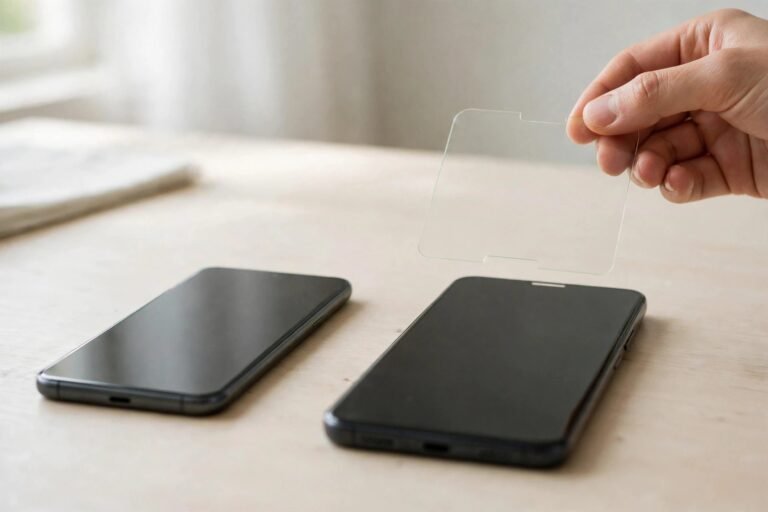
If you use a liquid glass screen protector, this question eventually comes up: you drop your phone, or notice a mark on the screen, and wonder whether the “protector” has cracked. Here is the honest answer, which the packaging rarely explains clearly: a liquid glass protector cannot crack, because there is no sheet of anything to crack. It is an invisible nano-coating bonded to your screen, not a physical layer you can inspect like tempered glass.
That does not make the question pointless — it makes it more important. If you can see a crack, it is in something real, and you need to know what. And a liquid coating does genuinely wear away over time, leaving signs you can check for. This guide explains what you are looking at, how to tell a worn coating from a cracked screen, and the tests that separate the two.
Key Takeaways
- Liquid glass is a nano-scale coating cured onto your screen. It has no thickness you can see or feel, so it cannot crack, chip or peel like glass.
- If you can see or feel a crack, it is a crack in your phone’s actual screen.
- What a liquid protector does instead of cracking is wear away: water stops beading, fingerprints smear more easily, and fine scratches start appearing.
- The water-beading test is the most useful home check for whether the coating is still present.
- A fingernail drawn gently across a mark will catch on a real crack in the glass and glide over mere coating wear or surface dirt.
- If the screen itself is cracked, no reapplication of liquid glass will help — that needs a screen repair.
First, a Gentle Correction: There Is Nothing There to Crack
A liquid glass protector is applied by wiping a solution of silicon dioxide over the screen and letting it cure. What remains is a bonded layer measured in nanometres — thousands of times thinner than a sheet of tempered glass, and indistinguishable from the screen itself. It fills microscopic pores in the glass surface and hardens it slightly, which is where its modest scratch resistance comes from.
Cracking is something rigid, brittle sheets do when they flex beyond their limit. A coating with effectively no thickness cannot do it: there is no edge to chip and nothing to lift. When owners go looking for a “cracked liquid protector”, they are really asking one of two questions: has my coating worn off, or has my screen cracked underneath it? Those have very different answers.
Signs the Coating Has Worn Away Instead
A liquid coating does not fail dramatically; it erodes. Friction is the main culprit — the areas your thumbs sweep, the strip that slides in and out of a pocket, the patch that rests against a desk. Over months of use the coating thins in those high-traffic zones first, and the screen gradually returns to how it behaved before you applied anything.
The practical signs are about feel and behaviour rather than appearance. Water that once formed tight beads and rolled off now spreads and smears. Fingerprint grease that wiped away with one pass of a cloth now needs two or three. And most tellingly, fine hairline scratches begin to appear in the worn areas — the very thing the coating was resisting. None of this means anything has cracked; it means the protection has quietly expired, which is why makers of these products typically suggest periodic reapplication (intervals vary by product, so check the guidance that came with yours).
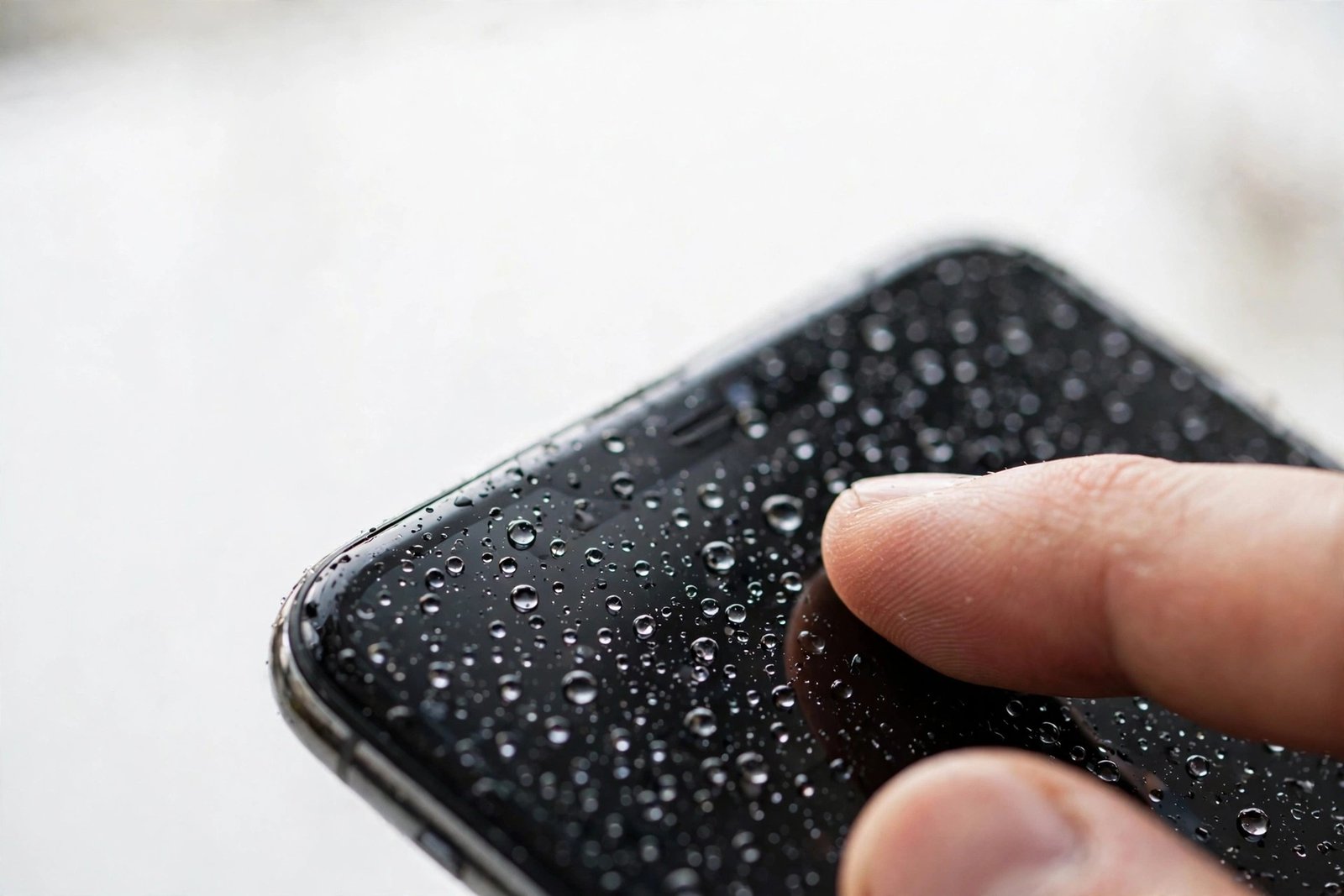
- Do the water-beading test: clean the screen first, then drip a few drops of water on it. On a healthy coating the drops sit up as rounded beads; on a worn coating they flatten and spread. Compare the centre of the screen with a rarely touched corner — the difference tells you where the coating has gone.
How to Check Whether Your Screen Itself Is Cracked
If what worries you is a visible line or mark, work through three checks. First, clean the screen thoroughly and examine it under a bright light held at a low angle. Dirt and dried moisture can masquerade as cracks until you wipe them away; a real crack stays put and catches the angled light along its length. Second, run a fingernail very gently across the mark. A crack in the glass is a physical step in the surface, and your nail will snag on it. A mark your nail glides over is a scratch or surface blemish, not a fracture.
Third, check the screen’s behaviour. A cracked display often announces itself functionally: a stripe of the touch screen that stops responding, coloured lines or inky blotches spreading from the impact point, or a crack pattern radiating from a corner or edge. If you have any of those, there is no ambiguity left — the damage is in the phone’s glass or display. Remember, too, that a liquid protector provides only limited impact protection in the first place; a hard drop can crack a coated screen just as it cracks an uncoated one.
What to Do Next, Depending on What You Found
If the checks point to coating wear — water spreading flat, greasy smears, early scratches, but no crack your nail can feel — the remedy is simple: reapply the liquid protector following its instructions, or take the opportunity to switch to tempered glass if you want protection you can actually see and inspect.
If your checks point to a cracked screen, do not waste money reapplying liquid glass over the top — a coating cannot fill, seal or stabilise a fracture, and the crack will continue to spread and let in moisture. Back up the phone, and look into a screen repair; prices vary considerably by model and repairer, so get a quote rather than assuming. Once repaired, fit a tempered glass protector before the new screen meets the world.
- Keep one reference point: when you first apply a liquid protector, note how water beads on the screen (a quick photo helps). Recheck every couple of months. The day the beads flatten is the day the coating needs renewing — long before scratches tell you the same thing.
Frequently Asked Questions
Can a liquid glass screen protector crack or chip?
No. It is a cured nano-coating bonded to the surface of your screen, with no rigid layer that could fracture. It does not crack, chip, peel or lift. Its only failure mode is gradually wearing thin through friction, which shows up as reduced water beading, easier fingerprint smearing and eventually fine scratches in the worn areas.
I can see a crack on my screen. Is it the protector or the phone?
It is the phone. Because a liquid protector is invisible and cannot crack, any crack you can see — especially one your fingernail catches on, or one radiating from an impact point — is in the screen glass itself. Clean the screen first to rule out dirt; a confirmed crack is screen damage, so back up your data and arrange a repair rather than reapplying coating over it.
How long does a liquid glass protector last before it wears off?
It varies with the product and how the phone is used, but treat it as months rather than years. High-friction areas — the thumb-swipe zone, the part that slides against pocket seams — wear first, so protection fades unevenly rather than all at once. Use the water-beading test every couple of months; when drops stop beading and start spreading, the coating in that area has effectively gone.
You cannot crack what was never a sheet of glass. Watch the water beads, trust your fingernail, and a liquid protector’s condition stops being a mystery.