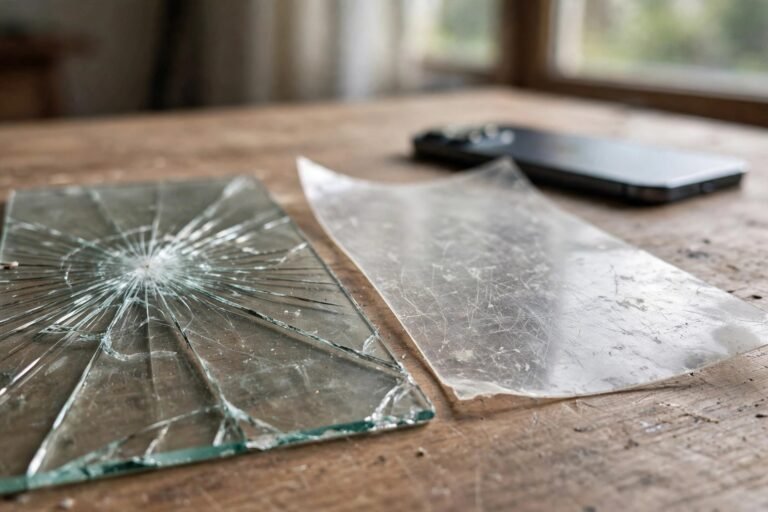
It happens to everyone eventually: you pick up your phone and notice a thin crack running across the protector that was definitely not there yesterday. The screen underneath looks fine, the phone works perfectly, and the new protector is sitting in a drawer at home. So the question presents itself — do you replace it right now, or can it wait until the weekend?
The honest answer is “it depends”, but not in a vague way. There are real risks to leaving a cracked protector in place — some immediate, some slow — and there are also a handful of situations where waiting a few days is genuinely fine. This guide weighs both sides so you can judge your own crack with clear eyes.
Key Takeaways
- The default answer is replace it soon — a cracked protector has already used up most of its protective value.
- Sharp crack edges can catch on skin and snag on pockets, and loose fragments are the most urgent reason to act today.
- Cracks give moisture and dust a pathway to the real screen, and grit trapped underneath can scratch the display it was meant to protect.
- Cracks tend to spread under everyday pressure — thumbs, cases, and temperature changes all work on them.
- Waiting is reasonable only when the crack is small, stable, outside the viewing area, and not shedding fragments.
- If you do wait, tape over the crack and order the replacement the same day — “a few days” should never quietly become “a few months”.
The Risks of Waiting
The most immediate risk is physical. A crack in tempered glass leaves edges that are sharper than you would expect — not razor blades, but enough to catch unpleasantly on a thumb mid-swipe and to snag threads in a pocket or bag lining. Worse, a badly fractured corner can start shedding tiny glass fragments, and you really do not want those migrating to a sofa, a bed, or a child’s hands.
The slower risks are easy to underestimate. A cracked sheet no longer seals against the screen, so dust and moisture work their way underneath. Grit trapped between protector and display can then scratch the very glass the protector exists to defend — damage you will only discover when you finally peel the old one off. Meanwhile the crack itself is under constant low-level assault: thumb pressure, the flex of a tight case, warmth from charging. Cracks in glass grow under exactly these conditions, a few millimetres at a time, until one day the whole sheet is a spider’s web.
The Touch Problem Nobody Mentions
There is a subtler cost to living with a cracked protector: it changes how the phone feels and responds. Your thumb learns to skirt the damaged area. Fine cracks can interfere slightly with touch registration along their length, and the fractured edges of the sheet can flex independently, giving an odd, uneven sensation that people often blame on the phone itself. Cracked areas also catch the light, producing glare lines across text and video that your eyes keep snagging on.
None of that will break your phone. But it does mean the “free” option of waiting is not quite free — you pay in small daily irritations, plus the background risk that one more knock lands on an already-weakened sheet and reaches the screen this time. A protector’s whole job is to be the thing that breaks; once it has broken, it cannot break usefully a second time.
- Run a clean fingertip very lightly over the crack: if you can feel edges lifting or any roughness that catches skin, that crack is a replace-today crack, not a wait-and-see one.
- Take a photo of the crack today and compare it in two days — spreading branches are hard to judge from memory, and obvious in side-by-side pictures.
When Waiting a Few Days Is Fine
Now the other side. If the crack is a single short hairline in a corner, outside the part of the screen you actually look at, with no branches, no lifted edges, and no loose fragments, then the practical risk of waiting until the weekend is low. The same applies if a replacement is already ordered and in the post. Life is busy, and screen protectors are not emergency medicine.
Film protectors are even more forgiving here: a tear or crease in a film layer has no sharp edges and nothing to shed, so the urgency drops further — though a torn film still lets grit underneath and should not become a permanent resident. The key word in all of this is “few”. A crack inspected daily and replaced within days is a managed situation. A crack forgotten for two months, quietly spreading under a case rim, is how people end up with a scratched display and no idea how it happened.
- While you wait, cover the crack with a strip of clear tape. It smooths the sharp edges, holds fragments in place, and keeps grit out — a two-minute job that removes most of the risk.
- Peek under the case rim when you inspect the damage; cracks that start at the edge often hide there and are longer than the visible part suggests.
A Simple Rule for Deciding
If you want one rule to carry away, use this: replace immediately if the crack crosses the viewing area, reaches an edge, sheds anything, or can be felt with a fingertip; replace within days if it is small, cornered, smooth, and stable. And when you do swap it, peel the old one off slowly over a bin — taped first if it is badly fractured — then clean the screen properly before the new one goes on, because the grit that crept underneath is exactly what causes mystery bubbles in a fresh install.
Treat a cracked protector the way you would treat a cracked windscreen, scaled down: not a catastrophe, not an emergency, but a known weakness with a known fix, priced in pennies. The people who regret waiting are never the ones who waited three days. They are the ones who meant to get round to it.
Frequently Asked Questions
Will a cracked protector scratch my actual screen?
It can, indirectly. The crack itself sits on top of the display and rarely harms it, but the break lets grit and dust migrate underneath, and hard particles trapped between the two layers can mark the real glass as the phone flexes in your pocket. Taping the crack and replacing the protector promptly keeps that risk very small.
Can I just replace the protector later and use the phone without one meanwhile?
You can, but weigh it honestly: a cracked protector, even a weakened one, still offers more protection than bare glass, and it keeps grit off the screen. If the crack is sharp or shedding fragments, taking it off is the safer choice for your fingers. Otherwise, leaving it on until the replacement is in your hand is usually the better trade.
How long is too long to leave a cracked protector on?
There is no universal deadline, but think in days, not weeks. Beyond a week or so, the odds climb that the crack spreads, grit gets underneath, or the weakened sheet meets the one drop it can no longer absorb. If a crack has been on your phone long enough that you have stopped noticing it, that is your sign.
A cracked protector has already done the brave part. Your job is simply not to ask it to do the brave part twice — check it, tape it if you must wait, and swap it within days.