Liquid screen protectors make a seductive pitch: no glass to align, no bubbles, nothing to peel or crack — just wipe a liquid over your screen and it is protected. They are also some of the most overstated products in the phone accessory world, because the word “protector” covers everything from a thick sheet of tempered glass to an invisible coating thinner than a fingerprint. Whether a liquid protector is worth it depends on being honest about which of those things you are actually buying.
This guide gives you that honest picture: what a liquid coating genuinely does, the real advantages that make it the right choice for some people, the limitations that make it a poor one for others, and a clear verdict on who should spend the money and who should buy glass instead.
Key Takeaways
- A liquid protector is a nano-coating, not a physical layer — it adds scratch resistance to the surface, but almost nothing stands between your screen and an impact.
- Its real strengths: it is completely invisible, fits any screen shape, never lifts at the edges, and works flawlessly with cases and in-display fingerprint sensors.
- It cannot meaningfully protect against drops or cracks. A phone that falls on concrete is relying on its own glass, coating or no coating.
- Coatings wear away gradually and need periodic reapplication to keep working — it is a subscription by effort, not a fit-and-forget layer.
- Worth it for careful owners who hate visible protectors and only need defence against keys, coins, and pocket grit.
- Not worth it as your only protection if you drop your phone regularly, work on site, or hand it to children.
What a Liquid Protector Actually Does
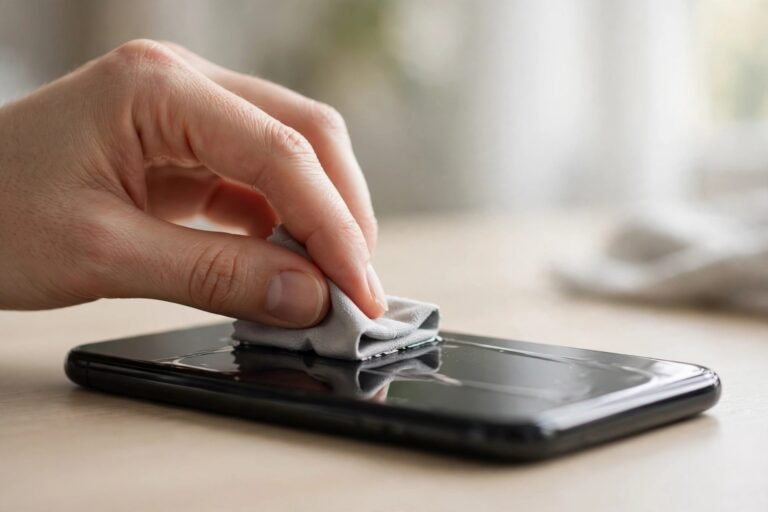
Liquid protectors are typically based on compounds such as silicon dioxide suspended in a carrier liquid. You wipe the solution across the screen, it fills the microscopic pores and imperfections in the glass surface, and as it cures it bonds into an ultra-thin hardened layer. That layer makes the surface smoother and somewhat more resistant to the fine scratches caused by grit, keys, and everyday abrasion.
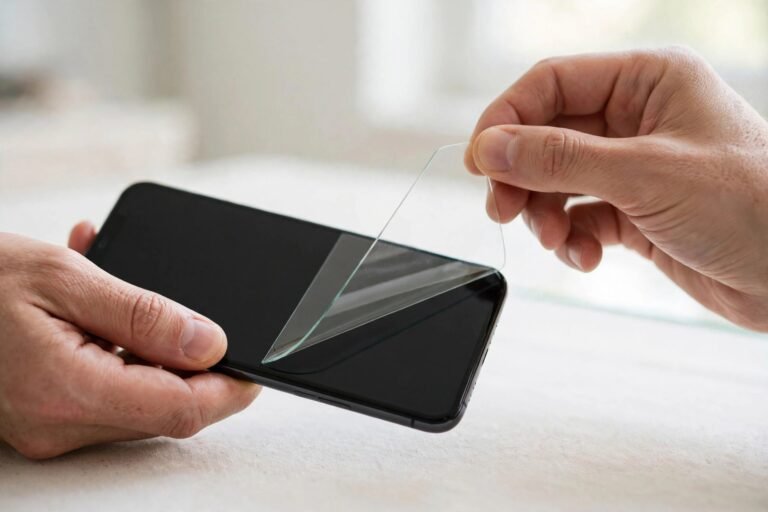
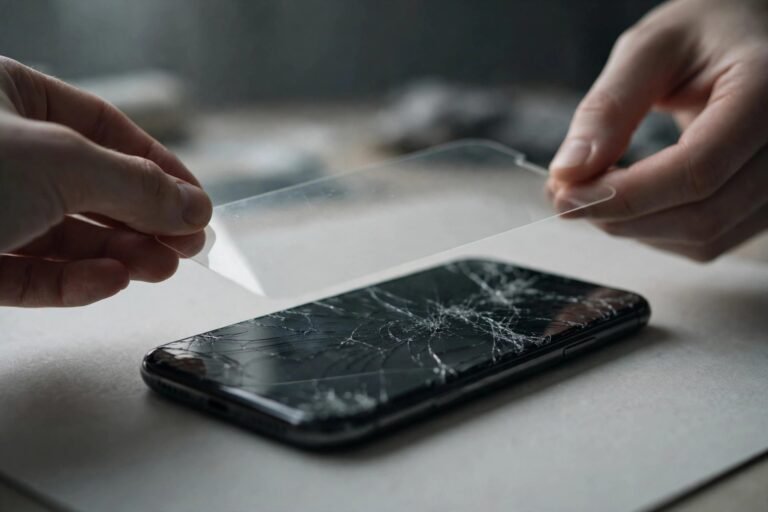
Here is the crucial context: the cured coating is measured in nanometres. It has no meaningful thickness, no flexibility, and no ability to absorb or spread the energy of an impact. Tempered glass protects by being a sacrificial, energy-absorbing layer that can crack so your screen doesn’t. A coating cannot do any of that — it is surface treatment, not armour. Some marketing leans on hardness ratings, but surface hardness resists scratches; it does not stop a screen shattering when the phone lands corner-first on a pavement.
The Genuine Advantages
Where liquid protectors shine is in everything glass gets wrong. The coating is utterly invisible — no edges, no border, no change to how the screen looks or feels. It fits every device, including curved-edge screens that defeat flat glass, older phones with no protectors still in production, and odd sizes like smartwatches. It can never lift, bubble, yellow, or interfere with a case, because there is nothing physical to lift.
Compatibility is the other real win. In-display fingerprint sensors — especially the ultrasonic type — sometimes struggle with thick glass; a coating adds no barrier at all, so biometrics behave exactly as they do on a bare screen. Application is also forgiving: no alignment, no dust-speck disasters, no tray. For someone whose only enemy is the micro-scratching that slowly dulls a screen over two years of pocket life, a coating addresses precisely that problem and nothing else.
- A liquid coating and a good case are a sensible pairing for careful owners: the case handles the drops, the coating handles the scratches. What a coating should never be is your only line of defence.
The Honest Limitations
Beyond the impact problem, the biggest practical limitation is that the coating wears away invisibly. Friction from pockets, cleaning, and daily handling thins it over time — typically over a period of months rather than years, though longevity varies by product and use — and there is no way to see how much protection remains. Reapplication is part of the deal, and forgetting it means quietly returning to a bare screen.
There are smaller caveats too. A coating cannot be removed or inspected once applied, offers no help if your screen is already scratched (at best, filling microscopic pores can make the finest marks slightly less visible — it does not repair damage), and its quality depends heavily on correct application and curing. Some products bundle a screen-repair guarantee; if that is part of why you are buying, read the current terms carefully, including any registration deadline, because the conditions are where the value lives.
The Verdict: Worth It for Some, Pointless for Others
A liquid protector is worth it if you are a careful owner who rarely drops your phone, dislikes the look and feel of glass protectors, owns a curved-screen or unusual device that glass fits badly, and wants low-effort resistance to everyday scratching. For that person it delivers exactly what it promises.
It is not worth it if drops are a regular feature of your life — a trade job, sport, small children, or simple clumsiness. In that case the money is far better spent on tempered glass, which costs about the same, can be replaced when it sacrifices itself, and actually stands a chance of saving your screen in the fall that matters. Judge the product by the risk you actually run, not by the most dramatic claim on the box.
- Ask one question before buying: “In the last two years, how did my screens actually get damaged?” If the answer is fine scratches and dullness, a coating fits. If the answer is a cracked screen from a drop, only glass and a case address that history.
Frequently Asked Questions
Can I use a liquid protector and tempered glass together?
Generally yes — glass can be fitted over a cured coating, and some people use the coating as a base layer on a device they sometimes use without glass. Just be aware the coating adds little once glass is on top, since the glass takes the abrasion. Let the coating cure fully first, following the product’s stated curing time.
How do I know when the coating has worn off?
You usually can’t tell by looking — that invisibility is the trade-off. A rough indicator is water behaviour: on a fresh coating, droplets tend to bead more noticeably; as it wears, water spreads flatter, much like a worn oleophobic layer. The practical approach is to reapply on the schedule the manufacturer suggests rather than waiting for evidence.
Does a liquid protector fill in existing scratches?
No, not in any meaningful repair sense. The coating fills microscopic surface texture, which can make the very finest hairline marks marginally harder to see in some light, but visible scratches remain visible. If your screen is already scratched, a coating will only help prevent new ones.
Is a liquid screen protector worth it? As invisible scratch insurance for careful owners, yes. As protection against the drop that cracks screens, no — that job still belongs to glass. Buy it for what it actually is, and it earns its money.