

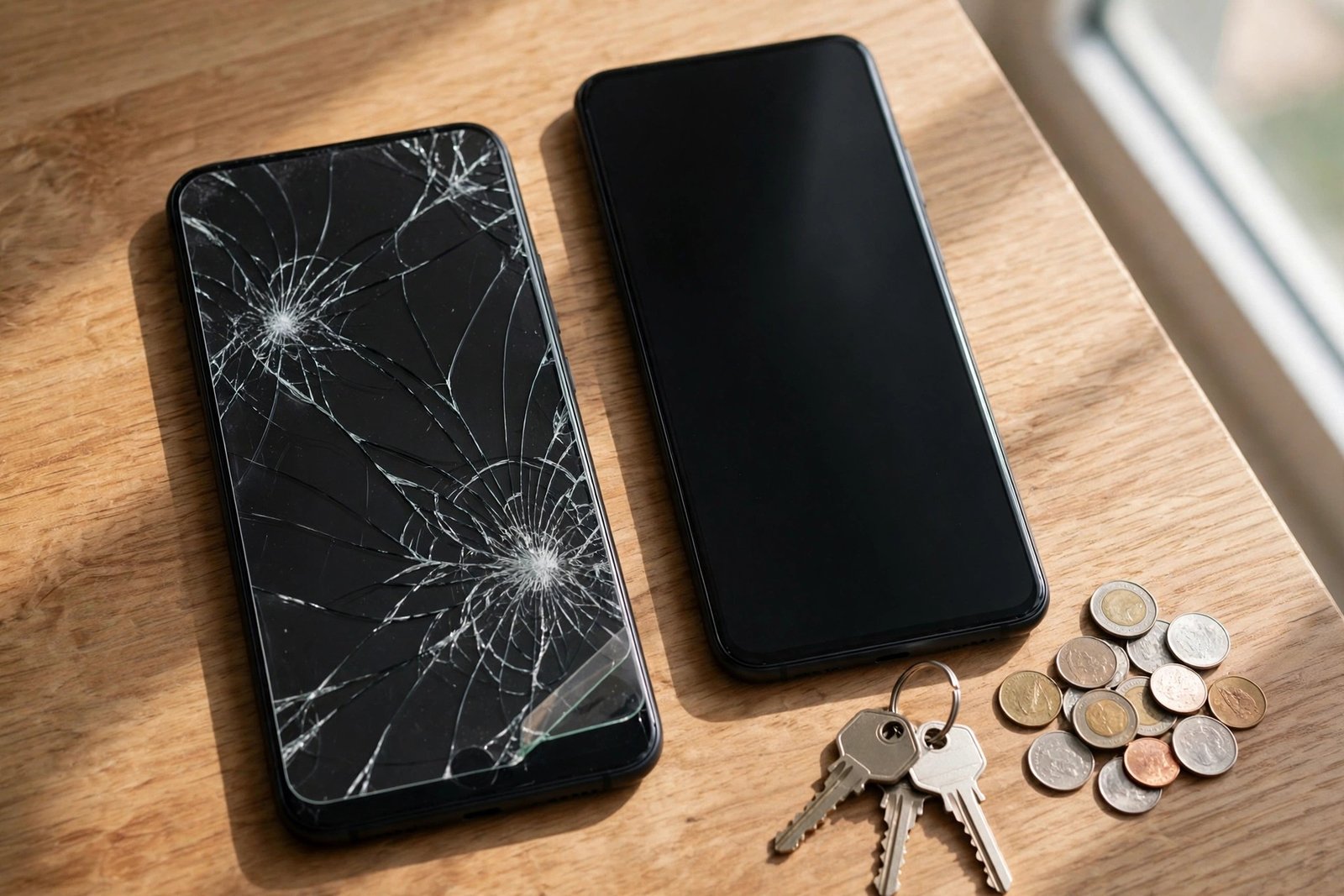
Ask a room of phone owners whether a screen protector is worth it and you’ll start an argument. One side points to a drawer of cracked protectors that “saved” their screens; the other points to years of bare, unmarked glass and calls protectors a waste of money. The truth is that both experiences are real — because the right answer depends far more on you than on the protector. Your habits, your job, your phone, and your history with drops matter more than any general advice.
This guide gives you a simple decision framework: five honest questions about how you actually live with your phone, what a protector can and cannot do, and how the cost of protection compares with the cost of a repair. Answer them frankly and the verdict usually becomes obvious.
Key Takeaways
- Your drop history is the best predictor — if you’ve cracked screens before, you’ll very likely do it again.
- Protectors excel at stopping scratches from keys, coins, and grit; their drop protection is real but never a guarantee.
- The cost asymmetry is stark — protectors are cheap and replaceable, while screen repairs are among the priciest phone fixes.
- Outdoor, manual, and active jobs raise the risk sharply; desk workers with a good case face far less.
- Insurance reduces the financial risk but not the hassle, and excesses mean a claim still costs you money.
- For most people the honest verdict is yes — the small, certain cost buys protection against a large, uncertain one.
Question 1: What Does Your Track Record Say?
Start with evidence, not intentions. Think back over your last two or three phones: did any of them end up with a cracked screen, deep scratches, or a scuffed display you had to live with? If the answer is yes — even once — you have demonstrated the exact risk a protector addresses, and human habits rarely change. People who go years with pristine screens, on the other hand, have demonstrated the opposite. Be honest about which person you are, not which one you plan to become with the new phone.
Question 2: Where Does Your Phone Spend Its Day?
Environment matters enormously. A phone that rides in a pocket with keys and loose change, gets used on building sites, in workshops, at the gym, on the beach, or around small children faces constant scratch and drop exposure — sand alone, being harder than most screen glass, is a notorious scratch culprit. A phone that lives on a desk, in a handbag compartment, or in an empty pocket faces a fraction of that risk. Work through the day your phone actually has, hour by hour, rather than picturing its quietest moments.
- The pocket test is a good shortcut: if your phone shares a pocket with anything metal or gritty, fit a protector — scratches are a matter of when, not if.
- Children and pets are drop multipliers. A phone regularly handed to a toddler lives a statistically rougher life.
Question 3: What Would a Broken Screen Cost You?
Now weigh the two costs. A protector — especially in a multi-pack — costs very little and can be replaced in minutes at home. A screen repair is a different order of expense entirely: it typically costs many times more, may require posting the phone away or losing it for days, and on some models approaches a meaningful fraction of the phone’s value. Repair pricing varies a lot by model, region, and who does the work, so check the figure for your specific phone rather than guessing — owners of large flagship models are often surprised how high it is.
There’s a second, quieter payoff: condition. When you sell or trade in a phone, screen condition heavily influences what you’re offered. A protector fitted from day one keeps the glass underneath effectively brand new, and that preserved condition can be worth more than the protectors ever cost. If you run phones into the ground and never resell, this argument fades — but the repair-cost argument usually doesn’t.
Question 4: Are You Already Covered Another Way?
A good case with a raised lip already absorbs many corner drops and keeps the screen off flat surfaces, and accidental-damage insurance or a manufacturer care plan caps the cost if the worst happens. Both reduce what a protector adds. But neither is complete: cases don’t stop pocket grit scratching the exposed screen, and insurance comes with excess payments, claim limits, and the inconvenience of being without your phone during repair. Many insured owners still fit a protector simply to avoid the whole claims process.
- Read your insurance excess before deciding it replaces a protector — the excess alone is often more than several years’ worth of protectors.
- Case plus protector is not overkill; they protect against different things. Cases guard edges and backs, protectors guard the glass face.
The Balanced Verdict
Fit a protector if any of these sound like you: a past cracked or scratched screen, a physical or outdoor job, a phone carried loose with keys or tools, children in the picture, an expensive flagship you’d rather not repair, or plans to resell. You can reasonably skip one if you’re a demonstrably careful owner, your phone lives in a good case and a clean pocket, you have solid accidental-damage cover, and you genuinely prefer the feel of bare glass — accepting that a protector’s small downsides (a slight change in feel, occasional edge lifting, a consumable to replace) are, for most people, a trivial price for the protection on offer.
Frequently Asked Questions
Phone glass is tougher than ever. Doesn’t that make protectors obsolete?
Modern screen glass has genuinely improved, and it resists drops better than older generations. But harder glass still scratches — notably against sand and grit, which are harder than the glass itself — and “tougher” was never “unbreakable”. The improvement narrows the protector’s case; for most usage patterns it doesn’t close it.
Do protectors actually stop screens cracking?
Sometimes — a tempered glass protector can absorb and spread impact energy and crack in the screen’s place, and countless owners have peeled off a shattered protector to find perfect glass beneath. But a hard corner-first fall onto concrete can defeat protector and screen alike. Treat drop protection as a welcome bonus, and scratch protection as the reliable benefit you’re really buying.
What’s the downside of just fitting one anyway?
Very little, which is why the default answer leans yes. Downsides are minor: a slightly different touch feel, reduced clarity on the cheapest film protectors, edges that can lift with tight cases, and the small ongoing cost of replacements after cracks. If none of those bother you, there’s no strong reason to go without.
Don’t decide by slogan — decide by track record. Your last phone’s screen is the most honest review of whether you need a protector on the next one.


