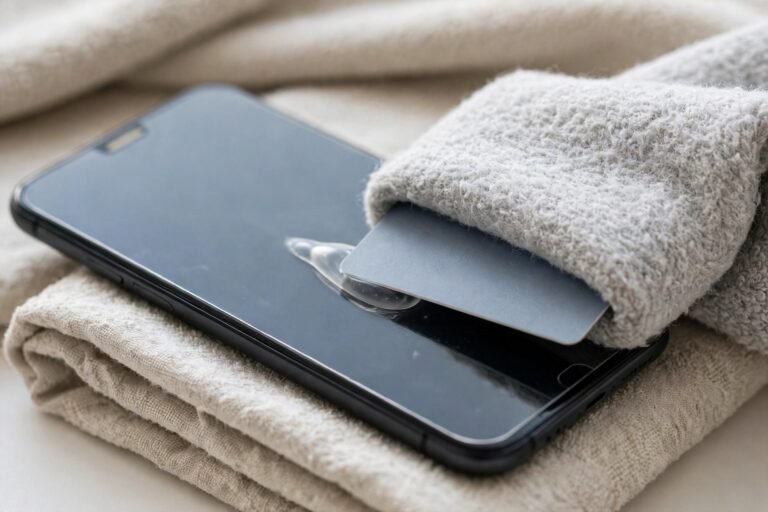
Almost every screen protector fitting ends the same way: you smooth it down, step back, and count the bubbles. Before you peel the whole thing off in frustration, take heart — bubbles on a freshly fitted protector are normal, and most of them disappear by themselves. The catch is that “most” isn’t “all”, and knowing which kind you’ve got saves you from both needless refits and pointless waiting.
This guide covers bubbles on glass and film protectors generally: why they appear, how each material settles overnight, and the point at which waiting stops working and a two-minute intervention takes over.
Key Takeaways
- Most small bubbles vanish within 24–48 hours as the adhesive finishes curing and levels itself against the screen.
- Tempered glass settles faster than film — glass adhesives wet out quickly, while film can keep improving for two to three days.
- Bubbles with dust trapped inside never disappear, whatever the material — the speck has to come out for the bubble to go.
- Wait before you intervene: pushing and prodding in the first hour usually redistributes bubbles rather than removing them.
- If bubbles survive three days unchanged, they’re not leaving on their own — press them out properly or lift and clean.
Why New Protectors Trap Bubbles
A bubble forms wherever air gets sealed in as the protector meets the screen. Lower the protector slightly unevenly and the adhesive touches down in one place first, sealing a pocket before the air in it can escape sideways. Static, microscopic screen texture, and the protector’s own flexibility all play a part — even professional fitters, with clean rooms and years of practice, finish most fittings with a bubble or two to deal with.
What matters is what the adhesive does next. Protector adhesives are designed to keep moving after application: they flow slowly into full contact with the glass, a process called wetting out, and trapped air is gradually absorbed and pushed to the edges as they do. A fresh fitting is a work in progress, not a finished result.
Tempered Glass: The Overnight Cure
Tempered glass gives you the quickest verdict. Its silicone adhesive layer wets out decisively — usually within the first 24 hours — and small, clean bubbles shrink steadily over that period, many disappearing entirely while the phone sits unused overnight. Glass is rigid, so the pockets it traps tend to be simple: round, honest pockets of air with a clear path to seal.
By the second morning, a glass fitting has reached its final state. Anything still visible then is either a large pocket that needs pressing toward an edge, or a bubble with something inside it. Edge halos on curved screens are the one partial exception: they sometimes improve over several days as the adhesive creeps, but if a case is pressing the edge up, no amount of curing will hold it down.
- Leave the case off for the first night if you can. A tight case flexes the protector’s edges and can reintroduce edge bubbles while the adhesive is still settling.
- A bubble that has halved in size by morning is a bubble in retreat — leave it alone and it will finish the job itself.
Film Protectors: Slower to Settle
Film plays by a slower clock. Because film is flexible, it traps more, smaller bubbles, and its adhesives — particularly on wet-install TPU films — keep levelling for two to three days. Wet-install films often look frankly terrible for the first few hours: hazy, streaked, dotted with moisture pockets. That’s the application fluid still working its way out, and it clears as the film dries and bonds.
The trade-off for film’s slow start is forgiveness. A bubble in film can often be worked out with a squeegee days later in a way set glass adhesive won’t allow, because the material flexes and the adhesive stays slightly more mobile. Give film its full three days before judging it — and never judge a wet install in the first twelve hours at all.
The Bubbles That Stay, and When to Intervene
Two kinds of bubble ignore the settling process entirely. The first is the dust bubble: a speck of grit or fibre trapped at fitting, holding the protector up in a tiny tent. It will look identical on day three to how it looked in minute three. The second is the structurally trapped pocket — a big bubble sealed in the middle of the screen with fully cured adhesive around it, too far from any edge for the slow flow to reach.
Intervene once the settling window for your material has closed — after 48 hours for glass, 72 for film. For a clean pocket, press firmly with a fingertip or the edge of a card and walk the bubble steadily to the nearest edge. For a dust bubble, lift the nearest corner with tape, dab the speck away with a dust-removal sticker, and lay the protector back down. Both fixes take minutes, and both work far better on a protector that’s otherwise fully settled than on a fresh, shifting one.
- Look for the speck before you press: a bubble that refuses to move under firm pressure almost always has dust in it — pressing harder just grinds the speck against your screen.
- Intervene in a steamy bathroom, just like fitting. If your corner lift lets new dust in, you’ll have traded one bubble for two.
Frequently Asked Questions
How many bubbles are normal after fitting a protector?
A handful of small ones is completely normal, even for experienced fitters — three to five small bubbles on a home fitting is a good result, and most will settle within two days. A screen covered edge to edge in bubbles usually means the protector went down too fast or the cleaning step was rushed; that fitting is worth redoing rather than waiting out.
Should I remove the protector if bubbles remain after a week?
First try the interventions: press clean pockets to the edge, and lift-and-clean any bubble with a speck in it. If bubbles survive that too — or the protector is a film that’s gone cloudy around them — then yes, refit with the spare. A week is well beyond every settling window, so a fresh start costs you nothing but five minutes and gives you the clean screen you wanted.
Do bubbles affect touch sensitivity or the display?
Small settled-out bubbles, no. A large air pocket, though, can create a slight dead zone where taps register less reliably, because the protector flexes into the gap instead of pressing the screen. You might also catch a faint rainbow shimmer over a big pocket in bright light. Both are cosmetic-to-minor annoyances rather than harm — but they’re a fair reason to press a stubborn bubble out once the settling window has passed.
Bubbles are the fitting process still finishing, not failing. Give glass two days and film three, learn to spot the speck that changes everything, and you’ll rarely need to peel a protector off in anger again.