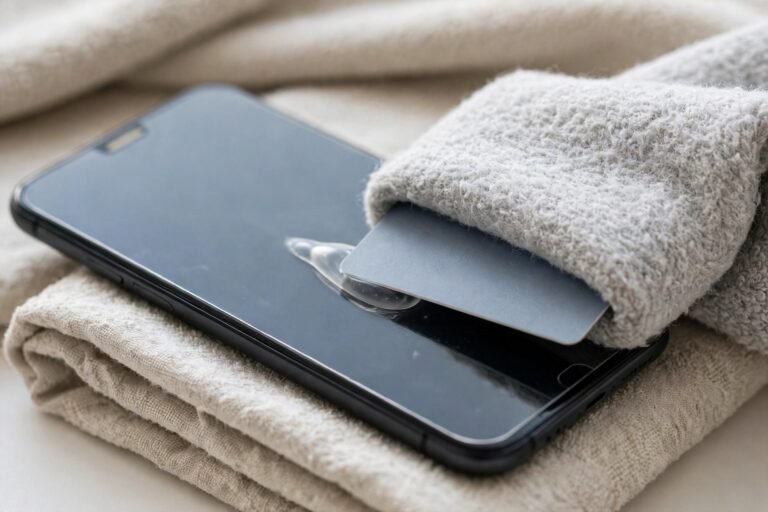
Taking a tempered glass protector off should be a two-minute job, yet plenty of people end up picking at a corner for ages or, worse, levering at the pane until it snaps. The trick is understanding that glass behaves nothing like a flexible film: it is a rigid sheet held down by a full layer of adhesive, and it rewards patience and warmth rather than force.
This guide walks through the safe way to remove a fitted glass pane — softening the bond first, starting a corner properly, and peeling low and flat so the sheet comes away in one piece, leaving the real screen clean underneath.
Key Takeaways
- Warm the phone first — gentle heat softens the adhesive and makes the pane release far more easily.
- Start at one corner with a fingernail or a thin plastic card; never use metal tools near the screen.
- Peel low and flat, keeping the glass close to the screen as it lifts — do not pull it upwards.
- Never bend or flex the pane the way you would a film protector; tempered glass will crack instead.
- If the glass is already cracked, tape over it before peeling so the pieces come away together.
- Work slowly — a steady peel takes a minute, a rushed one can leave shards and residue behind.
Why Glass Needs a Different Approach to Film
A plastic film protector is floppy. You can curl it, roll it back on itself, and practically scrunch it off the screen without consequence. Tempered glass is the opposite: it is a stiff, brittle sheet a fraction of a millimetre thick, bonded across its whole surface. Any attempt to bend it concentrates stress in one spot, and the pane responds by cracking along that line.
That rigidity also means the adhesive lets go gradually, in a moving line across the screen, rather than all at once. Your job is simply to guide that line from one corner to the far side at a steady pace. Treat the removal as coaxing rather than pulling, and the glass will usually surrender without a fight.
- Remove the phone case before you begin — a case lip overlapping the glass edge makes the first corner much harder to start.
- Work on a soft, clean surface such as a folded towel, so the phone does not slide around while you apply gentle pressure.
Warm the Pane Before You Touch a Corner
Adhesive softens as it warms, and that single fact makes removal dramatically easier. The simplest method is to use the phone for ten or fifteen minutes beforehand — gaming, video, or charging all generate gentle heat through the screen. Alternatively, hold the phone in warm hands for a while, or give the screen a few passes with a hairdryer on its lowest setting, kept moving and at a distance.
The screen should feel mildly warm to the touch, never hot. Excessive heat is bad for the battery and the display, so if you cannot comfortably rest your palm on the glass, you have gone too far. Once warmed, do not hang about: the pane cools quickly, and the softened adhesive begins to firm up again within a few minutes.
Starting the Corner and the Low, Flat Peel
Choose the corner that already looks the loosest — often the one nearest the earpiece or a slightly lifted edge. Slide a fingernail into the gap between glass and screen, working it in flat rather than digging downwards. If your nails are too short, a thin plastic card, a guitar pick, or a length of dental floss worked back and forth under the corner will all do the job without risking a scratch.
Once a few millimetres lift, grip the freed corner and peel slowly backwards, keeping the pane almost parallel to the screen. Think of folding the glass back over itself at a very shallow angle rather than lifting it towards the ceiling. Move steadily, letting the adhesive line travel across the display, and pause to re-warm if resistance suddenly builds.
- If the corner refuses to start, stick a small piece of strong tape to the top of the glass near that corner and pull the tape — it gives you a handle without prising at the edge.
- Support the lifting pane with your free hand as more of it comes free, so its own weight does not suddenly snap it.
Cleaning Up Afterwards
A slow peel usually leaves the screen almost clean, but you may find faint adhesive residue, especially around the edges where the bond was strongest. Most of it rolls off under a fingertip or lifts away with a dust-removal sticker. For stubborn patches, a microfibre cloth very slightly dampened with water does the job; avoid solvents, which can damage the screen’s own oleophobic coating.
If the old pane cracked while coming off, check the screen carefully under a bright light for stray slivers before running a cloth across it — dragging a shard with the cloth can scratch the display. Brush loose fragments onto a piece of paper with a soft, dry cloth and bin them wrapped in tape so they cannot cut through a bin liner later.
Frequently Asked Questions
Will removing the glass damage my screen?
Not if you peel slowly and keep the pane flat. The adhesive on a screen protector is far weaker than the bond of the display itself, and it is designed to release. Damage almost always comes from metal tools or from yanking the glass upwards, both of which this method avoids.
The corner will not budge at all — what now?
Re-warm the screen and try a different corner; adhesion varies, and one corner is usually weaker than the others. Dental floss sawn gently under a warmed corner frees most stubborn panes. If the protector was fitted with a liquid adhesive and cured under UV light, leave removal to a repair shop, as that bond is far stronger.
Can I reuse the protector after taking it off?
Realistically, no. Once peeled, the adhesive layer picks up dust and loses its even grip, so a refitted pane tends to lift at the edges and trap bubbles. Protectors are best treated as single-use; keep a spare from the multi-pack aside for the moment the old one comes off.
Warmth, a patient corner start, and a low, flat peel — that is all it takes. Treat the glass as the rigid sheet it is, and it will come away cleanly in one piece.